

Ad Free. Reader Funded.
Hidden Compass is on Team Human. This article was not written by generative AI. Support the journalist and editors of this piece with a direct contribution!
% of $ Goal
Total number of contributions so far:
0
Total amount raised for journalists
$0
"One thing I really appreciated about working with Hidden Compass is that it's a space where there is time for nuance and complexity. By donating, that's what you're supporting. You're able to help us as writers, but also as an outlet, continue to tell these kinds of stories."
- Anna Polonyi, Hidden Compass Journalist
"The reason why I contributed was because the article that I read really resonated with what I was feeling. I felt like the author was in my head... It just moved me and I felt like I needed to do something."
- Hidden Compass Reader
Throughout this story, the author uses the Cham names for historical regions (e.g., Vijaya) alongside the Vietnamese names for archaeological sites (e.g., Mỹ Sơn). While the Vietnamese names are not the original ones, they are commonly used today and their use should make these places easier to locate, visit, and research further.
VIJAYA (Quy Nhơn, Gia Lai Province)
A wailing gust assaults the mountaintop above, but the world inside the strangler fig lies in sheltered calm.
The tree’s gnarled, leafy branches crawl across the outcrop, both shading me from the molten sun and forming a twisted ladder for the final ascent. The natural rungs feel cool beneath my sweat-sodden palms while my shoes scrape for purchase against the rough stone.
As I scramble higher, sharp shafts of white sunlight begin piercing the canopy. Heat presses against the back of my sunburned neck. Then, almost without warning, the branches part to reveal a glaring sky.
Yanking myself from the tree and onto the rocky ridge, I pause to steady myself against the wind and squint at my surroundings.
I stand nearly 2,400 feet above sea level, enveloped by jungle-green mountains. Beyond them stretch vast plains of straw-yellow rice paddies. To the east lies the serpentine coastline and a pale turquoise sea that dissolves into the misty horizon.
Before me rises a granite dome jutting from the mountains like the charred fingertip of a buried giant.
At first, the temple appears to be nothing more than a geological quirk: a grassy protrusion interrupting the stone. But as my eyes fix on the peak, the unnatural symmetry of the human-made structure reveals itself. Sheer, bare cliffs guard its flanks, rendering the dome unreachable — except to the temple masons who built a tower upon its summit nearly 1,000 years ago.
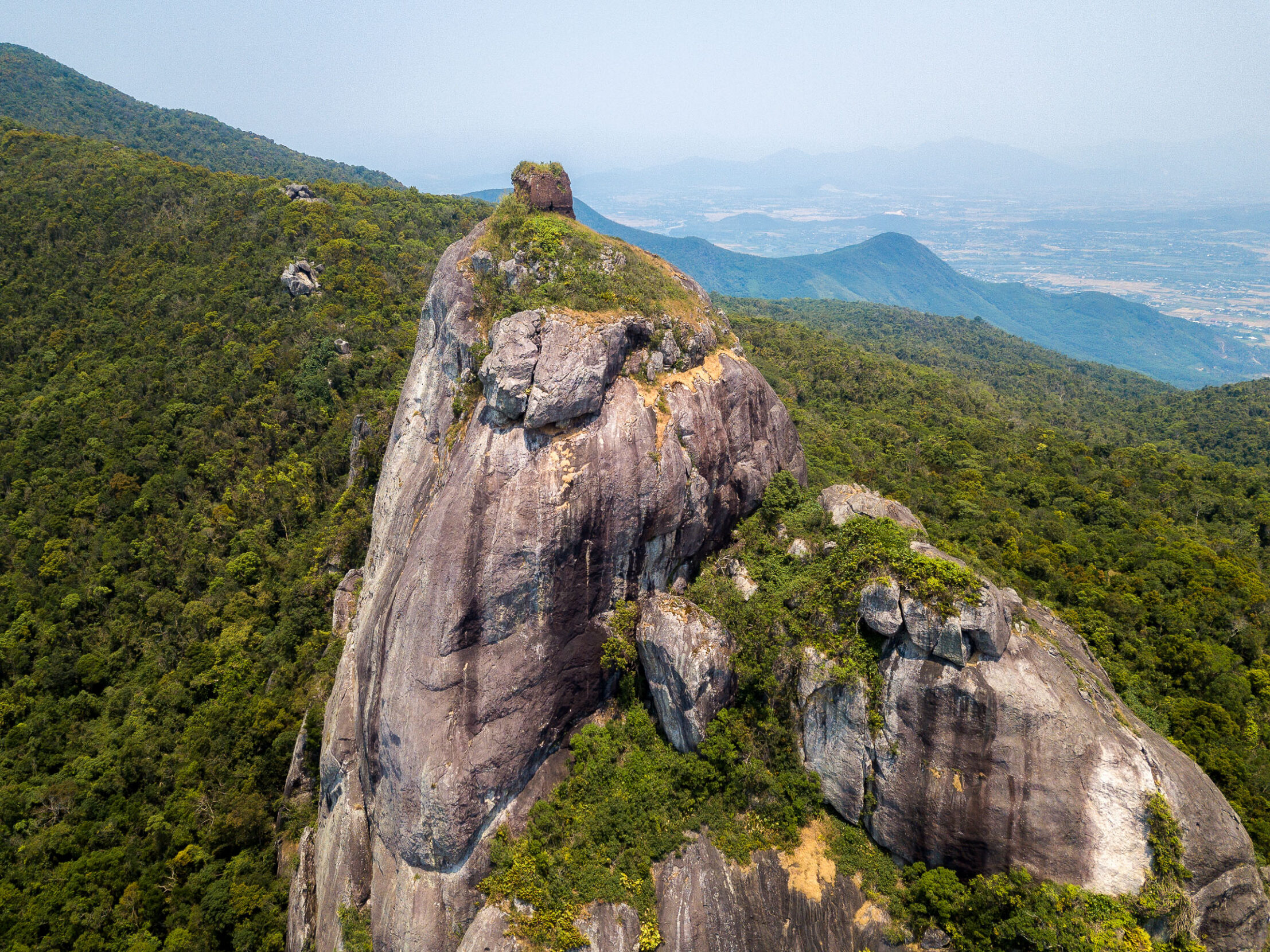
Bell Rock Tower, in what was once the seat of Cham power, sits on a perch overlooking the valley below. For the author, this structure was the beginning of a journey into the fantasy and reality of a seemingly forgotten kingdom. Photo: Đức Nguyễn.
There it is, I think. The Great Eye. At least, that’s what I’ve started calling it.
Ancient, weather-ravaged, and nearly forgotten, this tower has been watching me for two days.
~~
Tháp Hòn Chuông, or Bell Rock Tower, is one of hundreds of archaeological sites left behind by Champa, a Hinduized thalassocracy that ruled Central Vietnam beginning in the early centuries of the first millennium C.E. Despite intense regional rivalries, by the 11th century, Champa had emerged as one of Southeast Asia’s great powers, bordered by the Khmer Empire to the west, Đại Việt, or Vietnam, to the north, and a vast sea unfurling along its eastern shore.
In his 1928 book, Le Royaume de Champa, a colonial record that shaped early Western scholarship on the Cham civilization, French colonial administrator Georges Maspero described Champa as “a state whose power and wealth were extolled far and wide.”
The archaeological evidence bears witness to these words.
Cham ruins appear with startling frequency across Central Vietnam: abandoned beside highways, buried beneath sand dunes, swallowed by jungle, and, like Bell Rock Tower, perched on lonely hilltops. Built from brick and stone and dedicated to great kings and Hindu deities, most of these structures served as centers of pilgrimage, ritual, and religious ceremony.
Yet, despite an abundance of sites — and centuries of scholarship — Champa remains mired in mystery. We still do not know why Bell Rock Tower was raised atop an inaccessible summit, and, as with most Cham towers, we still don’t know how it was built.
As a nerdy millennial raised on Tolkien and Tomb Raider, I found my fantasies of lost worlds indulged by Champa. Perhaps that is why Bell Rock Tower exerts such a strange pull on me. It is more than an ancient structure perched atop an impossible summit. It is a monument suspended between competing and, at times, fantastical versions of Vietnamese history.
~~
I first fall under the gaze of Bell Rock Tower on a train.
I am traveling with Đức Nguyễn, my friend and a Vietnamese photographer, to Quy Nhơn on Vietnam’s south-central coast. We know we are nearing the mountain cluster that cradles Bell Rock Tower, but as afternoon fades, we cannot be sure we’ll see it before darkness swallows the wilderness.
Then, it sees us.
For the briefest of moments, Bell Rock Tower reveals itself between the peaks as though by will. Before we can make sense of what is staring at us, the train rattles onward, and the vision vanishes behind the mountains.
~~
Before dawn, Đức and I set out on a motorbike to explore. We are in a region that, 1,000 years ago, was known as Vijaya — Sanskrit for “victory.”
We catch the sunrise from the hilltop Phú Lốc Tower after abandoning the bike in the cemetery below and forcing our way through thigh-high brambles that scratch my legs bloody. We are alone as we watch sunlight spill across the valley and illuminate the vast Đồ Bàn Citadel complex, once the seat of Cham power.
Farther west, we ride to the triplet towers of Dương Long, their neglected summits tufted with grass. Built to honor Brahma, Vishnu, and Shiva, these are among the tallest surviving medieval brick structures in Asia. By sunset, we arrive at Bình Lâm Tower, built before the others and now largely ignored by the rural community that lives beneath it.
It is clear that Vijaya ought to be a headline attraction, yet all day we have had the sites entirely to ourselves. Contemporaneous sites in Southeast Asia – Angkor in Cambodia, Prambanan in Java, Sukhothai in Thailand – swarm with visitors. Why is no one here to witness the ruins of this great civilization?
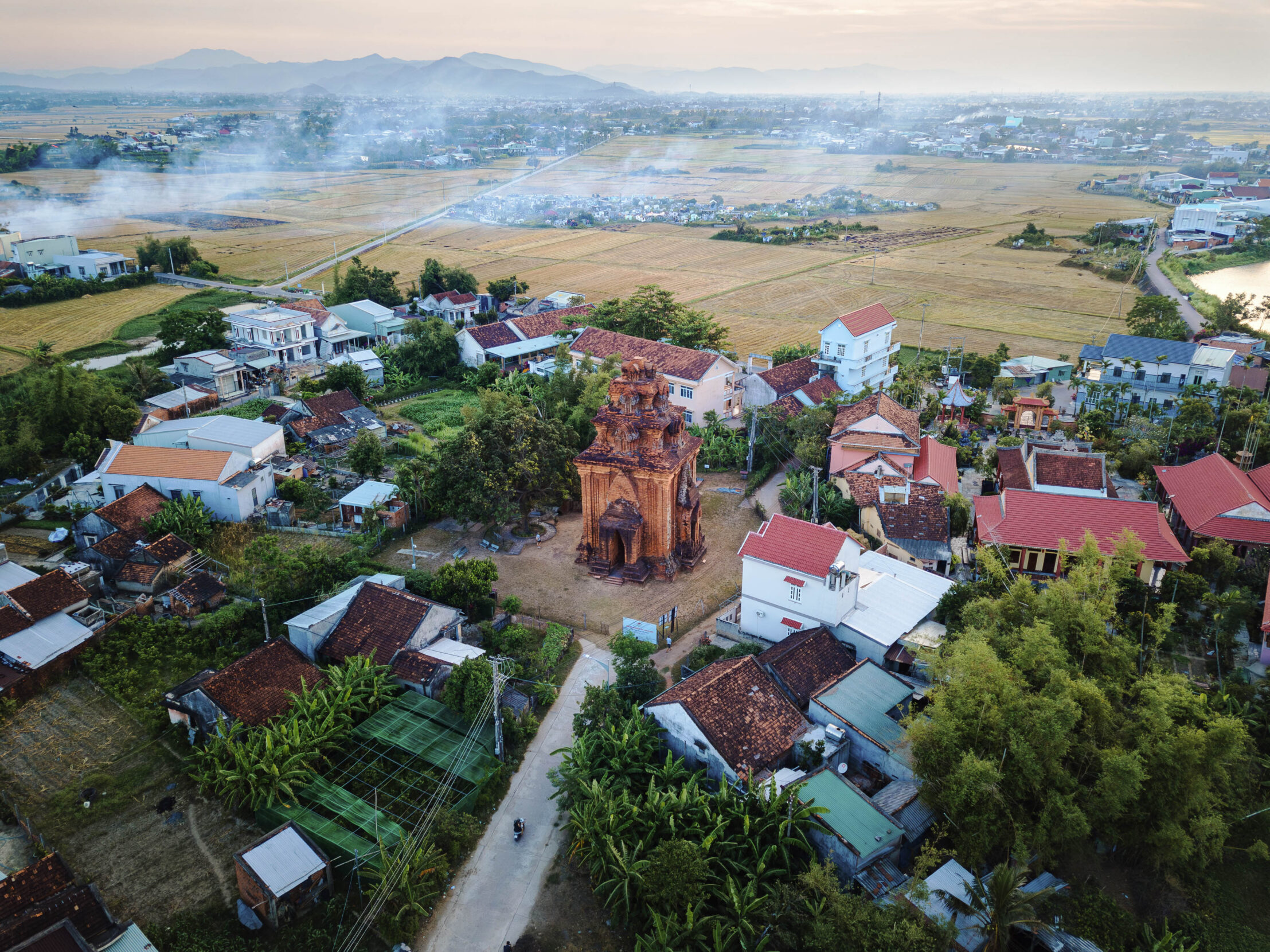
Today, Cham temples like Binh Lâm still stand, dotting the landscape in what is now the Vietnamese province of Gia Lai. Photo: Đức Nguyễn.
~~
The next morning, Đức and I are ready to indulge in the fantasy of exploring a forgotten civilization. We are finally ready to stand eye to eye with Bell Rock Tower.
We leave the city long before sunrise, hoping to complete the climb before the midday heat sets in. After entering the forested foothills, we surrender to enchantment.
Giant spiderweb clusters from Shelob’s lair shimmer beside the trail. Butterflies flicker into view like Elves in shadeless clearings. Even our provisions feel borrowed from Middle-earth: The glutinous rice cakes wrapped in banana leaves resemble lembas bread.
After hours of bushwhacking, we reach the strangler fig and the final climb.
~~
From where we stand, level with Bell Rock Tower, the outcrop resembles a gigantic linga — an abstract representation of Shiva and a sacred shape in ancient Champa.
After surveying the site in 2020, Hoàng Như Khoa, a researcher at the provincial museum in Quy Nhơn, concluded that Bell Rock Tower is the highest surviving Cham tower in Vietnam and that, like most towers, it probably served a religious function.
The structure rises with austere, tapered walls, probably to withstand the violent mountain winds. This design seems to have worked: despite centuries of storms, isolation, and neglect, the structure still “defies time,” according to Hoàng.
Yet, as we stand before the defiant structure, the fantasy of discovery begins to curdle.
No pilgrims lay offerings at the foot of the outcrop. No intrepid tourists appear from the brush. Even the jungle seems reluctant to approach the summit, leaving the granite dome naked and exposed beneath the cloudless sky.
We had spent two days tracing the scattered remains of Vijaya, one of the great centers of ancient Champa, and now, at its crowning monument, there is still only silence.
~~
In 1471, after centuries of conflict and nam tiến, or southward expansion, Vietnamese King Lê Thánh Tông led an army at least 100,000 strong into Vijaya. He “captured Vijaya and razed it to the ground, beheading more than forty thousand people, and deporting more than thirty thousand others,” wrote Po Dharma, an influential, modern Cham historian. “He then embarked on the systematic destruction of everything connected with Hinduized Cham culture.” He burned temples, destroyed libraries and Sanskrit manuscripts, and killed teachers, priests, and religious scholars.
If they were praying for peace and protection, it didn’t work.
“It is here that the history of the Champa kingdom ends,” wrote Maspero of the Vietnamese invasion. The sentiment resurfaced in Walter E. J. Tips’s 2002 English translation of Le Royaume de Champa, which added the subtitle The History of an Extinct Vietnamese Culture.
The violence and displacement of the 15th-century invasion robbed Vijaya of its people. And, standing at this silent site, it seems something else has robbed it of remembrance.
AMARAVATI (Đà Nẵng)
North of Vijaya, hidden cicadas thrum from the enveloping jungle. Beneath the dissolving mist, the valley stirs in the morning warmth.
I move slowly along the pathway, my footsteps muffled by wet earth and fallen leaves, while the silhouettes of temple clusters drift in and out of the trees. Somewhere high in the canopy, birds call across the forested slopes.
After the sun breaches the mountains, I watch the golden light animate the sculptures on the temples. Crumbling carvings of apsaras and garudas — celestial dancers and winged guardians — and Kala, the devouring face of time, begin moving from the shadows. Sheltering inside one structure, a multi-armed Shiva dances in the open jaws of two roaring makaras, sea serpents.
The carvings are static, of course, but the craftsmanship, coupled with the shifting light, breathes movement into stone.
~~
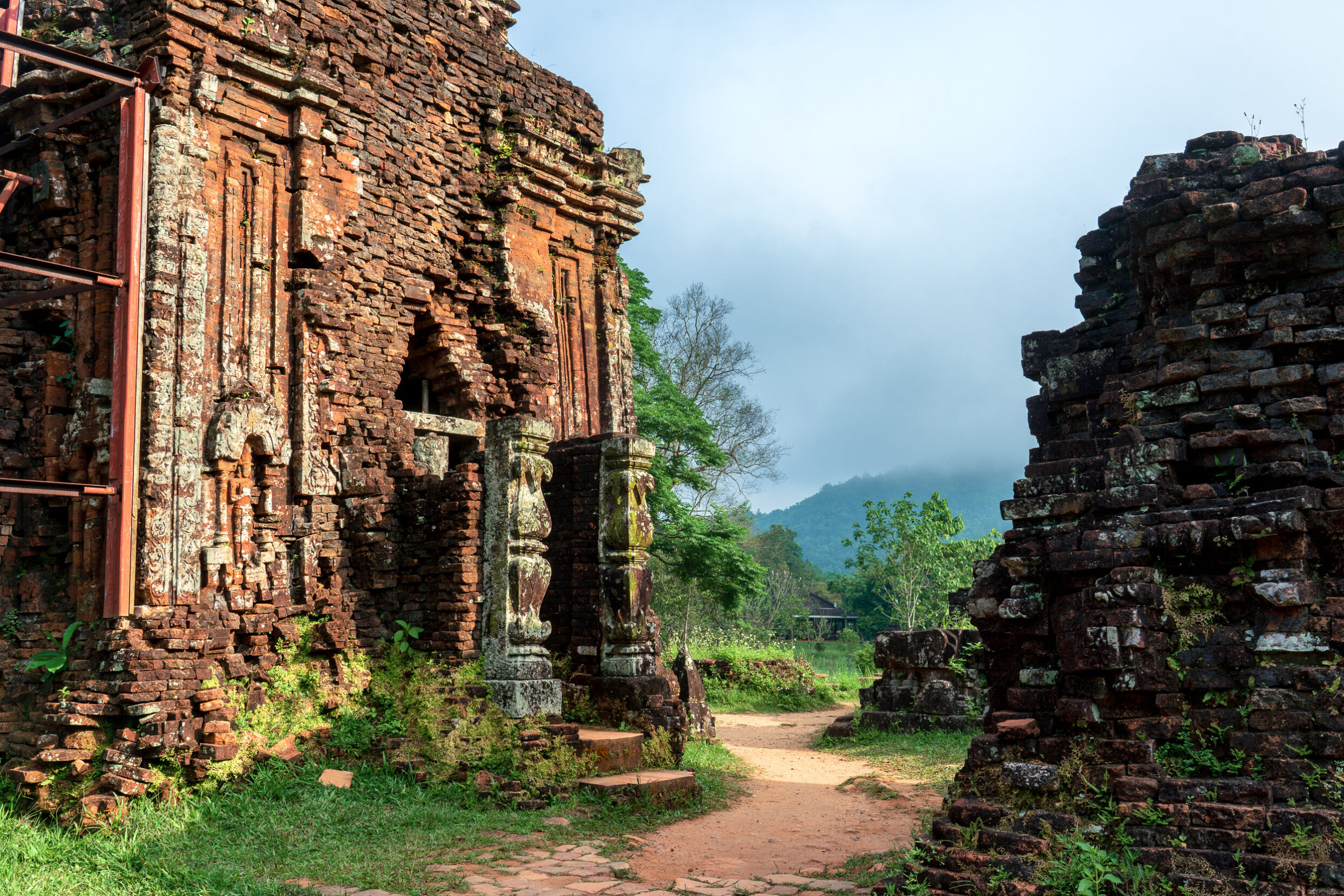
On the worn paths between the temples of Mỹ Sơn, something is missing, but it’s not the visitors. Photo: Đức Nguyễn.
Mỹ Sơn, like the temple towers of Vijaya, is one of Vietnam’s great archaeological sites, but here, the pathways fill with tour groups. In Vijaya, monuments lie scattered across the countryside, but Mỹ Sơn unfolds as a single, walkable sanctuary, making for a more manageable tourist site. Unlike Vijaya, this place begins to challenge the fantasy of a forgotten civilization. There are enough people here to make this site feel loved — or at least appreciated.
The valley lies in what was once Amaravati, the northern heartland of Champa. Vijaya was one constituent state. Amaravati was another.
Beginning in the fourth century, the Cham transformed this valley into a sacred landscape, raising temple after temple using fired brick and carved stone. For a millennium, pilgrims, priests, and rulers journeyed here to make offerings and court divine favor.
If they were praying for peace and protection, it didn’t work. The valley was abandoned around the time of Vijaya’s defeat, bombed during the Vietnam War, and ultimately left for dead.
But as I stand among the ruins, perhaps helped by the sight of dozens of curious tourists, it is easy to imagine Mỹ Sơn brimming with life: the jungle held at bay by a forest of towers; incense mingling with the scent of tropical resin; the altars pulsating with chanting and chatter.
Many of the altars are empty, but I already have a sense of what was once worshipped here.
MUSEUM OF CHAM SCULPTURE (Đà Nẵng)
The entrance garden has changed many times over the years, but in 2026, modern shallow steps guide visitors toward the Museum of Cham Sculpture. The building itself, however, is the original early 20th-century colonial structure, painted a cheerful butter-yellow.
Beyond the entrance, scenes from Amaravati’s objets d’art unfurl.
Brahma emerges atop a lotus flower blossoming from the navel of a reclining Vishnu. A 16-armed Shiva dances in ecstatic motion while enthralled devotees look on in wonder. A procession of musicians, ascetics, and celestial dancers attends the wedding of Rama and Sita, a foundational episode from the Ramayana.
The most arresting artifact is a bronze Bodhisattva Tara, the goddess of compassion, who stands proud and bare-chested with outstretched arms. Though revered for tenderness, her expression is fierce — as if shaped after witnessing the obliteration of her monastery.
As we stand before the defiant structure, the fantasy of discovery begins to curdle.
This statue is a replica; the original, valuable and lightweight, hides in storage to protect it from theft. It was discovered in Đồng Dương, a Buddhist monastery founded in the ninth century, 20 kilometers southeast of Mỹ Sơn. Abandoned a few centuries later, excavated by the French, then bombed by the Americans, the monastery survives more completely in this gallery than at the original site.
Here is where I linger longest.
I peer at colonial-era photographs taken during the excavations, gaze up at the dvarapala, guardian demigods, towering above me, and try to decipher the human figures carved into the pedestals, arranged as they might once have stood in Đồng Dương.
There is a clear attempt to recreate something of a sanctuary here, to present more than a collection of detached artworks. Yet the result falls flat.
The sculptures surrounding me once stood in shrines, monasteries, and sacred enclosures. They were not created as works of art in the modern, secular sense, but as ritual objects — focal points of devotion and religious life.
Inside the museum, however, spotlights, plinths, and whitewashed walls have transformed them into something entirely different. Their purpose is no longer to be worshipped by the people who made them, but to be admired by the people who did not.
The monastery has been fragmented not only by time and war, but also by dispersal. Many of its sculptures now reside in museums and collections across Europe and North America. Referring to sculptures of deva — celestial beings — now scattered across continents, art historian, archaeologist, and Champa scholar Nguyễn H.H. Duyên asks: “How have some of them become part of the collection of the Cleveland Museum of Art and the Rietberg Museum [in Zurich]?”
As is so often the case, the answer lies somewhere in the murky and shameful overlap of colonial looting, backroom deals, and reluctant repatriation.
Đồng Dương survives today neither as a monastery nor as a complete artistic ensemble, but as a diaspora.
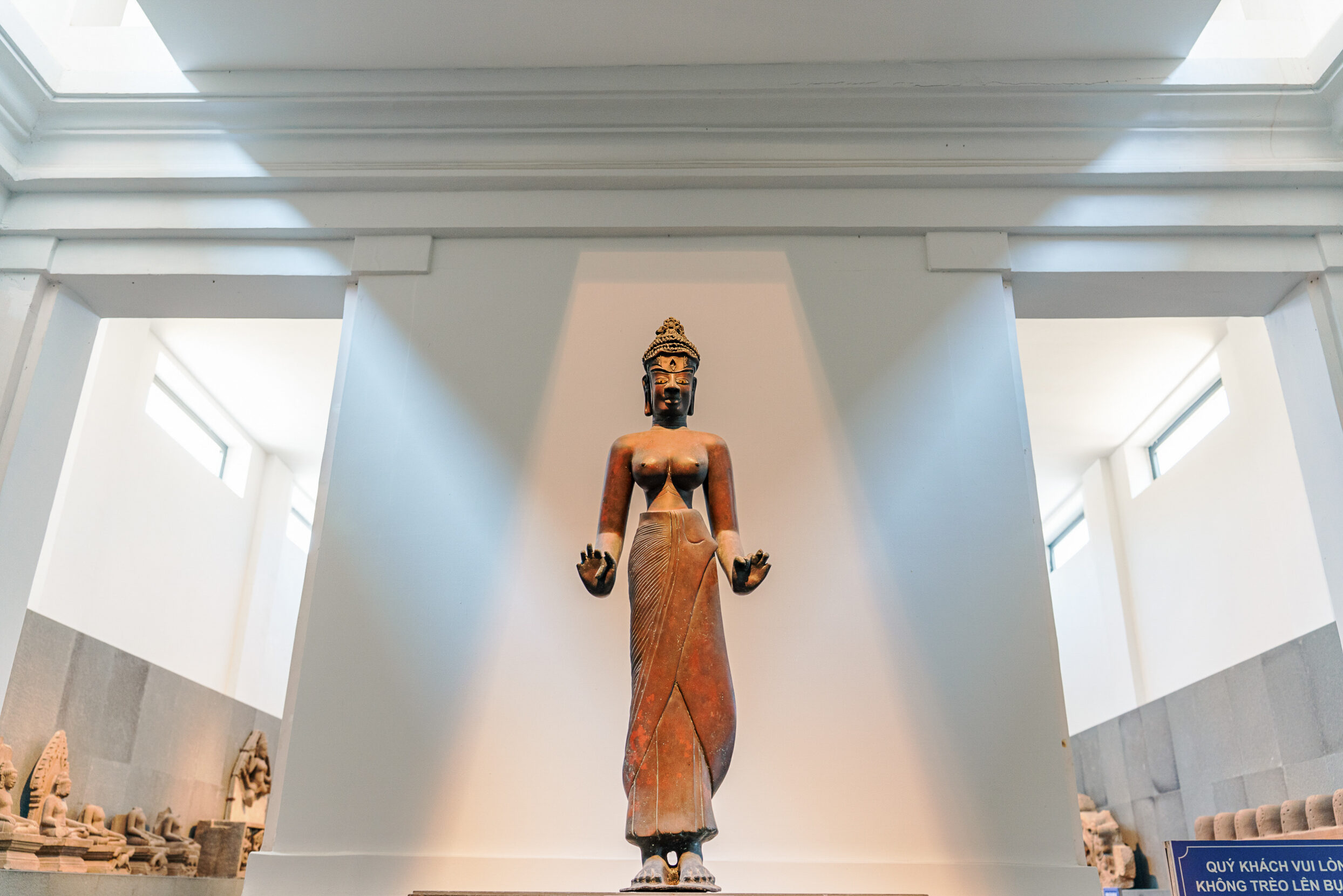
Relics like this Bodhisattva statue, which some researchers believe depicts the goddess Tara, have been removed from the context of their original locations and placed on plinths in museums in Vietnam, Germany, the United States, and beyond. Photo: Đức Nguyễn.
~~
The Museum of Cham Sculpture represents the culmination of the French effort to catalog, interpret, display, and perhaps, in their view, sustain Champa.
“It can be viewed as a museum of multiple histories, not just the history of the Cham art it displays, but also of the histories of 20th century Vietnam, and the mission civilisatrice of French colonialism,” wrote the English academic Julian Richard Brown in his doctoral thesis on the presentation of Cham art.
Founded in 1915, the museum brought together sculptures from sanctuaries, citadels, and temple towers scattered across Amaravati and beyond. Removed from their original settings and assembled beneath a single roof, these artifacts transformed a sprawling civilization into something that could be studied and exhibited.
Remarkably, after Vietnam’s tumultuous 20th century, the museum still stands, and it continues to house the world’s largest collection of Cham artifacts.
Before setting foot among the ruins of Mỹ Sơn, I first encountered the site in this museum, where its sculptures stood divorced from the jungle valley they were created to inhabit.
~~
After Vietnam secured its independence from France in 1954, the country was partitioned and found itself engulfed in a domestic and international conflict that drew in the United States and lasted until 1975.
The victorious government in Hà Nội, which still governs Vietnam today, inherited the Museum of Cham Sculpture and, in some respects, the French framework through which Champa was understood.
With virtually no Cham communities remaining in Amaravati, there was little prospect of restoring these artifacts to anything resembling their original religious setting. But while artifact repatriation has garnered attention elsewhere in Southeast Asia, that hasn’t been true for Cham artifacts and Vietnam.
“There have… been no requests to date for the return to either Vietnam, or to the Cham people, of Cham objects in foreign museum collections,” wrote Julian Richard Brown.
KAUTHARA (Nha Trang, Khánh Hòa Province)
Voices in more than a dozen languages rise and fall around me as I climb the steps, squinting in the midmorning sun.
Tour groups swarm the site. Guides hold umbrellas and collide with one another like bumper cars. Others chat, pose for photographs, and jostle for selfies beneath a temple complex that has stood for more than a 1,000 years. Somewhere nearby, a phone blares TikTok videos at full volume.
The contrast between the sacred ruins and the supercharged scene around them is surreal — a vision of our metamodern age — but the atmosphere is undeniably cheerful.
Reaching the top of the hill, I find a shaded ledge and take a seat. From here, I gaze at the towers as the crowds swarm around them.
~~
Despite the crush, the Po Nagar temple complex is exquisite.
Four brick towers crown the hilltop, the closest of which is a squat, pyramidal tower with a gently curving profile. Nearby stand two smaller shrines reminiscent of the ruins at Mỹ Sơn. A fourth tower, the grandest and most intricate, flaunts details that echo the great monuments of Vijaya.
This is the tower that gives the site its name.
Po Nagar is a Cham primordial goddess associated with the Earth. She created the land, taught people to grow rice, and continues to protect her followers from harm. Inside Po Nagar Tower, a draped statue of the goddess sits enveloped in darkness, framed by walls blackened by incense smoke.
For more than 12 centuries, this complex has been the spiritual heart of Kauthara, the Champa state that lay south of Amaravati and Vijaya.
Below the towers, the cerulean waters of the city of Nha Trang sparkle in the distance.
Today, Nha Trang draws visitors from around the world to its sandy beach, high-rise resorts, and reliable sunshine. Heritage sites are thin on the ground here, which explains why Po Nagar is so thick with tourists. The city’s visitor economy is built on “The Four S’s” — sun, sand, sea, and sex — but even those attractions eventually lose their novelty.
For those looking for something deeper — or to diversify their selfie backdrops — the Po Nagar complex is often the first port of call.
From my shaded ledge at the top of the hill, I notice three women wrapped in blue, orange, pink, and red moving against the flow of the crowd.
While most visitors are busy photographing themselves outside the towers, these women carry offerings for the shrines hidden within.
Curious, I follow them.
~~
This place begins to challenge the fantasy of a forgotten civilization.
They lead me to a gathering, and for the first time on this journey, I see dozens of Cham worshippers. They are seated on rattan mats behind Po Nagar Tower, their voices mingling in conversation and prayer. Offerings of fruit, rice, chicken, and bottled drinks are laid out in front of them on silver trays that catch the sunlight.
Most of the worshippers are women dressed in bright reds and pinks, their heads shaded from the sun by scarves and broad-brimmed yellow hats. At the center of the gathering sits a man in white — presumably a priest — who periodically raises his hands above his head in prayer, his chanting voice commanding the worshippers to follow.
A teenage boy notices my interest, emerges from the blur of worshippers, and strikes up a conversation. My Vietnamese quickly reaches its limits, but he remains patient, keen to share his Cham heritage. Today, he explains, commemorates Po Nagar’s departure from the earthly realm, and this ceremony only happens once a year.
“You’re lucky to see it,” he tells me.
He’s not wrong.
Behind us, tourists continue their circuit of the towers, oblivious to the ritual just a few meters away. It’s as if the two groups inhabit parallel worlds.
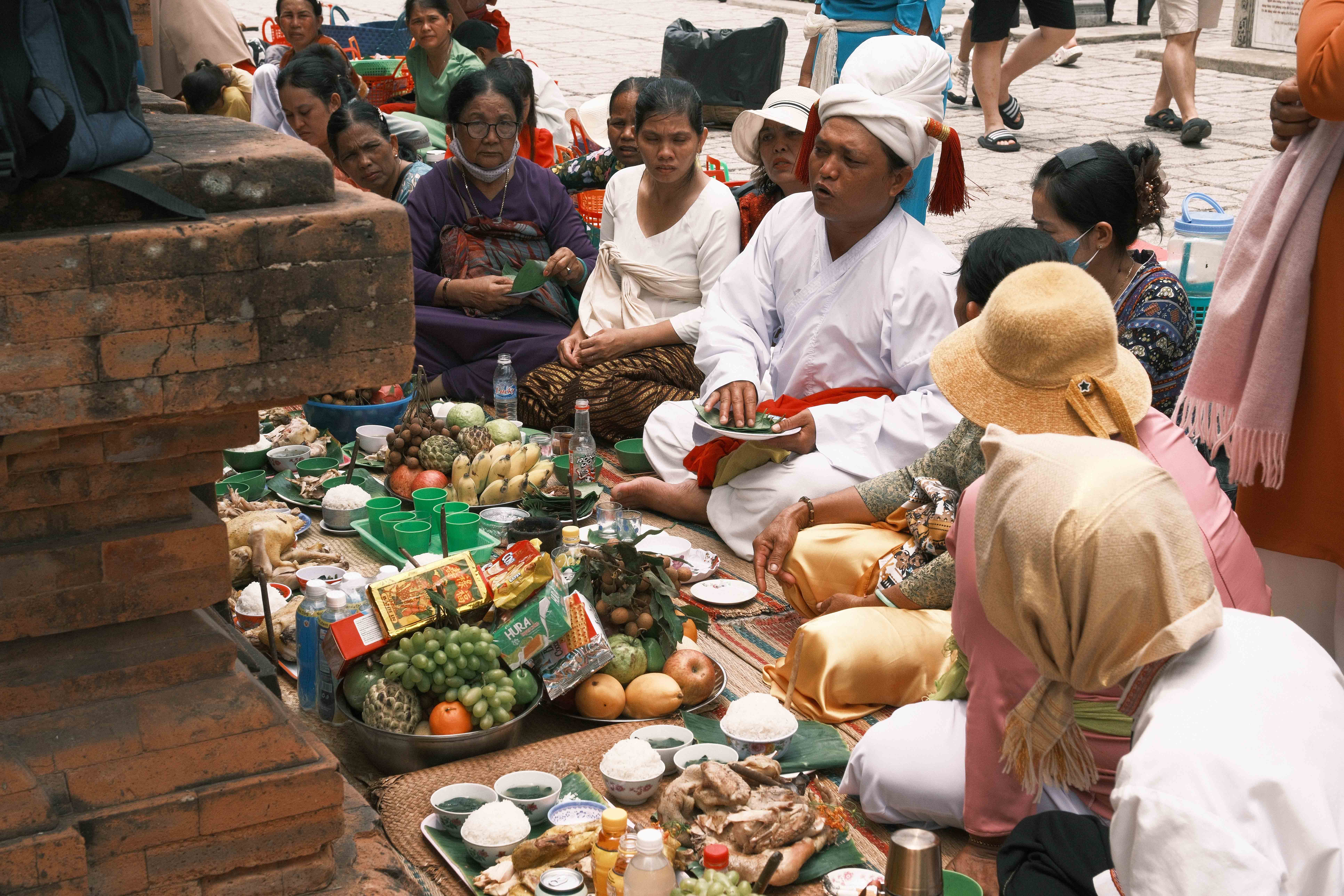
In Kauthara, the author follows his curiosity and witnesses something unexpected: Worshippers praying to the Cham and Vietnamese goddess Po Nagar. Photo: Biên Nguyễn.
~~
Colonial administrator Georges Maspero wrote that the capture of Vijaya in 1471 marked the “end” of Champa, and this guided the “erroneous view of many scholars during the first three-quarters of the 20th century,” wrote historian Po Dharma.
In truth, as the Cham fled the ruins of Vijaya and Amaravati in the 15th century, many moved south to Kauthara. The old kingdoms were shattered, but, remarkably, their people, culture, and political institutions endured in Champa’s southern states.
Centered in present-day Nha Trang and stretching along Vietnam’s south-central coast, Kauthara became one of the principal heirs to the fallen kingdoms. For nearly two centuries after the destruction of Vijaya, it remained part of a diminished Cham state.
As Vietnamese dominance waxed and Cham power waned, the annexation of Kauthara was inevitable. When it finally happened in 1653, it was a profound political and cultural defeat, but it was not another Vijaya. The area was absorbed into Vietnam and settled by migrants, yet there was no comparable campaign of destruction, and significant Cham communities remained.
Po Nagar Tower survived, and worship at the sanctuary continued.
~~
After 1975, Hà Nội embarked on the formidable process of national reunification. A reunified Vietnam had a clear story to tell: After decades of war, this was to be an era of national unity, reconciliation, and self-justification.
And so, Hà Nội began spinning a new myth. In many state-sanctioned chronicles and academic papers, historians emphasized integration, portraying the Cham as part of the national family of Vietnam, wrote American historian Bruce Lockhart. “Colonization became ‘migration,’ annexation led to ‘coexistence,’ and assimilation was glossed over as ‘cultural exchange.’”
In coastal communities, temples still honor the whales first revered by Cham and later Vietnamese fishing communities, their halls adorned with the suspended skeletons of beached leviathans. Cham craftsmanship survives in Vietnam’s pottery traditions, where motifs and kiln practices trace their roots to ancient maritime trading networks. Even nước mắm – the fish sauce found in every Vietnamese kitchen – owes its culinary lineage to the Cham.
And then, there’s the goddess Po Nagar.
According to the Vietnamese historian Nguyễn Thế Anh, Po Nagar’s legend had become “thoroughly Vietnamized” by the 19th century. After the annexation of Kauthara, she was absorbed into the Vietnamese pantheon as Thiên Y A Na, a benevolent mother spirit.
What had once been a guardian deity of Champa became a goddess for its conquerors, and Po Nagar Tower became a place of worship not only for the Cham, but also for the Vietnamese.
Today, the harmonious national family narrative remains the dominant one, echoed everywhere from classroom textbooks to museum signboards. What is often downplayed is the violence that forced assimilation in the first place: the destruction of Vijaya, the abandonment of Amaravati, the annexation of Kauthara, and the settlement of Cham lands by Vietnamese migrants.
Po Nagar stands as a testament to both realities, a symbol of cultural resilience and cultural transformation.
Beneath her towers in Kauthara, the chanting prayers continue, a reminder that cultures rarely vanish entirely. They persevere in altered forms.
PANDURANGA (Phan Rang, Khánh Hòa Province)
The evening is uncomfortably warm, but the spirit medium kneeling before the candlelit altar seems unfazed.
Dressed completely in white, the young woman faces away from me, deep in trance, a cloth draped over her bowed head. To her left sit female relatives, their brown, blue, and purple shawls providing cool flashes of color against the dim glow of the candles. To her right are two priests, their red-tasseled headdresses adding sudden bursts of fiery warmth. Behind them, an ensemble of musicians beats traditional baranưng and ginăng drums, composing a steady pulse that thuds through the incense-thick air.
The music is hypnotic. Every so often, the women move in unison, raising their hands above their heads in prayer, much like the worshippers at Po Nagar Tower.
At the center of it all, the medium remains motionless.
The spirits are gathering.
Soon they will descend and take possession of her body.
~~
Ancient, weather-ravaged, and nearly forgotten, this tower has been watching me for two days.
I’m sitting in the family home of Quảng Đại Tuyên, who also goes by his Cham name, Isvan. He is an academic at Văn Lang University and author of Heritage Conservation and Tourism Development at Cham Sacred Sites in Vietnam: Living Heritage Has a Heart. Isvan’s family lives outside Phan Rang, a city south of Nha Trang that takes its name from Panduranga, the last surviving Champa kingdom. Though absorbed into Vietnam in 1832 — marking the definitive end of an independent Champa — Cham culture runs deep here.
The ceremony unfolds beneath a large event tent in front of the house. It takes place only in spring, soon after Cham New Year, when the boundary between the living and the dead is believed to thin. Each Cham family has a designated medium — usually a girl chosen at a young age — who learns how to receive and channel the spirits of the ancestors.
The Cham, Isvan explains, are matrilineal, which is why women occupy places of honor beside the medium. Isvan and the other men remain outside the tent with the nonfamily members like myself, though from here we have a full view of the ceremony.
The atmosphere is solemn, but not somber.
There is still room for whispered jokes, knowing smiles, and fleeting glances exchanged between relatives. Younger children dart around my feet, throwing random English words in my direction before collapsing into giggles, while the older ones sit transfixed, waiting for the moment of possession.
“It’s important that the culture is practiced from the ground up,” Isvan tells me. “The children watch, and then they learn.”
~~
Suddenly, the visitation begins.
The medium springs to her feet and begins moving to the rhythm of the drums. A gong joins the percussion while the saranai — a high-pitched wind instrument like an oboe — threads its piercing cry through the accelerating beat.
Two blue hand fans appear as if from nowhere and become extensions of her body. Then she turns, and I see her expressionless face for the first time.
The dance grows more animated. She leaps and spins, the blue fans blurring into streaks of color as she moves.
The rhythm quickens. She turns toward the crowd. But still, her face does not change.
A gestured command passes through the tent. She beckons, summoning relatives one by one to prostrate themselves before the altar. At one point, Isvan himself is called forward. He hurriedly wraps a band around his waist and kneels before the candles. The atmosphere becomes quick, chaotic, utterly submissive to the will of the spirits moving through the medium.
The messages are not spoken aloud; nor is it clear which ancestor is speaking. Meaning lies instead in gesture, movement, command, and interpretation.
At one point, the medium drags a man forward by the hair — a transgressor perhaps? He kneels before her, bobbing and clapping in time with the drumming as she maintains her grip. Then she drives him away from the altar, shaking her head.
He is not worthy.
Outside the tent, she gestures furiously for him to drop to all fours.
“He must become an ass,” Isvan whispers to me, giggling.
The man obeys immediately, kicking and bucking while the family erupts in laughter. Only then, after he has humbled himself, is he permitted to return. The medium seizes him by the hair once more, drags him back before the altar, and permits him to pray before striking him repeatedly with one of her blue fans.
Then, as abruptly as it began, the performance ends and the music subsides.
The medium breaks into a smile for the first time that evening, pats the man gently on the head, and sends him back into the crowd, grinning with relief. The man gives me a look of playful embarrassment.
In the pause of activity, I think about what I thought I’d find when I set out in search of Champa. I was pursuing a fantasy — some vanished kingdom lingering in ruins. But the real depth of Champa was never hidden in myth. It survives in family gardens, religious rituals, laughter, music, and memory.
“This,” Isvan says, as I watch the medium ready herself for another visitation, “is how we preserve our legacy.”
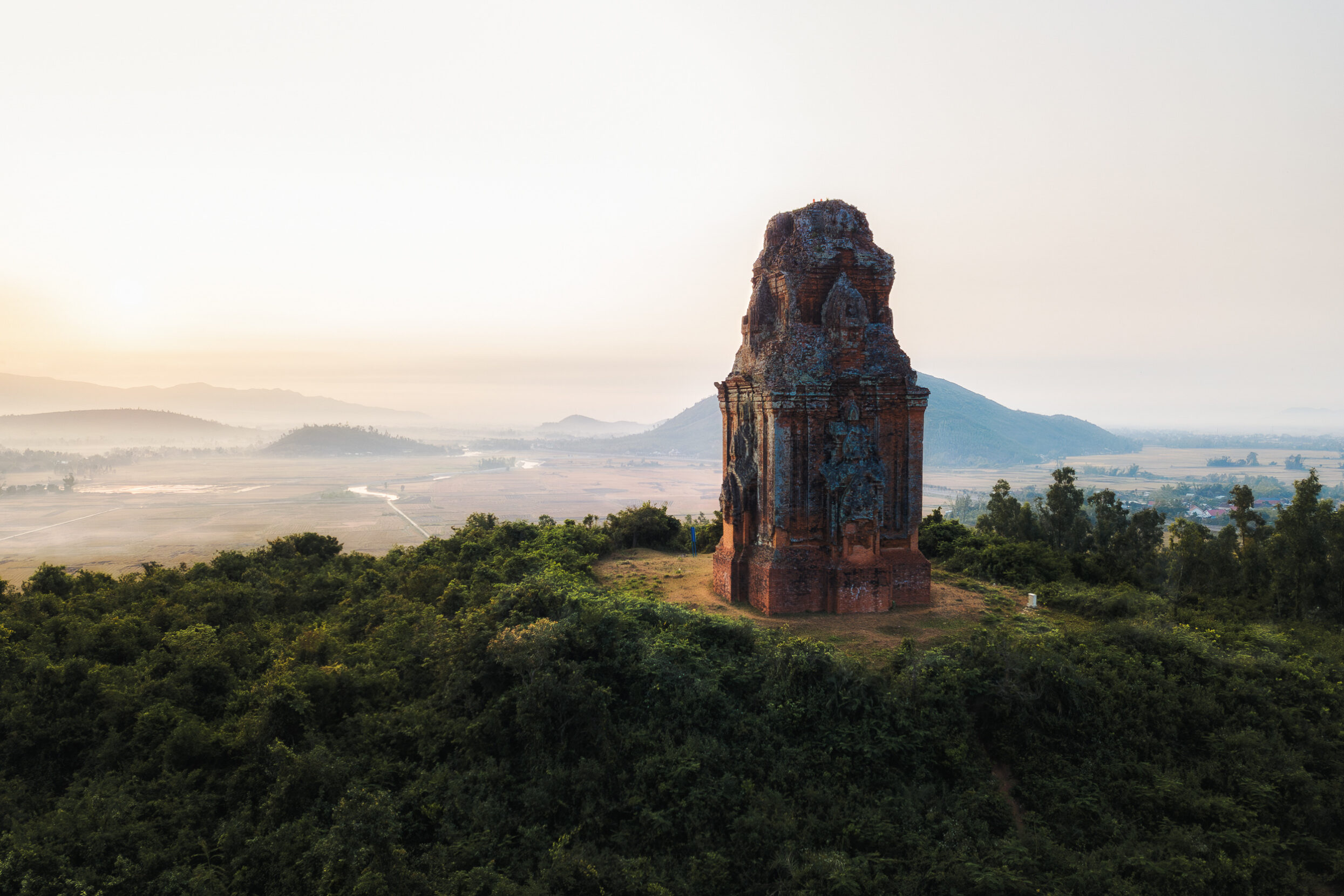
Phú Lốc Temple in the present-day province of Gia Lai, Vietnam, towers over the landscape. While temples like this one are reminders of an ancient Cham civilization, their culture is not as lost as it seems. Photo: Đức Nguyễn.
An earlier version of this story mistakenly identified Phú Lốc Temple’s present-day location as Bình Định Province and Amaravati’s historical territory as including present-day Quảng Nam Province. The story has been updated with the correct information.
Joshua Zukas
Joshua Zukas is a Hanoi-based writer, author, and speaker specializing in Vietnam, a country he has called home for almost two decades.