
Support Hidden Compass
Our articles are crafted by humans (not generative AI). Support Team Human with a contribution!
A solemn-faced man sat on a hastily crafted wooden throne set upon a dais in a carpeted courtyard, awaiting his crown. Faisal bin Hussein bin Ali al-Hashemi had been imported to become Iraq’s first king, deemed the best candidate in the eyes of British authorities to stave off the rising tide of nationalism against their rule.
It was six in the morning on August 23, 1921. To Faisal’s left was the building where he had been living since he arrived in Iraq two months earlier, its mighty columns rising beside him. Before him, a crowd of 1,500 had traveled from all over the country to witness the historic occasion.
An immaculately turned out Englishwoman stood in the front row, a sash around the waist of her pretty lace dress and bows on her hat and shoes. Her name was Gertrude Bell, and she also wore, for the first time, the medal she had been awarded for her service to wartime intelligence — Commander of the Order of the British Empire.
Though there was silence all around her, I imagine that it was anything but quiet in Bell’s head.
~~
Five months earlier, Bell attended a historic conference in Cairo that would redraw parts of the Middle East according to British policy — and create a blueprint for the new country of Iraq, complete with Britain’s appointed leader.
In a now-famous photograph, Bell sits astride a camel in a fur stole. On either side of her are “Lawrence of Arabia,” of whom she was fond despite finding him slightly irresponsible, and Colonial Secretary Winston Churchill, whom she found clever but “never really trusted,” according to a letter she wrote a year later. Behind them are what she called the “wide open eyes that look and look and look and hypnotise you” of the Great Sphinx of Giza.

In 1921, British military leaders, colonial administrators, and certain Arab leaders gathered behind closed doors to create a blueprint for British-controlled territories in the Middle East, including Iraq. In attendance, and pictured directly below the chin of the Sphinx in the photo above, was Gertrude Bell. She is flanked by future Prime Minister Winston Churchill to the left and T.E. Lawrence (Lawrence of Arabia). Photo: George M. Georgoulas.
An enlarged version of this image greets me at the entrance to an exhibition dedicated to the “challenging legacies” of Bell and her role in making the Kingdom of Iraq. Its staged formality doesn’t capture much about Bell that interests me.
So I turn away. Far more curious objects are crying out for my attention.
~~
As I wander among cabinets of ephemera that featured in Bell’s prolific life, I take a few deep breaths. I had found out about this exhibition, curated by a team at Newcastle University — home to the Gertrude Bell Archive — in northeast England, just in time to arrive on the final day.
Bell, who died the same year my paternal grandmother was born, had long struck me as black-and-white and stuffy. But then a friend gave me a biography of her for my birthday, which I swallowed whole.
Each item on display shares something about Bell, her wide-ranging work as a writer, diplomat, and archaeologist — and her inimitable spirit. Amid her carefully labeled photo albums and books, a diagram she sketched out maps the relations among desert tribes she visited in her 40s.
I feel giddy, as if I’ve slipped through a tear in the fabric of time.
In the center of the exhibition room, a giant chest holds court. I can practically picture her maid, Marie, carefully folding and packing her linens, china, and crystal for shipment to the next destination.
It’s big enough, I muse to myself, that I could have jumped in and popped out on arrival. “Tosh!” I can almost hear Bell retorting. I had read in her letters how she felt about the “silly females” who came to Baghdad and told her she had been their inspiration for years, making her “sick on the spot.” I would have been no exception.
The exhibition tells her life chronologically. I take it in twice. Then I go around again. Near the exit, an unassuming document catches my eye — a typewritten manuscript economically labeled “Baghdad, Mosul etc.”
~~
The call to prayer from Baghdad’s minarets had stirred her, like most days. It was 1924. Faisal had been on the throne for two and a half years with Bell serving as Oriental secretary to the British high commissioner of Iraq — the only woman serving as a political officer in the empire. She stretched her now 55-year-old body, as she did each morning, likely thinking about the tasks on her agenda. There was that report to finish and a visit by Sir something, that “dessicated stick” of an engineer.
Before taking up her post in Baghdad, Bell had been on expeditions penetrating deep into harsh landscapes on camelback, her routes determined by ruins to survey and active excavations to drop in on. Her team set up camp, cooked, and navigated their passage safely between tribal spheres of influence, eased by the gifts Bell presented. In turn, these local sheikhs welcomed her into their tents where she drank coffee and feasted with them, absorbing their tales under starlit skies.
Her Arabic and understanding of tribal politics had made her a highly valued asset, headhunted for the wartime intelligence service in Cairo, then sent to serve in Basra and now Baghdad, where she had been posted for the last seven years.
“My heart is in it,” she wrote home about her work. “I live and die for it. Nothing else matters.”
For years, Bell had been Sir Percy Cox’s trusty firewall, a filter between the stream of locals who showed up at British headquarters keen to vent their grievances to the commissioner. Though Cox had now retired and Bell’s influence was waning, his replacement still found her “invaluable.”
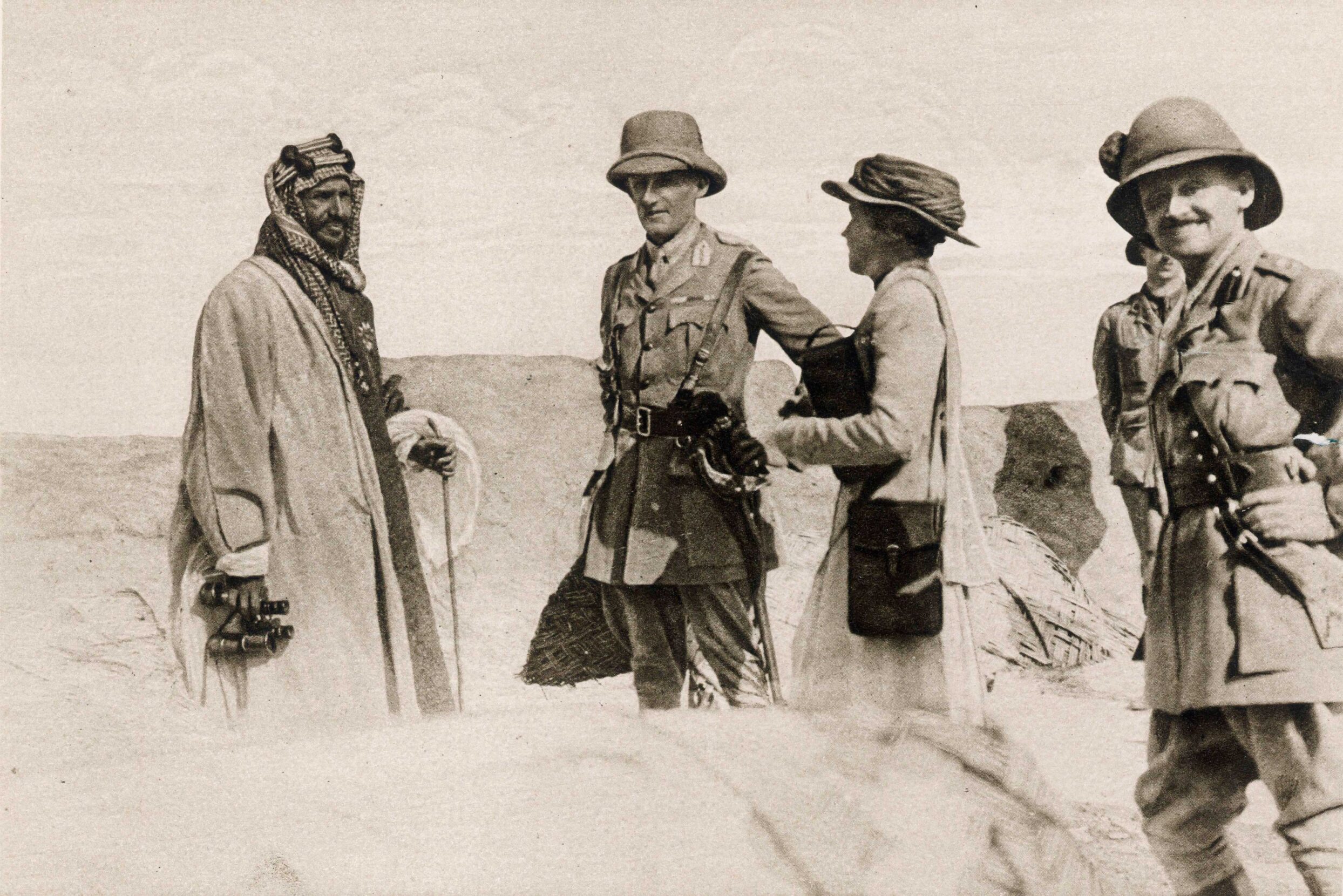
Chief Political Officer in Mesopotamia Sir Percy Cox and Oriental Secretary in Mesopotamia Gertrude Bell meet with Ibn Saud in 1917. Later that same year, Bell was made a Commander of the Order of the British Empire. Ibn Saud would go on to become the first king of Saudi Arabia in 1932. Photo: Smith Archive / Alamy.
That morning, on her way out the door, she would have grabbed the letter she wrote by hand at her desk the night before. It set out her latest idea, a pitch for a guide to Iraq for the popular and reliable Murray’s Handbooks for Travellers series, which she had traveled with when she was younger. Murray’s didn’t cover the remote reaches of the Levant or Arabian Desert, nor was there an edition for the new state of Iraq.
She wrote to publisher John Murray, “I may frankly say that I don’t think there is anyone better qualified than I am to write it.”
~~
For years, I had been dreaming of visiting Iraq. What better guide could I ask for than the “Queen of the Desert” herself — one Englishwoman to another, one century apart? The fact that her guide went unpublished, meaning this might be the first time her efforts would be put to use, sealed the deal.
Twenty-five years ago, as a newly hired editor at the BBC, I covered the 9/11 terrorist attacks and then the U.S.-led coalition’s invasion of Iraq and deposition of Saddam Hussein. My team’s daily briefings and weekly analyses closely followed the ensuing chaos — the incessant shootings and bombings, the looting of the main museum in Baghdad, the sectarian splintering and growth of militias, and painstaking efforts to rebuild the state. More recently, I had reported on an ever-more stable Iraq that was seeing massive energy investment and drawing up a plan to link East and West through a mega-highway, though these green shoots of growth were always threatened by regional airstrikes and missile and drone warfare that come from being Iran’s neighbor and ally.
I understood that news stories about Iraq could only offer a shallow, tainted impression. For my first trip there, I wanted to go beyond the headlines, to sift through the sands of history and see where Bell might take me.
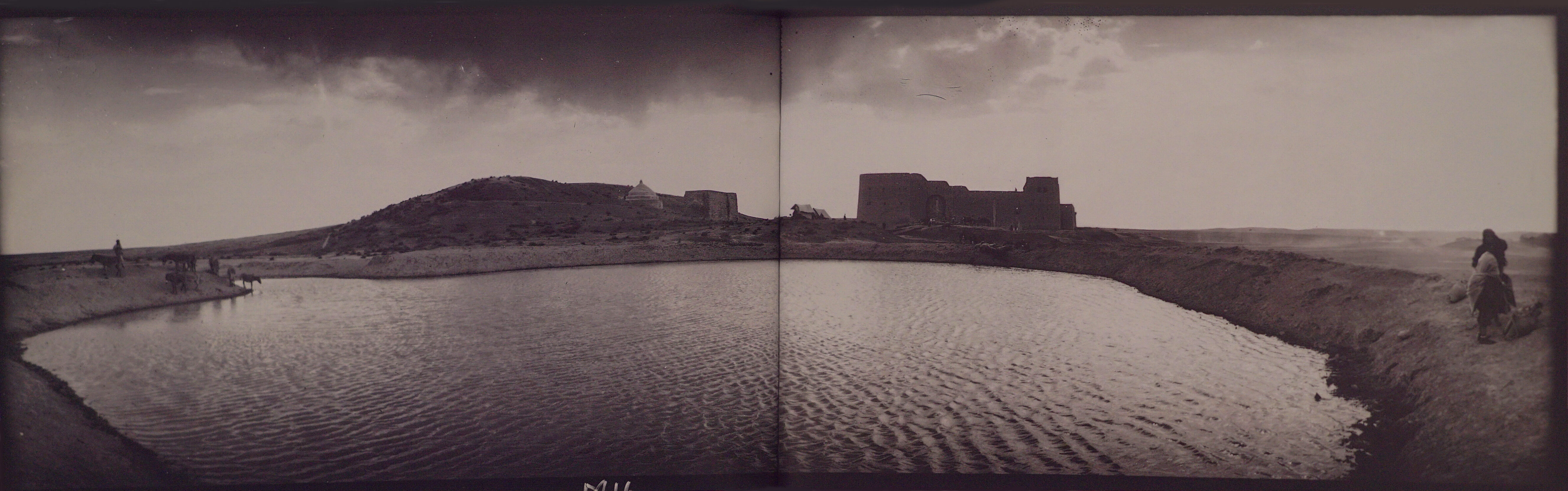
As Bell traveled through Iraq, she wrote about and photographed her experiences extensively. In the photo above, she captured a striking image of Mar Behnam Monastery, some 22 miles southeast of Mosul. The Catholic monastery, which dates back to the 4th century, was severely damaged and nearly destroyed by ISIS in 2014 and 2015. After Iraqi Security Forces retook the area in 2016, local communities collaborated to restore and repair the historic religious site. Photo: Gertrude Bell.
~~
At last, I arrive in Baghdad, with my typed-up version of Bell’s long-forgotten manuscript tucked into my rucksack. In May 2025, the capital was the only destination Bell wrote about to which the U.K. government did not advise against travel.
Following a guide written 100 years ago is tricky; it reflects a lost moment in time. New regimes regularly muscle their way into power in Baghdad and rename bridges, streets, and buildings to erase the echoes of those they supplanted.
Conferring with internet sources and the one modern English-language guidebook to Iraq, the Bradt guide, helped me determine which of Bell’s sites were visitable today. It was easy enough to figure out other details, such as how the major thoroughfare Bell lived off of — “New Street” — was today’s Rashid Street. It had been renamed for an eighth-century leader of the Abbasid Caliphate, an era spanning some 500 years in which Baghdad thrived as a center for trade and the exchange and development of ideas.
One piece of the puzzle eluded me, though. I couldn’t find a trace of the room where Bell had carved out her most lasting legacy — the site where she had donned perhaps her favorite hat, that of an archaeologist, and sorted her beloved antiquities.
~~
A taxi sweeps me down Rashid Street. We pass groceries, cafes, mosques, and street hawkers. Many buildings are decorated with traditional, protruding wooden balconies known as shanasheel: some restored, some in the process of restoration, and others seemingly collapsing above the heads of pedestrians.
Here on this key artery of one of the Arab world’s most polluted and populous cities, it is hard to picture Bell’s jasmine and rose-scented garden shaded by palms. Yet this is where she wrote letters and her guide, worked late, entertained, and looked after her two greyhounds, her partridge, and her hens, which, despite her wishes, didn’t “lay many more eggs than my gazelle.”
She felt immersed in this place and was buried nearby.
Her memory lives on among Iraqis. At the Newcastle exhibit, a video played on loop showing Iraqis commenting on Bell, mostly with warmth. While one decried Bell’s implementation of a “Western colonialist agenda” in Iraq, another called her Iraq’s Ataturk, the legendary founder of modern Turkey. Still another said she was made of iron and praised her as a great example for women.
~~
A stream of shoppers wanders in and out of an indoor market, the type that provided Bell with a welcome distraction from affairs of state, her curious eyes always searching for treasure. In one diary entry, she describes a day’s market haul: “a very charming Chinese bowl, a little copper incense burner 300 years old (it has a dated Arabic inscription, a thing I can never resist) and a metal water bottle.”
Laughing to myself over my own paltry find — a Baghdad fridge magnet — I exit onto a street that Bell wrote was “cut through the bazaar” during the First World War, now known as Martyrs’ Bridge Road.
I wait as tuk-tuks rush by, overtaken by battered custard-yellow taxis, which are in turn overtaken by sleek, white, purring vehicles driven by men in sunglasses. Once I’ve finally made it across safely, a sign directs me to another Abbasid site: Mustansiriyah University.
Handing over my dinars, I enter a calm oasis: an open courtyard surrounded by a near-perfect two-story structure of highly decorated fawn bricks that form a honeycomb of rooms where several hundred students at a time studied medieval mathematics, astronomy, philosophy, theology, and medicine.
A fountain awakes. For me? I am the only visitor.
Water once kept the rhythm of the day for prayer at the madrassa by triggering the mechanisms of an enchanting clepsydra, or water clock. Built by local engineer Ali Ibn Tha’lab, the clock echoed a masterpiece designed a century earlier by a man widely regarded as the father of robotics, Ismail Al-Jazari. As the clock sounded each hour, two golden falcons would open their wings and drop balls from their beaks into bowls, followed by the opening of one of 12 small doors set against a lapis lazuli sky.
For an instant, my vantage and Bell’s meld into one.
Cushions have been laid out within one of the courtyard’s recesses. Seated cross-legged, I compare my impressions of the Mustansiriyah with what Bell wrote in her guide.
Founded in the early 13th century, the Mustansiriyah is counted among the world’s earliest universities, named after the penultimate Abbasid caliph and “reputed to be the finest building in Baghdad in its day.” But Bell also wrote that the madrassa appeared in “a sad state of decay,” and was “filled with sheds and bales of merchandise” in its role as a customs house. Her photos show crumbling walls, not the restored space gleaming before my eyes. Today’s madrassa may look more like the original but is largely a fabrication overlaying what Bell saw a century ago.
Only a wisp of this once-great madrassa was glimpsed by both of us.
~~
“Brick work in a pattern resembling that of a Persian carpet.” Bell’s description has lured me to what she says remains of an Abbasid palace built in the 12th century by Caliph an-Nasir, the grandfather of Mustansiriyah’s founder.
Two soldiers positioned outside the gate, however, say that I can’t go in. “Tomorrow,” they say, smiling.
No matter. When Bell first visited, she couldn’t get in either.
In April 1909, Baghdad remained under the control of the Ottoman Empire. After months traveling through the desert, Bell arrived in the city for the first time. Little of old Baghdad remained, but Bell and her kavass, an armed guard appointed to accompany her, would “sally forth every day in search of adventure.”
She had read that there were “beautifully decorated” fragments of a palace within the arsenal. So she showed up at the doorstep of its gatekeeper, the Turkish commandant.
She was escorted to his rooftop terrace to wait. She must have felt impatient, maybe noting with irritation some dust accumulated from a recent sandstorm that needed sweeping up. For her amusement, a pair of sad, thin lions were prodded through their cage — beasts she recognized as the short-maned lion of ancient Assyrian reliefs.
At last, the commandant was ready for her. After sherbet and niceties, she would have explained that she wanted to see the caliph’s palace, having read about its stunning decoration in her books.
She had met a request from his guards to bring a letter from the British Residency to gain access. Her frustration was surely palpable as the commandant slowly read over the document, his expression offering no indication whether this would go her way.
Just as her blood started to simmer, he finally responded: “You see, Effendim. These rooms are much ruined and not worth seeing, they are full of military stores and besides, these rooms do not exist.”
She was not amused by the absurdity. Perhaps it was unreasonable to have expected access to the arsenal, even if it did include the remains of an Abbasid palace? In later years, Bell did gain entry and went on to write the description that had drawn me there.
~~
The palace now behind me, a blanket of calm and order stretches ahead, a contrast from the traffic and disorder of the surrounding city. I am in “Baghdad Downtown,” a massive project to restore and protect the city’s heritage. Perfectly arranged, bright paving slabs lead me past buildings of historic interest.
“You are here alone? Such audacity!” Out of nowhere, an Iraqi man in his late 20s or early 30s appears, startling me.
“Why are you in Baghdad?” “This is your first time in the Middle East?” He drills down as he walks alongside me, but I reveal little. I am aware there are people who might not want me in their country, and I do not want to talk myself into a corner. Despite his probing questions, I am disarmed by his wide-toed, comfortable-looking shoes, which remind me of an affable Iraqi colleague back home. We walk together for a while.
He shifts gears, pointing and telling me about the history of the Qushla Building up ahead. If tourism were properly developed, this man might make an excellent guide.
But not for me. I already have Bell and am not about to change course.
~~
The Qushla’s wooden gate is open, so I wander through. Though there is no mention of this name in Bell’s guide or her letters, the two-story building looks grand and historic.
I weave my way between stylish young women, giggling in twos and threes, and young men and dads photographing their loved ones. After ordering a coffee from the cafe, I choose a table on a balcony overlooking the garden, which is taped off for renovations, but the dust and grind of power tools force me inside. There, I look over my notes and pictures, pondering the significance of this place.
Suddenly, a rush of recognition overcomes me as I look at the photos I have just taken on my phone. The smooth, round columns with their distinctive capitals are the same ones that can be seen behind Faisal as he awaits his crown in 1921.
For an instant, my vantage and Bell’s meld into one.
~~
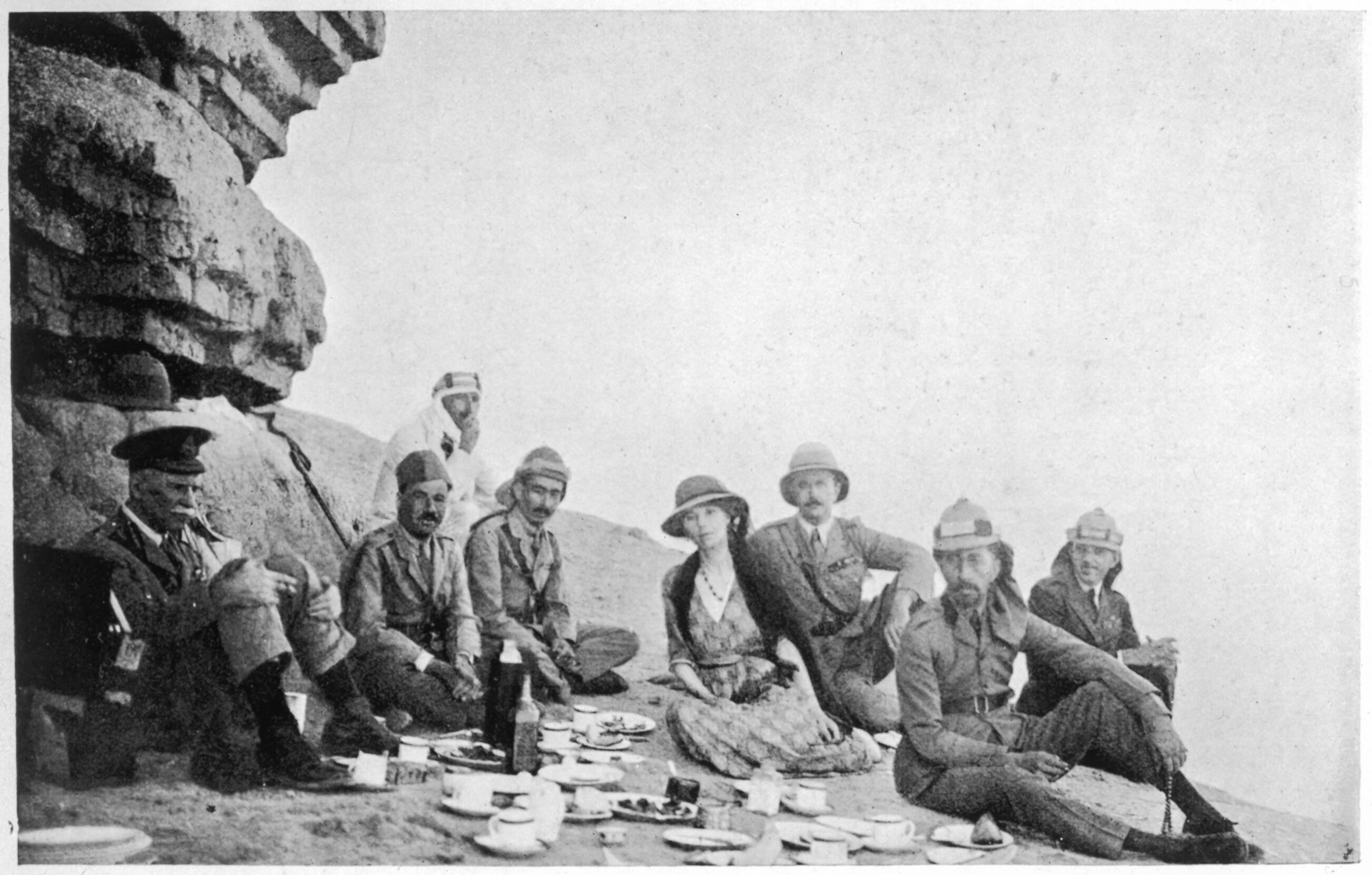
Bell picnics with King Faisal, the first king of Iraq, and others. In Cairo in 1921, Bell helped orchestrate the Faisal’s selection to lead the newly formed Iraq. After his coronation, she became a trusted confidant and political advisor. Photo: Unknown photographer.
During that early August morning, Bell held up her eyeglasses so she could see her friend Faisal. On the hour, he made his way to the throne and took his seat. Usually dignified and confident, he appeared “much strung up,” she wrote later. Catching his eye, she gave an encouraging “tiny salute” of support.
A last-minute cable from London had nearly derailed the coronation, demanding that Faisal proclaim in his speech that the British high commissioner was Iraq’s ultimate authority. Bell and Cox had argued that this would contradict everything they were trying to achieve in the new state — and won, she explained in a letter home, noting that this must be kept secret.
Looking down at the garden, I can’t fathom such a pivotal moment playing out below. But then I connect some more dots linking past and present. From Bell’s letters, I know that the coronation took place at the same site where she later sorted archaeological finds as King Faisal’s honorary director of antiquities.
That means that I am in the same building and possibly even drinking coffee in the very room that Bell called her “museum.” I feel giddy, as if I’ve slipped through a tear in the fabric of time.
~~
My Qushla surroundings take on new gravity.
Bell worked in a room just like this one with her curator, Abdul Qadir, an elderly Baghdadi man, carefully labeling and cataloging artifacts — some of which she herself had hauled back from digs as director of antiquities. Once these objects outgrew her “museum,” Bell located and equipped a nearby building for them, her passion coalescing around the establishment of a home for these treasures — a mirror to reflect the country’s magnificent past back to its people and play its part in nation-building.
She had been working at this for three years, on top of her regular job, the Murray’s guidebook seemingly forgotten.
“I am nothing better than an antiquarian at heart,” she wrote home.
Excited but exhausted, perhaps a little lightheaded from the heat, she might have opened a locked box, taking out and gently squeezing a favorite treasure she described as “a small but very perfect statue of the Goddess Ban who presided over the farm yard and has two geese by her throne and two under her feet.” She had wrested it from renowned excavator Leonard Woolley at the Ur excavations, securing it for her museum despite its being the “best thing” they had found. That same day, she had seen a sky “black with geese” flying north “and talking as hard as they flew.”
Bell was empowered by legislation she herself had drawn up to ensure Iraq retained its share of the finds. At a time when many excavators and their patrons thought what they unearthed was rightly theirs, she had the gall to believe the country of origin had rights, too.
~~
The Baghdad Archaeological Museum opened to the public — and to Bell’s delight — on June 14, 1926. Bell forecast that the museum was the one permanent thing she would create.
A month after the opening, she died from an overdose of sleeping pills, her death marked by a military funeral.
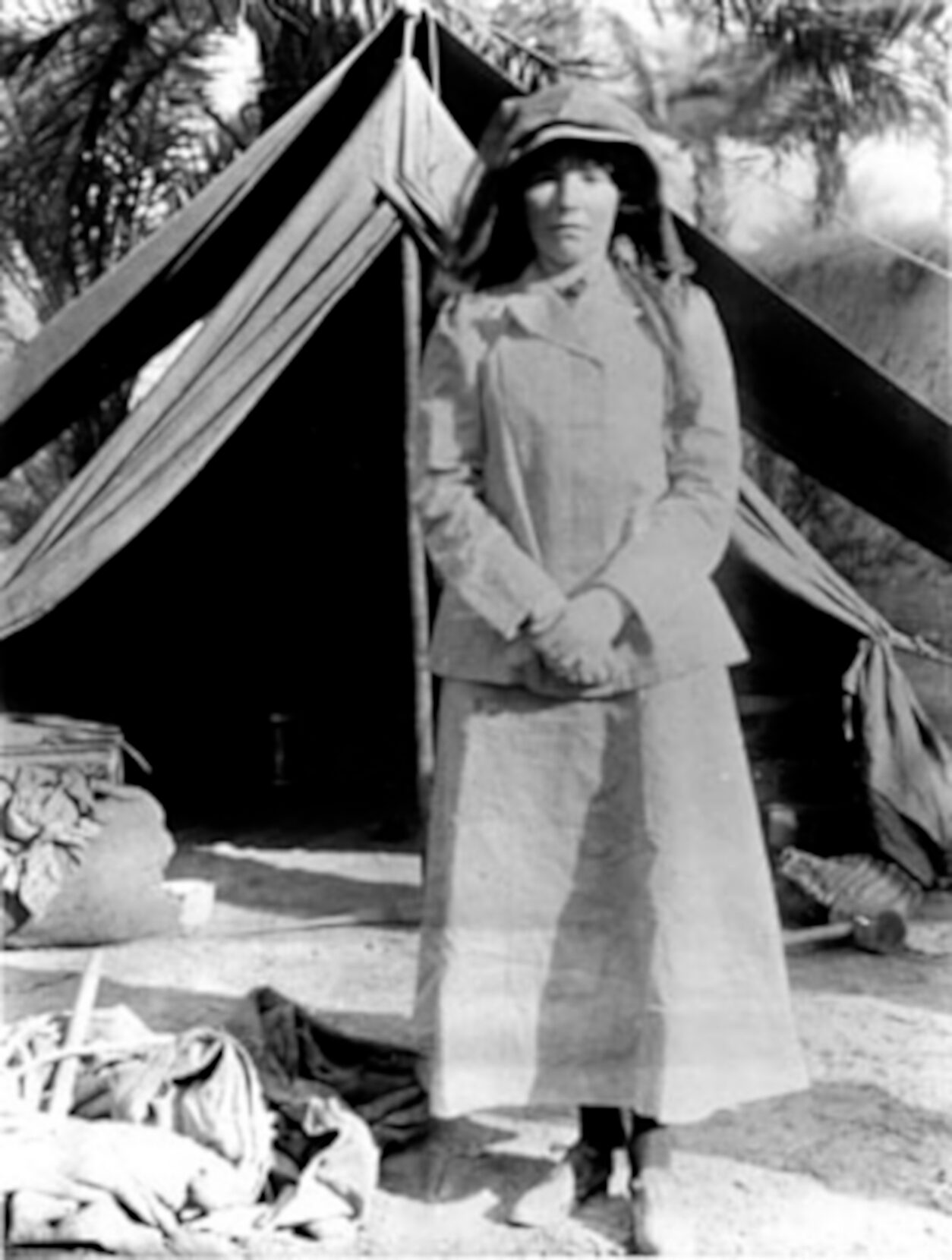
Bell was known for extensive travels and excavations in Iraq and beyond. She is pictured here at an archaeological site in Babylon, Iraq, in 1909. Photo: Unknown photographer / Alamy.
~~
It is my last day in Baghdad. I stand behind a small group of German tourists, waiting to have my bag checked before entering the grounds of the modern Iraq National Museum. As Bell predicted, the original museum soon outgrew its home; the collection was moved here in the 1960s.
This is the one place I am visiting that I was able to picture before arrival, though my impression was of the U.S. tanks and troops that had failed to prevent the looting of 15,000 artifacts in 2003, amid the chaos after Hussein was toppled. Though many of those treasures remain missing, the museum is celebrated as one of the world’s greatest repositories, a showcase of Iraq’s unique contribution to humanity. I am excited to be here.
I pass two statues on the grounds. One celebrates Iraqi archaeologist Taha Baqir; the other is an imposing 12-foot statue of Nabu, the Mesopotamian god of writing and wisdom, clasping his hands on a plinth at the main entrance.
After Bell’s death, King Faisal commemorated her “wonderful knowledge and devotion” and work on Iraq’s “precious objects” by unveiling a bust and plaque in her honor, flanked by two figures of Nabu. Could this be one of them?
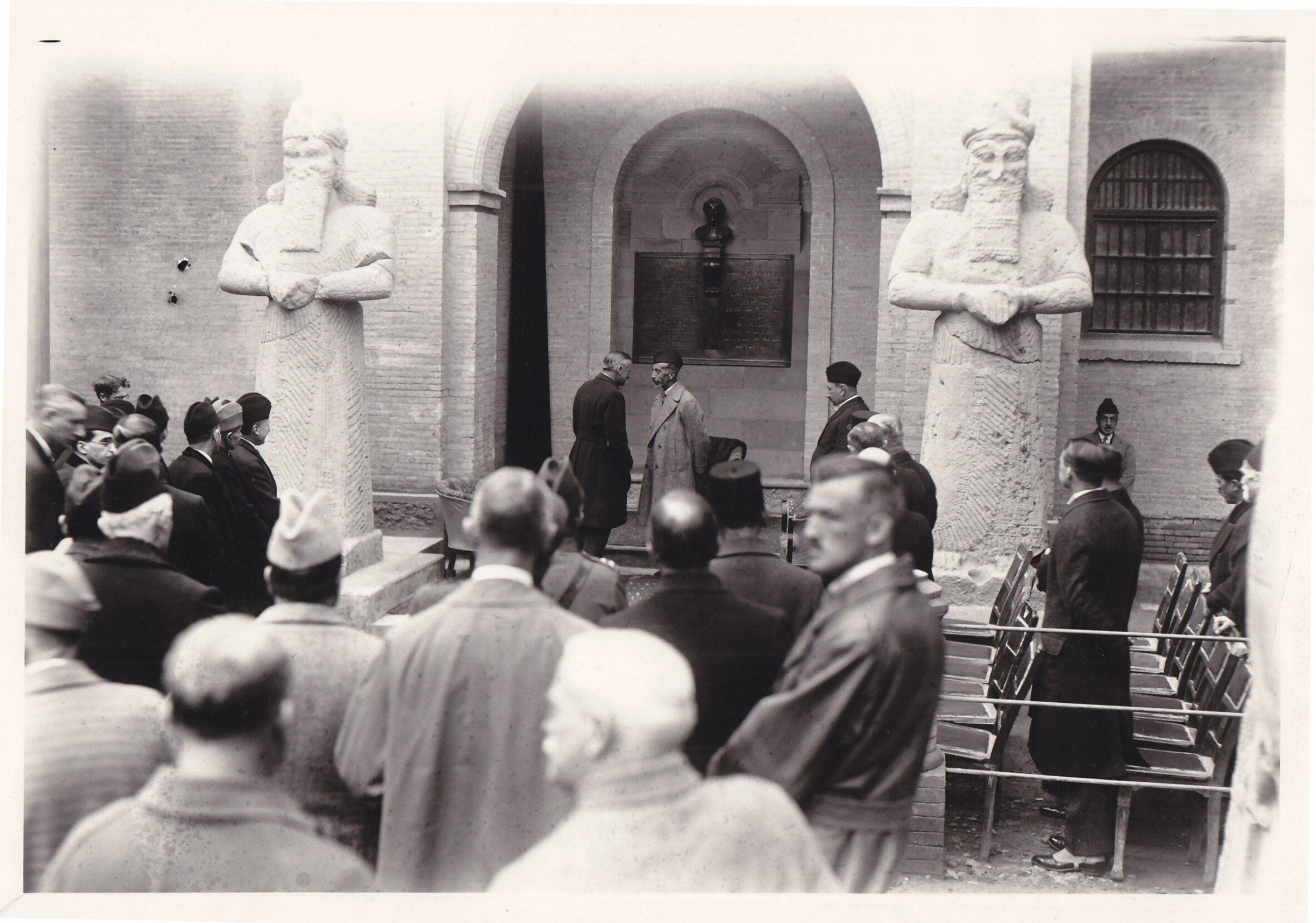
Flanked by large statues of Nabu, King Faisal unveils a bust of his late friend and confidant Gertrude Bell at the Iraq Museum. Bell was instrumental in ensuring artifacts unearthed in Iraq stayed in their home country. Photo: Iraq National Museum.
At the ticket desk, I ask the assistants whether Bell’s plaque or bust was moved here from the old museum. They don’t seem to understand my inquiry and call over a third woman, who advises me there is nothing here to recognize “Miss Bell.”
I thank them, crestfallen.
“Miss Bell” is also how a woman in the Newcastle exhibition reel referred to her. This, in turn, reminds me of the voice in the video that described her as a “bad omen,” likely because she helped set up an exclusive political system that was doomed to fail many of its people. Her legacy is challenging indeed.
Bell recognized these fault lines, too, and did what she thought was best. That her political role in Iraq strikes a dissonant chord with us today speaks more about the progress we have made.
~~
After passing through room after room of cabinets, plinths, and wall mounts, I finally enter the Assyrian Gallery, where a second towering stone figure of Nabu greets me.
Over the past century, regimes have come and gone, as have the commemorations of Bell herself. But this museum, the seeds of which Bell planted, persists. That legacy resounds through these reverent halls.
I nod in the direction of Nabu’s bearded face, a tiny gesture of recognition of all that Bell managed to set in motion — the unfinished work included.
Suzanne Ruggi
Suzanne is an editor with a Middle East specialty and a passion for finding ways to tell Gertrude Bell’s story.