

Support Hidden Compass
Our articles are crafted by humans (not generative AI). Support Team Human with a contribution!
Editor’s note: The following article was reported in April 2025, prior to the attacks on Iran by the U.S. and Israel and ensuing war.
The valley is still coal-dark when Ramezan opens his eyes. Lean and weathered, with a black mustache dominating his features, he gazes ahead. Somewhere in the distance, a newborn goat bleats once, thin and sharp, calling for its mother before being drowned out by Ramezan’s voice: “Setareh. Fire up the tea.”
A figure rises from beneath a stack of blankets, pulling on her black hijab midstep. She huffs into her palms, then leans forward and nudges the smoldering embers with a stick. Sparks flare, die, flare again. Pungent smoke hangs low, blending with the scent of tawed grass. A blackened, dented kettle emerges from beside her knee. Setareh sets it onto the two metal rods, just high enough to escape the flames, and feeds the fire with twigs, one by one. Her hands know this hour.
“Mehran.” “Ashkan.”
Their father’s voice cuts clean through the air. Mehran, 18, long-legged and solid, heads out first. Ashkan, 14, smaller and still boyish, follows close behind. Obedient, the brothers move without hesitation; they vanish into an open landscape, interrupted by pale rock, boulders, and oaks. Two daughters, ages nine and 11, remain cocooned a little longer, spared until their mother pulls them from their dreams to help prepare breakfast.
I have awoken into a dream of my own: my first morning joining this family’s spring Kooch, a migration on foot across western Iran’s rugged Zagros Mountains. Their trek might be the planet’s most arduous seasonal journey still undertaken.

The Zagros Mountains, a hiker’s paradise to outsiders, are, for the Bakhtiari, simply their workplace — and often a difficult one. While the landscapes are stunning, they come with challenges: extreme weather, isolation, and hard physical labor. High in these mountains, some Bakhtiari nomads still migrate with their flocks, tracing centuries-old paths through snow, canyons, and the constant chime of bells. Photo: Claudio Sieber.
~~
Two weeks earlier, I navigated the traffic-choked streets of Tehran, past bazaars bustling with shoppers preparing for Nowruz, the Persian New Year, the scent of cardamom and dried rose petals wafting through the air. Mohammad Malekshahi, who runs a local tour company, pulled up to our meeting place on a bicycle in loose Afghan-style trousers. Carrying himself with calm confidence, he chose a traditional restaurant where the entire menu was written in Farsi, leaving me little chance of ordering without his help.
In my native Switzerland, stability is practically a national virtue. Yet for much of the past decade, my life as a photojournalist has unfolded in motion — first across the Americas, then deep into Asia and the Pacific. Having passed through more than 50 countries along the way, the road has stopped feeling temporary and started to resemble a way of life — a sort of modern nomadism. I have long wanted to experience the real thing. With Mohammad’s help, a family of Bakhtiari nomads has agreed to take me under their wing.
I confidently assured Mohammad that I was a seasoned mountaineer, having grown up near the Alps, and he needn’t worry about my ability to keep up. Eyeing my lightweight walking shoes, he shook his head and urged me to buy proper hiking boots, warning that while Swiss trails are built for hikers of all levels, most Zagros paths are meant for goats.
~~
“You surely have a more convenient life than us.”
It was early, the sun just beginning to burn through the haze, as my bus dropped me at a small stop beside a modest mosque. I found Mojgan (“Moji”), my 53-year-old Iranian guide and translator, waiting in a nearby parking lot. Whatever first-day nerves I had didn’t survive her sharp gaze and no-nonsense demeanor — or the fact that she has walked most of Iran’s major mountain routes more times than she can count.
Shortly after, our driver pulled in. Yossi was a broad-shouldered, semi-pro wrestler who didn’t shake my hand so much as compress it. He muscled us through Shushtar in a blue diesel pickup he claimed to have been driving since the age of nine, built for the dust storms and steep ravines of the Zagros Mountains.
Before taking to the road legally, Yossi told us, he smuggled knockoff Dior, Gucci, and branded phones — until a bullet to the leg put an end to one of his escapes from the police. Through the truck’s battered stereo, Yossi blared Bakhtiari folklore music — vocals filled with raw, gravel-throated heartbreak. Hopelessly in love with a faraway girlfriend, Yossi subjected us to his melancholy, despite repeated protests from Moji and me.
The dirt track stretched for nearly 10 hours, winding through folds of sunbaked hills. Along the way, we occasionally took on Bakhtiari hitchhikers, far beyond the reach of public transport.
At last, we reached a hamlet. Waiting for our arrival was 18-year-old Mehran, with unruly curls he kept trying to tame as he led us to the other five members of his family. They greeted us with the warm Persian saying ghadam ru-ye cheshm — literally “your step is on my eye,” a poetic way to say: You are welcome here, more than words can hold.
~~
On our first morning of the Kooch, Ramezan stands, pouring steaming tea into a small saucer and sipping from it, plotting the day ahead as the first sunbeams spill over the surrounding mountain range. With the herd meticulously counted and gathered — some 250 goats and 30 sheep — the family starts tearing pieces of yesterday’s stale noon flatbread and dipping them into goat yogurt, maast. The bells tied to each animal sound a steady rhythm.
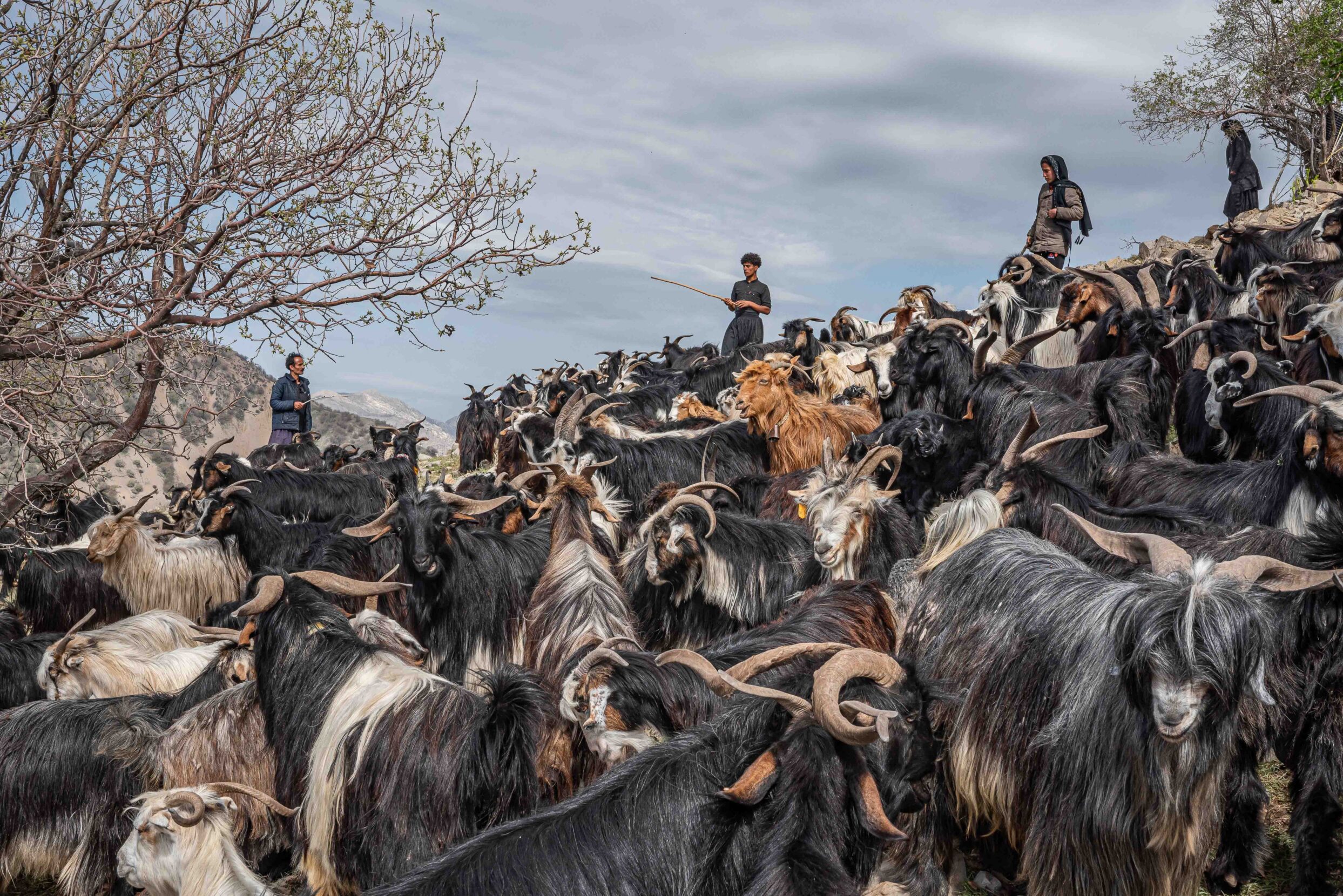
In 2025, Swiss photojournalist Claudio Sieber accompanied the Mokhtari Chaharbori family on their seasonal migration. Known as the Kooch, the journey is both a fight for survival and a living heritage on the edge of extinction. Photo: Claudio Sieber.
No second goes to waste. With seven days and nearly 93 rugged mountain miles to the summer pasture ahead, the family begins breaking camp, bundling blankets and spare clothes, tying pots and tarps, and packing food onto the pack animals.
They move four times a year. Winters are spent in the lowland pasture near Cheshmeh Qaleh, in the Zagros foothills, where a teacher from Lali village visits to school the children. Then comes a short move — just a month or two — before the spring Kooch begins. It is a five-to-seven-day migration, or transhumance, to the high-altitude pastures of Cheshmeh-ye Shah, where they remain through the summer. Another brief relocation follows until the autumn Kooch returns them to Cheshmeh Qaleh.
While migrations like this once unfolded as entire clans moving together across the mountains, they are now more often undertaken by smaller family bands like this one. The Bakhtiari are the last tribe in Iran still preserving this seasonal journey on foot, though fewer families continue each year.
Less than 1 percent of Iran’s population is said to still migrate seasonally. But in the not-so-distant past — within living memory for many elders — it was the prevailing way of life. Census data shows that just two centuries ago, in 1830, approximately 40% of Iran’s population lived nomadically.
In fact, the roots of nomadic pastoralism stretch deep into the soil of ancient Persia, where early civilizations relied on seasonal migration for survival, trade, and military strength. From the Iron Age to pre-Islamic Iran, nomadic and semi-nomadic tribes formed the backbone of Persian society — guardians of its frontiers, drivers of its livestock economy, and carriers of cultural continuity across millennia.
~~
Setareh and Ramezan secure the heavier bundles to the pack animals — one mule and three donkeys — as Azita and Arghavan gather the newborn lambs and goat kids from the small, hand-built stone enclosure where they spent the night. Only days old, some born during the migration itself, the animals are tucked snugly into panniers strapped to one of the donkeys.
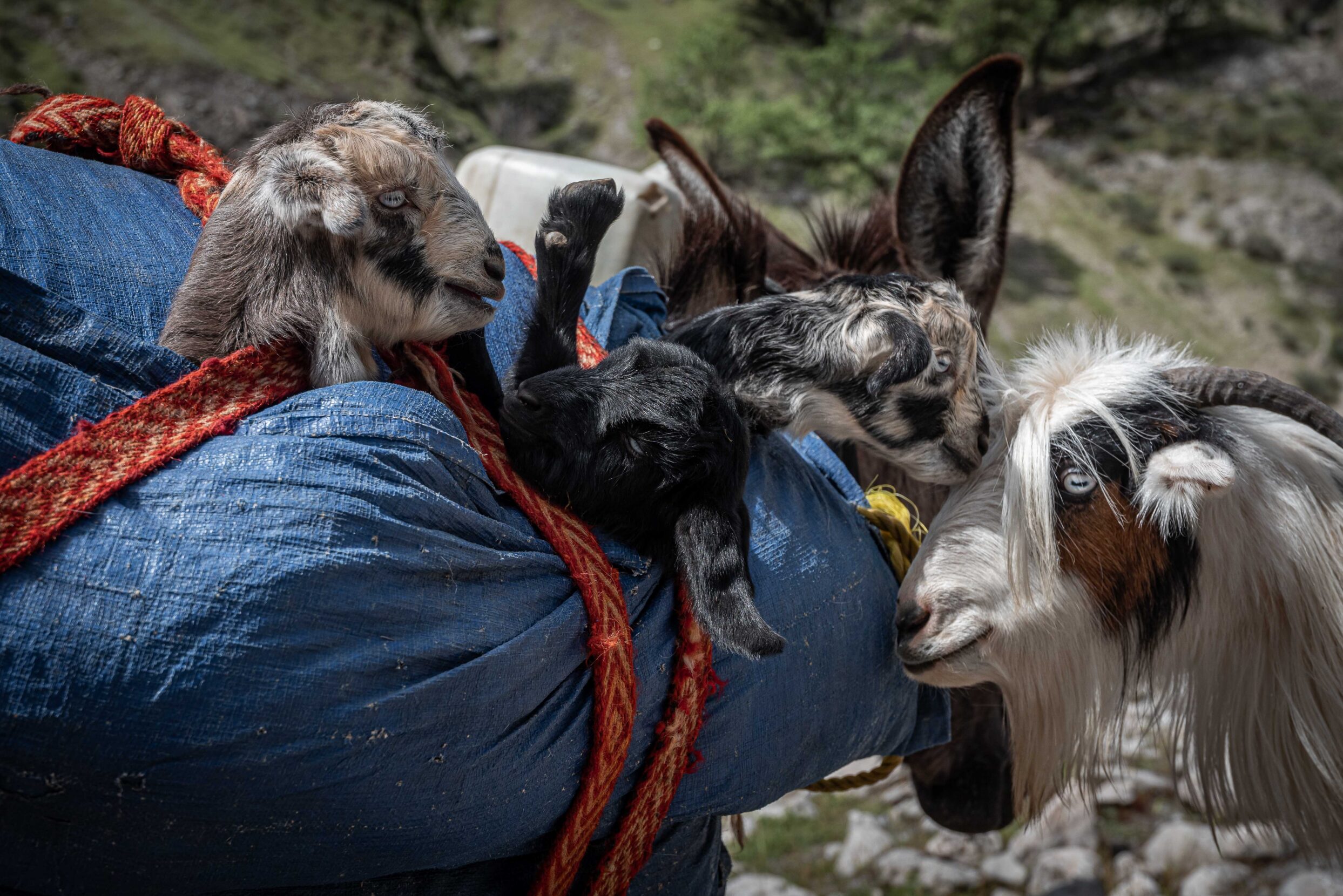
During migration, many goats give birth along the trail. The health of the newborns is a priority: During longer treks, the youngest and most fragile kids are loaded onto pack animals, like this donkey, ensuring they survive the rough journey. Photo: Claudio Sieber.
“Heeeey yaa!” A harsh whistle from Ashkan, and then they move.
Soon, the boys and the herd are already out of sight, somewhere up the trail. Moji adjusts her pack, scans the slope ahead, and steps forward without comment. Having joined her first Bakhtiari migration 17 years ago and many times since, she slips easily between the men and the women — helping with cooking, trading jokes, translating when needed. We walk together, talking about the mountains, the state of the country, the world beyond the trail, already more like old friends than colleagues.
Our trail climbs steadily through a pastel-colored mountainscape, crossed again and again by a shallow river. At the first ford, I stop to untie my shoes and wade across, only to find the herd already pulling away on the far bank. At the second, I repeat the mistake. By the third crossing, I stop bothering. I wade straight through knee-deep water, the cold biting into my skin. We gain altitude through the afternoon, moving at a pace that isn’t punishing, but exact.
~~
The Bakhtiari, once among the most prominent and mobile nomadic tribes in Iran, have long held a deep connection to the rugged landscapes stretching between the Zagros Mountains and the plains of Isfahan. Yet over the past century, and especially in the last four decades, that rhythm has been interrupted, fragmented, and, in many cases, forcibly halted.
Tribes such as the Bakhtiari are self-governed and mobile, with their own internal structures and leaders — such as the Kalantars, who often act as clan judges, mediators, and negotiators. A hundred years ago, Kalantars engaged in independent negotiations with foreign powers such as the British Empire, particularly over access to oil-rich territories. Fearing that tribal autonomy could challenge central authority, the Iranian state under the Pahlavi shahs — the dynasty overthrown by the Iranian Revolution of 1979 — implemented a series of control measures, from forced sedentarization and disarmament to the removal of tribal leaders.
In the more recent past, as cities like Isfahan expanded and infrastructure projects multiplied, the grazing routes of the Bakhtiari were swallowed by development. With the rise of centralized governance, militarized borders, and a push for industrial “progress,” nomads were recast as relics of the past — romanticized in literature, yet systematically pushed aside. Schools, clinics, and administrative services were tied to fixed settlements, forcing families to choose between movement and modernity.
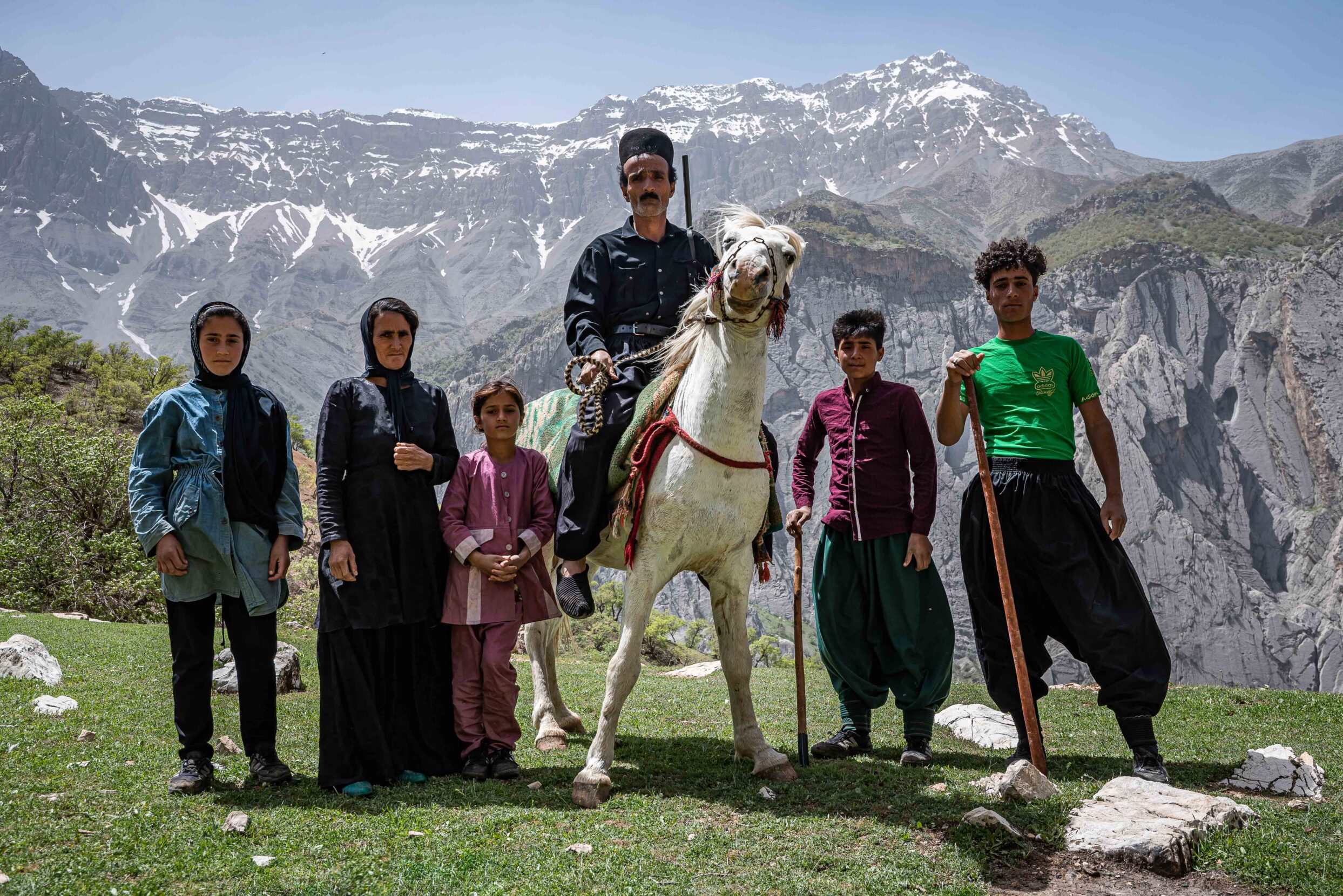
Portrait of the Mokhtari Chaharbori family. From left to right: Arghavan, 11 (daughter); Setareh, 40 (mother); Azita, 9 (daughter); Ramezan, 44 (father); Ashkan, 14 (son); Mehran, 18 (son). Photo: Claudio Sieber.
~~
During a brief lunch break, another herder crosses our path, settles, and lights an opium pipe. I glance at Ramezan, half-expecting him to reach for it, but he waves it off. “Never tried,” he claims, then smirks. “Though I look like someone who would.”
The man warns us that migrating this early can lead to fines from the Natural Resources Organization. Ramezan listens, unimpressed. “Timing matters more,” he says to the man. “Business awaits.”
For Ramezan, it comes down to numbers. He keeps the female animals, knowing they’ll give birth to the next generation. Last year, he sold 20 sheep and 100 goats. In May or June, he plans to sell another 40 to 50 to cover food for the family and fodder for the animals. If prices are right, he’ll reinvest, buying new females to grow the flock again. He likens it to the stock market. The equation shifts every year. With inflation stubbornly gnawing at Iran’s currency — reaching more than 50 percent in 2025 — today’s numbers won’t hold for long. Even so, nomadic trade remains surprisingly lucrative, Ramezan explains as we walk, often outearning office jobs in the cities. Most Iranians still prefer sheep and goat meat from the Zagros Mountains, not industrial farms.
While we linger, two goats give birth within minutes of each other. The newborns wobble briefly, then are lifted away. “They won’t stay with their mothers for long — too much milk weakens both,” Moji explains, referring to the mother and her newborn kid.
Ramezan returns from counting the herd and begins barking orders. “Bring me some dates! Clean that — no, with the new sponge!” All commands are directed at Setareh, who carries on without complaint. A moment later, Moji leans toward me and remarks quietly, irritation clear in her voice, that within Iranian, and particularly Bakhtiari, culture, roles like these leave little room for negotiation.
~~
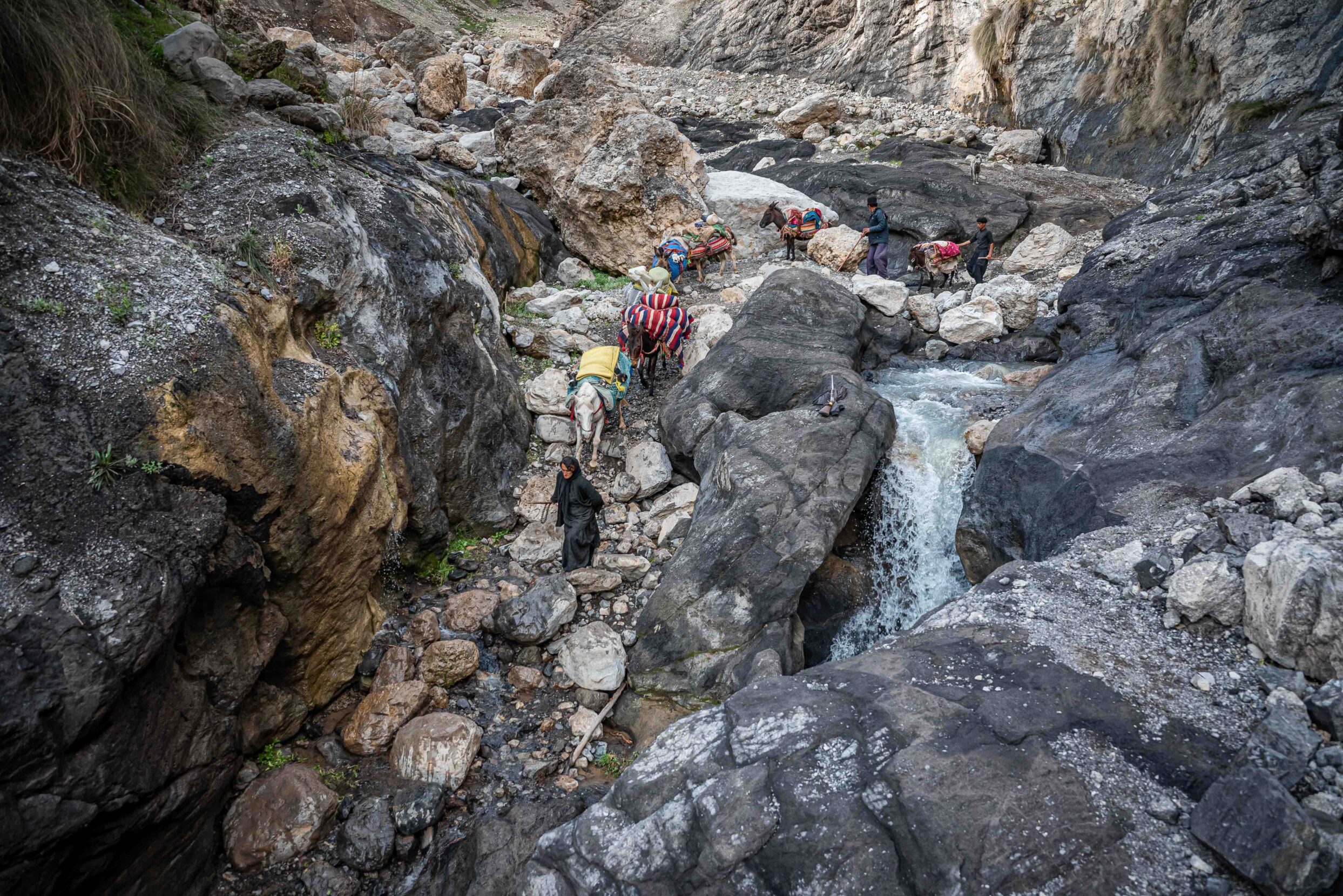
Life in the Zagros Mountains demands constant movement, endurance, and resilience. This family’s weeklong migration doesn’t follow paths made for humans — but rather trails meant for goats. Photo: Claudio Sieber.
We caravan farther uphill, to around 5,600 feet above sea level, so the family can keep better watch over the grazing flock, which immediately goes off to explore the surrounding grassland.
Ramezan turns to me. “How did it go?” he asks, then slurps his afternoon tea. Today’s 12-mile march has served as a test run, a way for Ramezan to gauge whether I can maintain their pace in the days ahead. I give him a confident smile; long days on foot feel familiar.
Still, I can’t help but ask why they don’t simply load the herd onto a truck and skip the weeklong march through canyons and mountain passes. For Ramezan, tradition is only part of the answer. Hiring transport is expensive. The journey is risky — goats and sheep can injure themselves during the rough ride. And even with trucks, two days would still have to be done on foot: one to reach the nearest road, the other to get from the drop-off point to the encampment.
Their trek might be the planet’s most arduous seasonal journey still undertaken.
Sensing something out of place, Ramezan suddenly lifts his binoculars and spots two bears wandering across a distant hill. The rifle is always close, slung over his shoulder, tied to a saddle, or carried by Mehran. Last year, he mentions nonchalantly, he shot eight of the animals. He tells me that the Bakhtiari are permitted to carry firearms — not to hunt bears, officially, but to scare off predators.
“Actually, bears aren’t that much of a nuisance,” he remarks. “They’re rather deliberate — snack on a goat or sheep and take off.” It’s the wolves — or the occasional leopard — that bring real chaos, slaying as many as they can.
Later, we sit together under the stars and watch a line of glimmering specks glide across the sky. “UFOs,” Ramezan suggests, half-joking. Moji corrects him softly, identifying the phenomenon as a satellite train settling into orbit. The children’s eyes lift from the campfire’s edge to follow it. Yet Ramezan’s flip phone won’t pick up enough signal to check the weather forecast. He groans. A lonely solar-powered bulb illuminates our dinner: Setareh’s freshly pan-baked noon and doogh — goat yogurt diluted into a tangy, slightly sour drink, which she repeatedly offers from a traditional goatskin pouch.
I’ve chosen to forgo a tent and sleep under the open sky, as my hosts usually do — except instead of thick wool blankets, I’m wrapped in every scrap of wearable fabric I can summon and cocooned inside a frayed sleeping bag. Bound so tightly that only my eyes are free to wander, I stare into the sky, watching stars drift until sleep carries me off.
~~
At first light, the trail calls. Over sticks and stones, we meander through the Zagros, where jagged limestone ridges fall away into deep, rocky valleys scattered with wild almond trees.
Ramezan had aimed to camp near a natural spring, but it’s clear the place has seen better days. Water is becoming an increasing challenge, he explains. The controversy around dam projects — designed to benefit the state more than the people — looms large. Over the past four years, the Bakhtiari nomads have noticed a steady decline in rainfall and a growing number of dried-up springs, none of which bodes well.
I watch as father and children crouch around what remains of one such spring, filling metal pots and plastic containers with cloudy water seeping from between the stones. Ramezan talks as he works, his voice low and practical. Springs that once ran through the season now vanish early, he says. The concern is there, held in check. With the containers filled, we continue climbing.
Not that water is lacking today. After eight hours of hiking, rain begins to fall — first lightly, then steadily, and finally with purpose. Ramezan reacts instantly. Orders snap through the camp. “Find the saw. Fetch the rainwater. Pull that rope.” “Aaaay,” Mehran grins and moves at once. Even little Azita drops to her knees, carving a shallow channel with a stick to steer the runoff away from what might be our shelter.
Within minutes, a makeshift tent stands firm between us and a sudden burst of hail. Like a patchwork rug made of humans and baby lambs, we’re woven together, grappling for warmth. Only Ramezan remains in motion, fixing loose edges and hacking off tree branches to feed the fire. “Can’t allow myself to be tired,” he grumbles without pausing. “There’s no way out but through.”
Done with the day, 14-year-old Ashkan lies down, snatching a cigarette from his father’s pack to ease a toothache, the result of gorging on sugar the way others snack on apples. Somewhere in the distance, a leopard lets out a guttural roar.

Because of rain, the family has decided to wait for the next day before moving on to the mountain pass. Photo: Claudio Sieber.
~~
Ramezan decides to wait out the rain. Continuing toward the pass today would be too risky for the animals, let alone the children in their worn sneakers. Packs stay on the ground. Ropes are retied. We spend the day at 6,500 feet under a sagging tarpaulin, squeezed between two smoky campfires. Only the lowest foot of air above the damp rugs is breathable; higher up, the wood smoke stings the eyes.
Last night, our tent caught fire. A blackened seam and the smell of burned fabric are all that remain. If Ramezan hadn’t woken in time, the situation might have taken a darker turn.
By now, I’m growing used to the relentless bleating. Paired with the crackle of flames, it turns oddly meditative. Between conversations and long stares into goat eyes, we pass the hours. Occasionally, Moji helps us interview one another.
Dreams come up. Not as abstractions, but as quiet answers between feeding the fire and wringing water from sleeves. Lives shaped by different starting points. When you’re raising half a dozen children out of necessity in a country with an unstable pension safety net, without the freedom to choose what else life might hold, it’s clear the state has already done the math for you.
Mehran, the Mokhtari Chaharbori clan’s eldest son still herding with the family, is the first to speak — and likely the next to leave family affairs behind. He pokes at the dying fire with a stick, then looks up. He dislikes life out here — menial chores, constant rain, drying off just to get soaked again. He has plans, but Iran’s inflation — projected to exceed 68% in 2026 — derails everything.
“What you hope for today changes by tomorrow,” he confides.
But he doesn’t give in so easily. He wants to move to the city, just like his two older brothers, to become a mechanic or perhaps a singer. The main thing is to earn money and trade it for a bit of comfort, though he knows that such ease comes at a cost. Still, he smiles and jokes as often as the day allows.
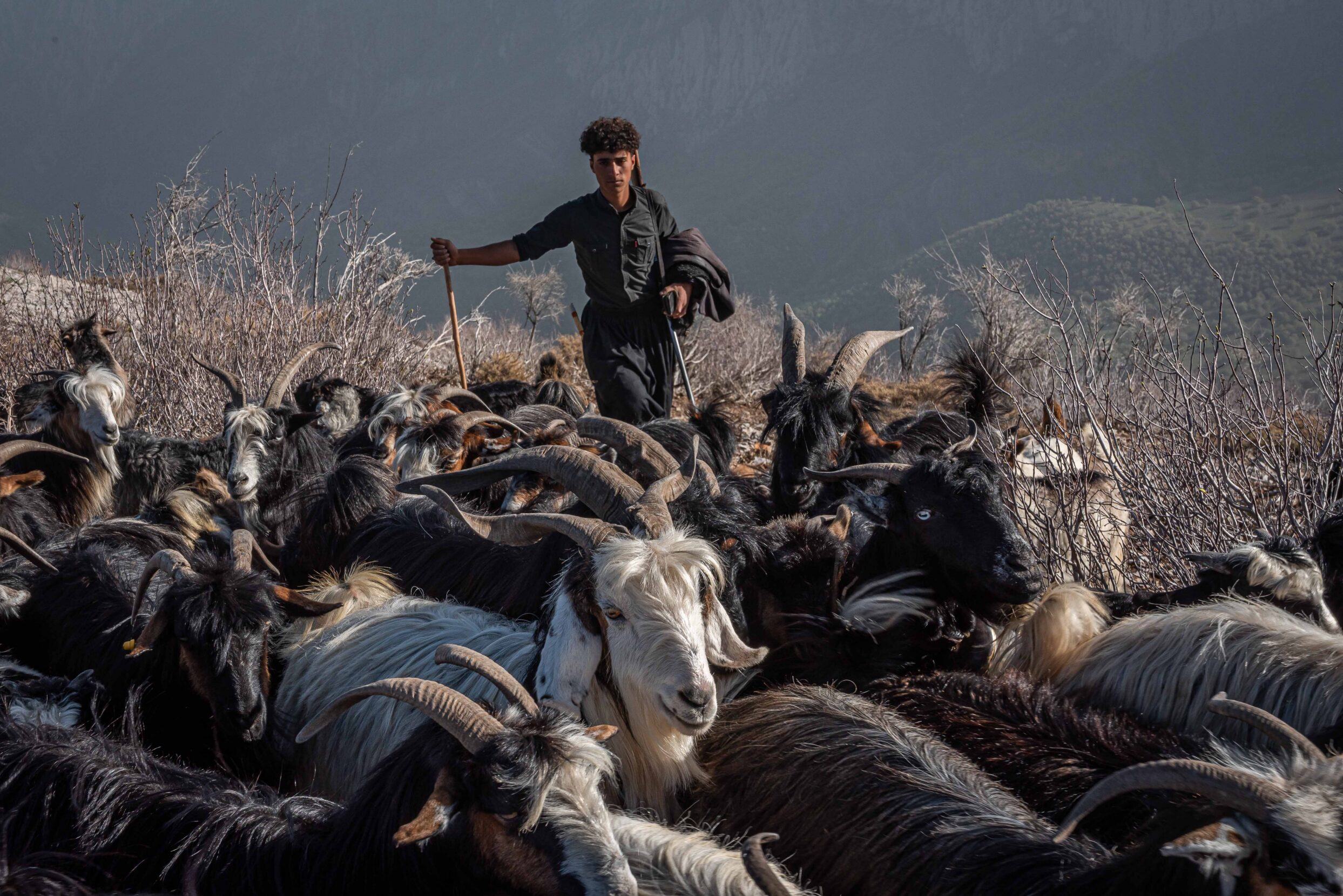
Mehran herds the family’s flock across the highest pass en route to their next pasture. Photo: Claudio Sieber.
Ashkan is equally set on leaving. “In the city, they have cars,” he gushes, tugging at his damp shoelaces. “It’s more comfortable than wandering out here.” Privacy, more than anything, tops his wish list. Having dropped out of school in grade six, he dreams of opening a small shop — clothes, maybe fruit and vegetables. For now, he herds, helps during lambing, and scouts for good grazing land.
Arghavan is just as hardworking but more introspective, often tucking her thoughts behind her hijab as she goes about her chores. Azita is her opposite — curious, confident — quick to gather firewood, fetch spring water, and carry lambs heavier than they look. When asked about her aspirations, her father answers bluntly on her behalf.
Moji cheekily cuts him short and sends him off to watch the livestock, allowing Azita the chance to actually answer. One day, following her siblings’ longings, she will likely end up seeking city conveniences — maybe working as a hairdresser or a teacher. But what exactly would draw her there?
She doesn’t hesitate. “They have cake,” she says. “We don’t have that here.”
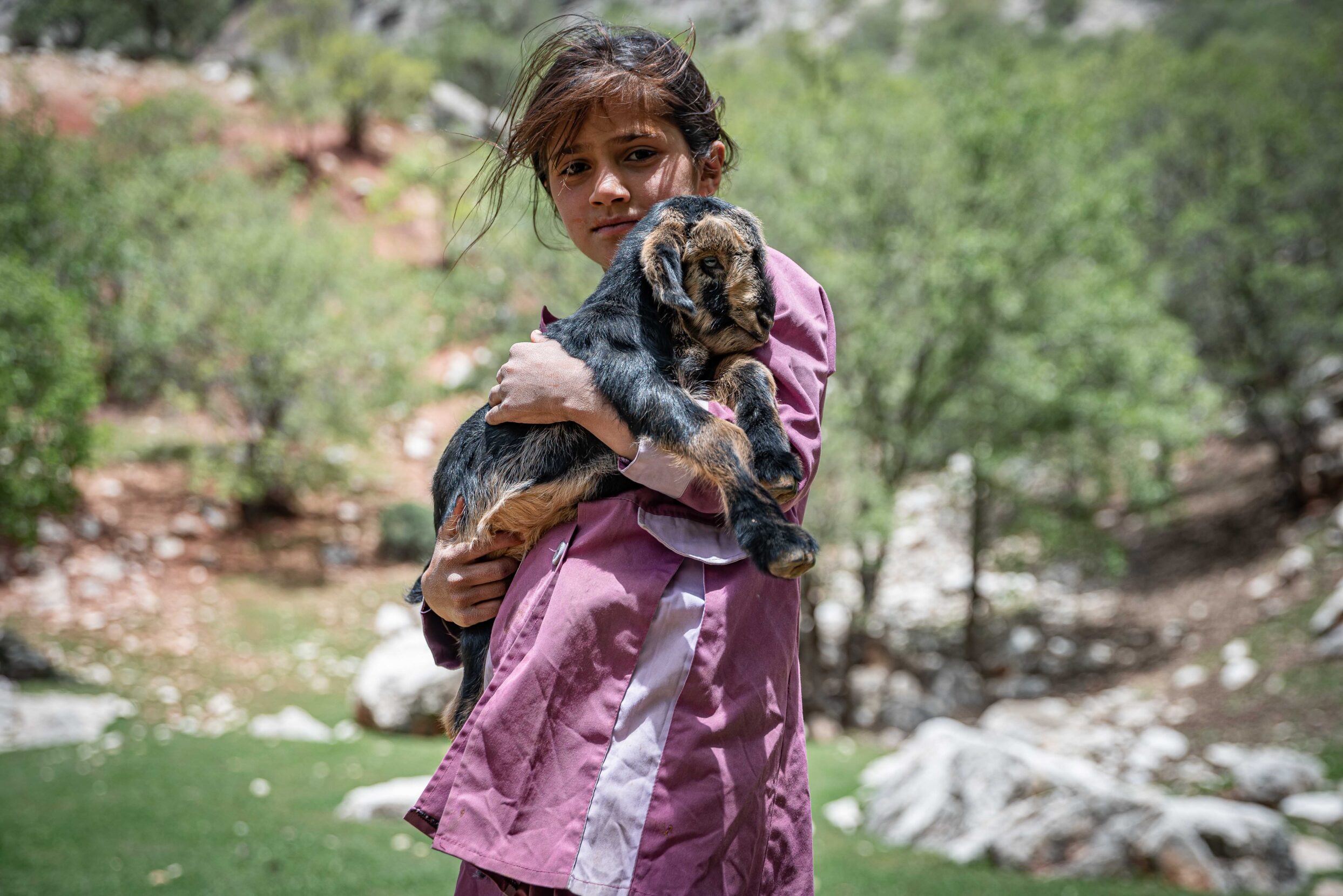
Azita with her favorite baby goat. Though the youngest in her Bakhtiari nomad family, Azita is already helping with daily tasks, from gathering firewood to caring for baby lambs. Photo: Claudio Sieber.
~~
“Titititititi!” (“Come here!”) “Brrrrpsch! … Warch, warch!” (“Assemble and move!”)
Ashkan closes each command with a harsh whistle, and the flock surges forward in a burst of motion. Each vocal cue echoes across the mountains like a code.
Today, we gain altitude quickly. By 10 a.m., we’re at 7,800 feet, edging along a steep, rugged slope. Every step requires pure intuition. Mehran, Ashkan, and Arghavan have long disappeared from view. Young Azita dances past as if the jagged terrain were her playground, flashing me a grin that says, “Keep up, if you can.”
Atop the mountain pass, two vast valleys fall away on either side, the wind cutting hard across the ridge. The entire herd has assembled at the edge of a snow patch clinging to the north face, hesitant to cross. One brave soul inches forward, testing the white crust hoof by hoof while the others hold back, watching. Setareh and Ramezan are still behind, searching for a lost goat, but the descent won’t wait. From across the slope, Mehran shouts for our attention, flushed with excitement, already sliding down the snow in his baggy black Bakhtiari trousers, a baby goat tucked firmly in his arms.
I follow his lead, sliding down 650 alpine feet, smirking the whole way.
Down in the vales, beneath the commanding presence of the Kūh-e Menār massif, a stentorian echo carries from afar. Ramezan is furious. The goat was found, but only after he had to scale the same peak twice, riding a clumsy donkey that kept sliding back down the slope. He shows his frustration by snapping at everyone else: “I’m cold! Where’s the tea? Don’t use that much oil! You think one onion isn’t enough?”
Given the altitude, tonight’s outdoor dorm is particularly brutal. It’s so cold, I keep rolling around to check if my extremities are still attached.
~~
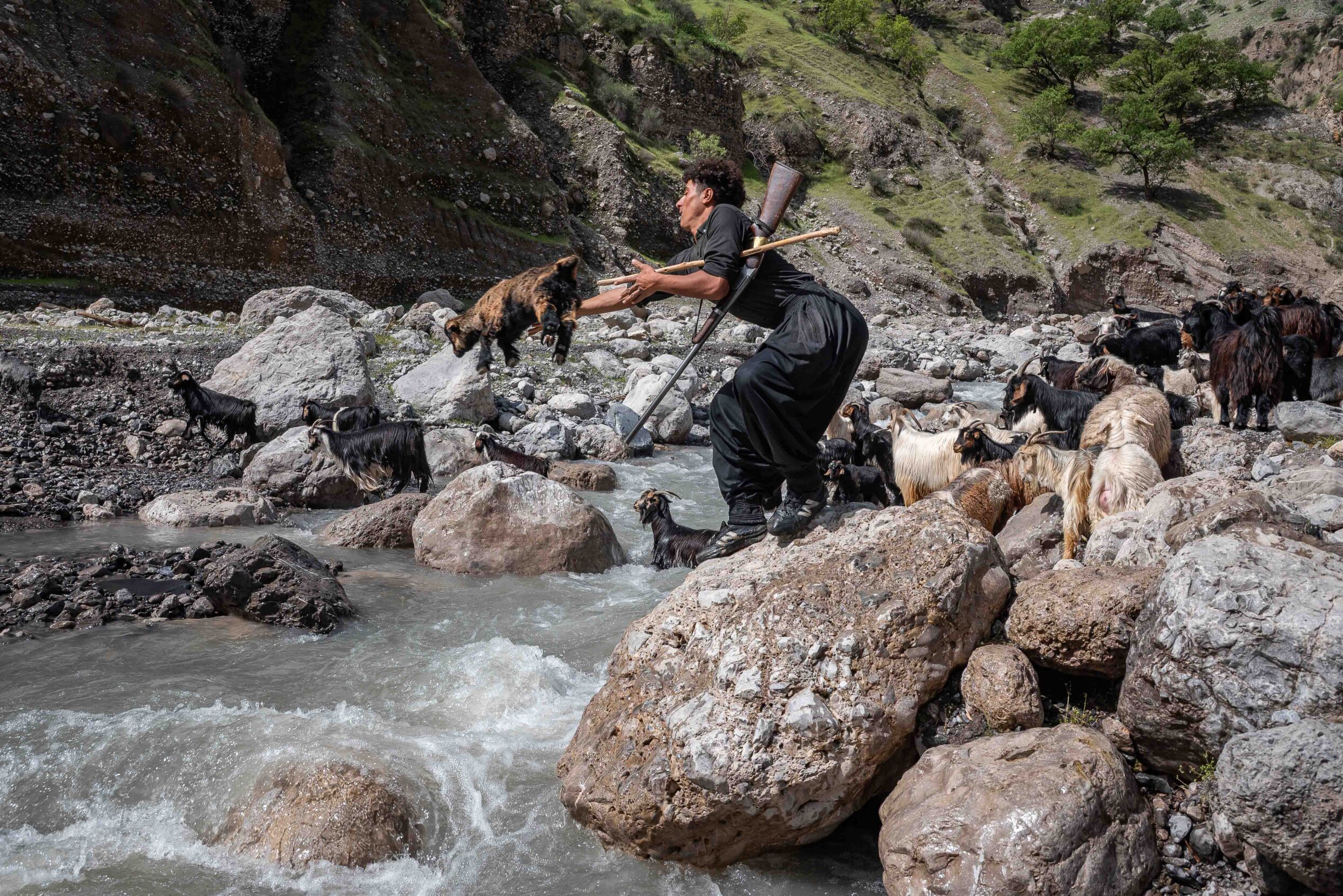
After heavy rains, the family encounters a tributary that is too deep and fast moving for some of the goats to cross alone. So Ramezan, Ashkan, and Mehran (pictured here) toss them across. Photo: Claudio Sieber.
Despite a slight chance of rain, the sky looks clear enough for Ramezan to call a spontaneous departure around 4:30 a.m. Everything is packed in minutes. Before dawn, the trail plunges through gorges, past waterfalls, and into majestic canyons opening toward the next valley.
The fast-moving tributary feeding the Bakhtiari River doesn’t look threatening to humans, but it is running faster than it should for the flock. Ramezan marches straight into the gray-green water, the current hitting his thighs as he keeps pushing, then grabs the first goat under the belly. He swings once and throws it across, where it lands awkwardly, slides, scrambles, and then finds its footing. More goats are flung over, with Ashkan and Mehran stepping in to help, while others make their way across independently, the noise constant — water slapping rock, hooves scraping, bells colliding. A few feet downstream, other nomads cross the main channel high above on a rusted cable ferry that needs two men to steady it, the steel line humming under tension as the wooden planks creak.
Migrations like this once unfolded as entire clans moving together across the mountains.
Ten hours in, without a bite of food and running low on water since three hills ago, we pitch camp for the last time together, mere minutes before the rain commences. We tear into Setareh’s freshly baked noon. Even the doorgu tastes spectacular today. Just then, a rain-soaked Ramezan steps into the tent, warming his worn hands over the fire. He looks at me, tired-eyed, and mutters, “You surely have a more convenient life than us.” There’s no resentment in his voice — just a plain, unfiltered truth. His tomorrow will mirror today, most likely yesterday too, while I’ll return to hot showers, plated food, and a proper pillow.
~~

Setareh crosses a fast-moving tributary with the family’s pack animals. Photo: Claudio Sieber.
Later that night, while Ramezan is out counting goats and sheep, the camp shifts. The noise thins. Setareh sits close to the fire and, for the first time, speaks openly without interruption. She married young, at 15. Ramezan was 18, the son of her cousin — an arrangement that follows Bakhtiari custom, meant to keep land, lineage, and influence within the clan. “Out here, that structure still holds,” she says with a nudge of irony.
Earlier questions directed at her were answered by Ramezan without pause, without ceremony. Now, with him gone, her voice settles into the space he’s left behind. Dreams of the city start to unfold — a small house, maybe, running water, fewer miles underfoot. “After years of raising children on the move, I envision a different rhythm: my husband keeping a handful of animals, myself managing a household that doesn’t have to be packed up at dawn when seasons change.”
Even as she speaks of leaving, her hands don’t slow, kneading dough with the same quiet precision she’s practiced for decades. Whatever life she imagines elsewhere, this one lives in her muscle memory.
When Ramezan returns, counting finished, the moment closes. He speaks of his ancestors, of five centuries of Kooch traced through these mountains. Setareh listens, nods, and pours some tea.
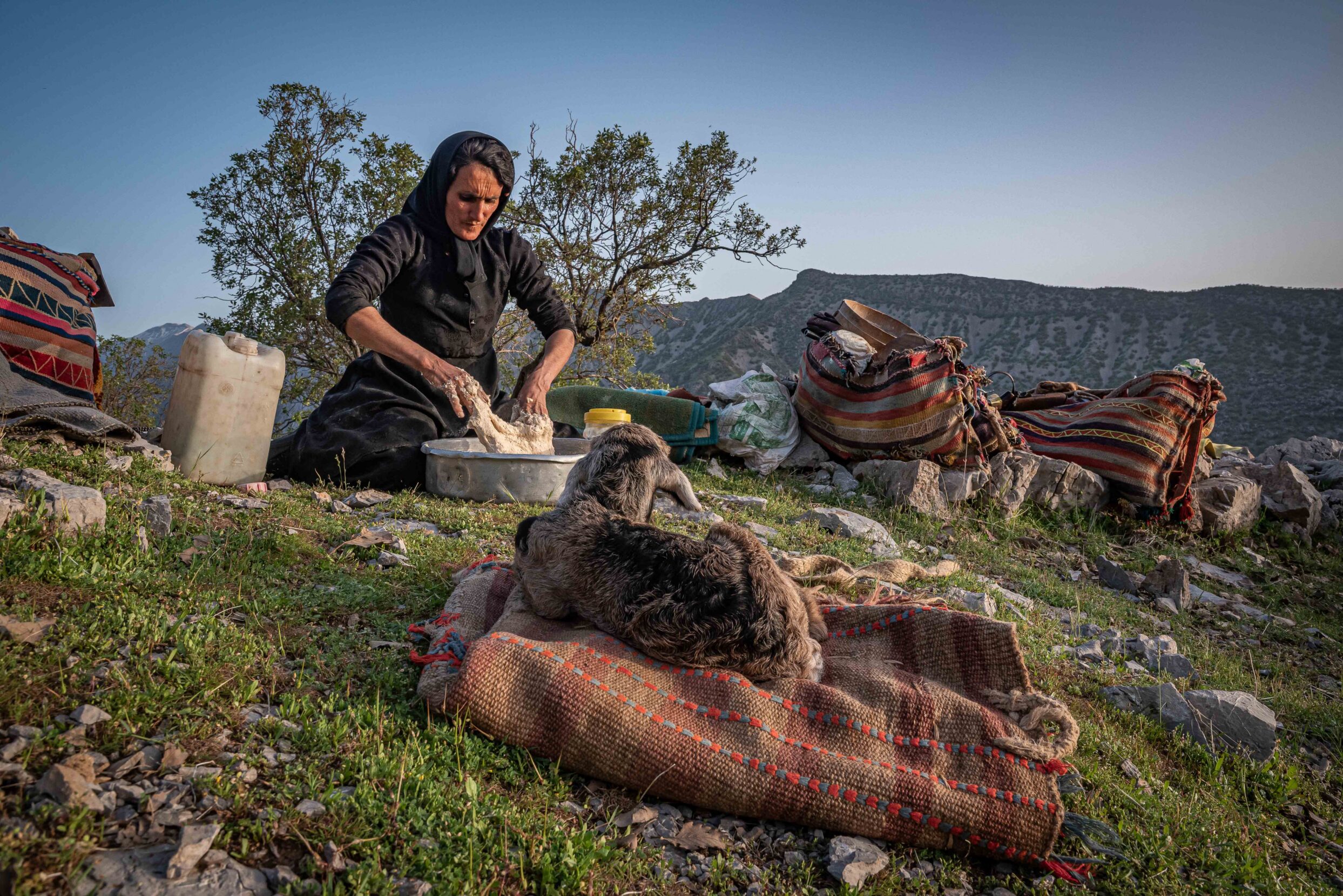
Every day, Setareh kneads dough by hand, preparing the family’s staple: noon, the traditional flatbread of the Bakhtiari. Working with practiced movements, she shapes and flattens the dough before baking it over a simple metal griddle set above an open fire. Photo: Claudio Sieber.
~~
After five days together, we part ways. Ramezan and his family will continue migrating for another two days before reaching their summer pasture, while Moji and I turn back toward Isfahan. A week of vegetarian sustenance has left us hungry for heartier fare, so we decide to stop at a roadside restaurant offering kebab.
We sit down cheerfully. Tea is poured, skewers and flatbreads passed.
Suddenly, the owner steps behind us. He lifts a sheep by the jaw and draws his knife. The animal’s legs buckle. Dark blood spills from its opened throat into a drain just a few feet from our table.
Yesterday, the distance between animal and meal had felt abstract. Yet the heartfelt care for the newborns, the shared movement, and the endless counting of the herd all pointed here, to this bloodshed — to a sacrifice so fundamental it catches me off guard.
The pungent tang of iron mingles with the cooking aromas from the kitchen. I think about all that is given and received — all that is lost and gained — inherent in building a life here, a life anywhere.
For years, I had embraced the idea of nomadism as freedom. But somewhere along the trail, my notion of movement shifted. The romance I had long associated with a life on the go dissolved into a rhythm shaped instead by ancestral obligation, the needs of the herd, and endurance.
~~
Dreams come up … as quiet answers between feeding the fire and wringing water from sleeves.
A few days later, in a neat house in a quiet neighborhood on the outskirts of Isfahan, I meet 30-year-old Mojdeh, who reminisces about her nomadic childhood: “Only winter was rest.” When she was 18, she explains, her parents could no longer manage the migration. “So we stayed. Not because we wanted to — because we had to.”
Ten years later, she married a cousin she barely knew. “In the mountains, we were more free than here,” she says, her eyes filling with tears. “One always has this fantasy about city life… but the reality is different.” Now pregnant and alone in the city other than her husband, she misses the cold mountain air, the sound of relatives around every corner. “Now it’s these four walls crushing me.”
It’s so tempting to romanticize another way of life. We all do it, and the Bakhtiari people are no different. Trying to understand them without facing that truth would be like trying to make sense of Iran without acknowledging its nomadic identity — or describing a tree without its roots. What remains might still stand, but the source of life is hidden from view.
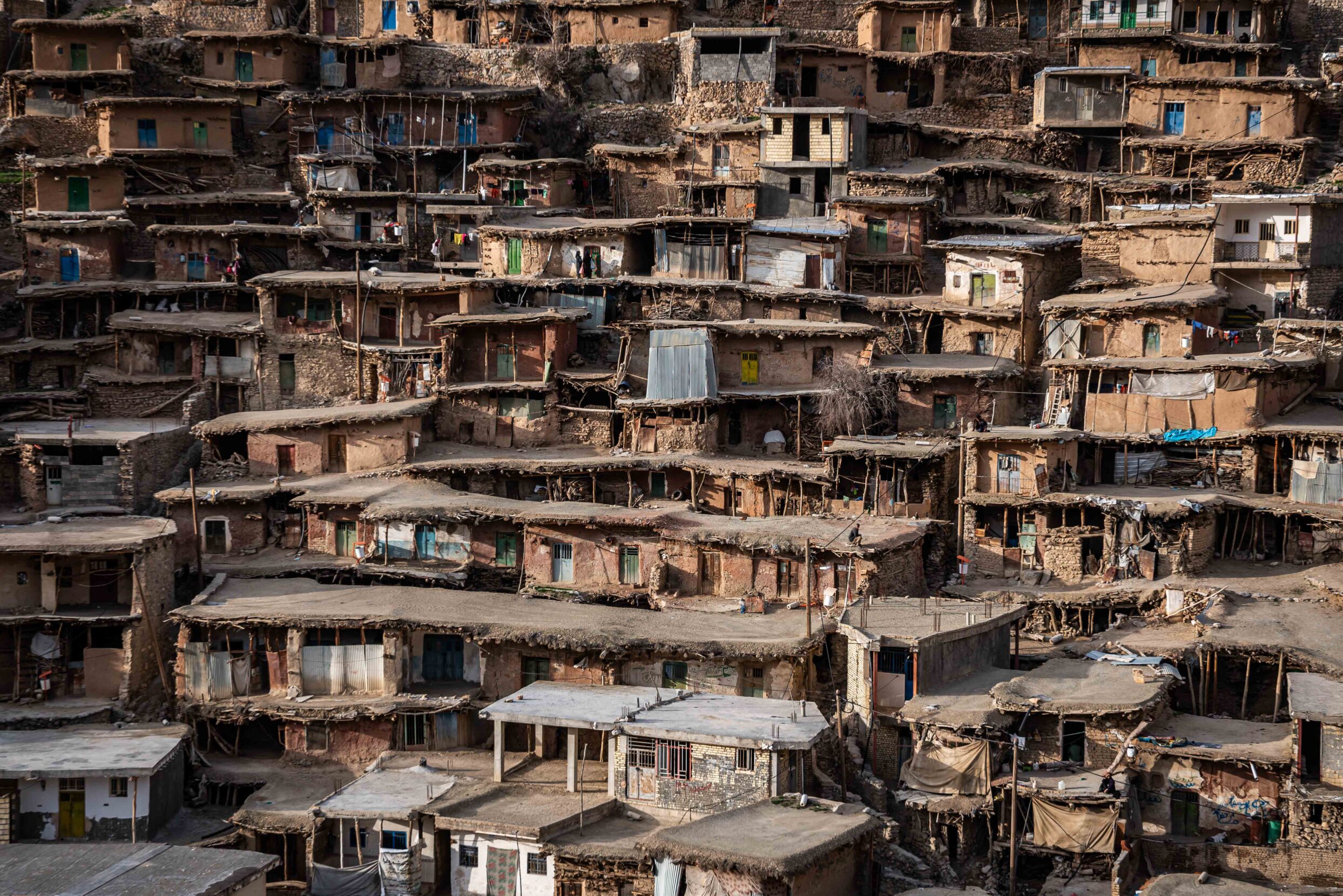
Nestled in the Zagros Mountains, the stepped village of Sar Agha Seyyed (pictured here) has seen a significant shift in recent decades, as Bakhtiari settle here semi-permanently. Whether we be journalists hoping to experience migration, nomads dreaming of cake, or city-dwellers pining for mountain air, each of us carries the rose-tinted nature of yearning. Photo: Claudio Sieber.
Claudio Sieber
Claudio Sieber is a visual journalist based in Siargao, drawn to the fault lines where tradition, identity, and modern life quietly collide.