



Support Hidden Compass
Our articles are crafted by humans (not generative AI). Support Team Human with a contribution!
Fakir Pradhan, 65, had just stepped outside to go to the bathroom. That’s his version of the story. Later, others will say he and his friend, 48-year-old Hadibandhu Bhoi, were drunkenly ambling through fields of rice paddy as they made their way home to Bampa, a tiny village in the Dhenkanal district of the Indian state of Odisha, after a day spent sipping homemade liquor. It was around 6:30 p.m. on August 25, 2025, and night had already dropped like blackout curtains. The only light glowed from fluorescent bulbs above the doorways of distant houses.
The friends crunched through a clump of brush, looking for somewhere to relieve themselves. Pradhan was squatting when Bhoi screamed. Pradhan stood, confused, and then felt “something monstrous” walking toward him. The elephant snaked its trunk around Pradhan’s waist and tossed him. Or maybe the elephant kicked him, or smacked him to the ground. As Pradhan discovered, when you encounter a wild elephant, your mind goes blank.
Afterward, Pradhan lay in the dirt. He rolled over and began to crawl in what he hoped was the direction of home, shouting for help. Pain lanced through his torso. Then he fainted.
~~
A little more than two months later, Pradhan sits on a wooden bed covered by a thin blanket in the front room of his home, wearing a dhoti and a gray-and-purple striped polo. He has a round face and ropey muscles made taut by decades of farm work. An iodine-colored stain leaks through the white bandage wrapped below his left knee.
He pulls out his X-rays and hands them to Susanta Kumar Sahoo, the local government forest officer who, back in August, had sped to the hospital with Pradhan sprawled across the back of his jeep. Pradhan had suffered a broken leg and five cracked ribs that forced him to grimace through just about every breath for weeks, but Sahoo calls him a “lucky, lucky person.” Unlike Bhoi, Pradhan had survived.
~~
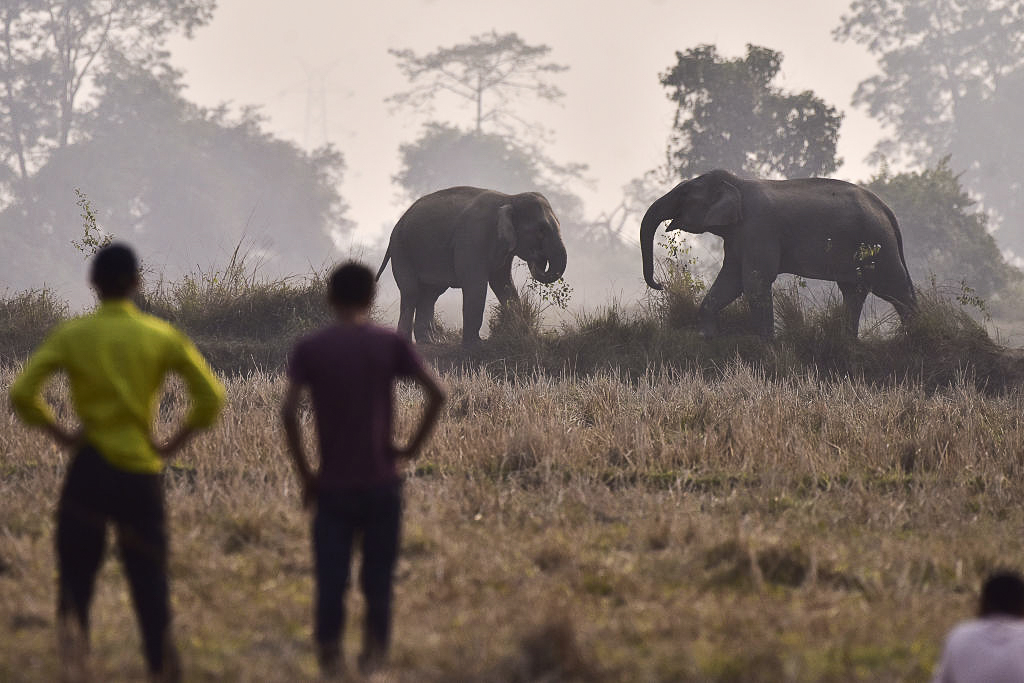
Villagers observe a herd of wild elephants that gathers near a field in search of food in a village in the eastern Indian state of Assam. Wild Asian elephant (Elephas maximus) populations have decreased by as much as 50% over the last three generations. India is home to some 60% of the remaining members of this endangered species. Photo: Anuwar Hazarika / NurPhoto via Getty Images.
Elephants and people have always lived side by side in India, but at the start of the 2010s, they began to kill each other in numbers that looked like statistics pulled from a low-grade war. Elephants killed 7,868 people from 2009 to 2024, according to the Indian government — with the annual average increasing over time. Nearly 70% of those people were killed in a collection of four states in eastern India, including Odisha. The mortalities go both ways: During that same period, human-elephant conflict was responsible for the deaths of 1,653 elephants.
Nowhere has the danger been more concentrated than in Dhenkanal.
~~
They’re often forced to stand there while villagers shout at them to do something, because what is there to do?
Two minutes after leaving Pradhan’s house, Sahoo is in the passenger seat of a jeep, traveling through a night as dark as the narrow road, when up ahead he sees a crowd of about 15 people standing behind an electric fence and staring beyond a paddy marsh at a line of trees. Flashlight beams brush along tree trunks and up to the canopy and back, whipping like stadium lights before a concert — until suddenly they converge on a single elephant, standing still as a boulder. A man in military camouflage blares a siren through a bullhorn.
This is step one in trying to ward off an elephant, a task that keeps farmers in Dhenkanal up every night for months as they wait for the right moment to harvest their fields of paddy, mango, and cashew.
Elephants are usually migratory creatures, but the roughly 290 that live in Dhenkanal have found that staying has, in many ways, made their lives easier. Paddy is the district’s primary crop, and it’s loaded with far more nutrients than what elephants can scrounge up in the forests. Rice also has to be swamped with water in order to grow, which gives elephants plenty to drink. Twenty of them can eradicate an acre of paddy in a day. Over a harvest season, they can bankrupt a village.
The siren wails for two, three, four minutes, but the elephant seems unbothered. He unfurls his trunk, uproots a shrub, and stuffs it into his mouth. Then, two more elephants show up.
The farmers decide to try something more. A 48-year-old man named Santosh Behera lights a torch and passes through a narrow gap in the fence, followed by the man with the bullhorn and two others wielding flashlights. Behera and the bullhorn-wielding man take firm but cautious steps forward until the elephants are merely 15 to 20 meters away. The siren yowls like an ambulance. The torch quivers, washing the elephants’ gray skin with a flickering orange glow. Two of the animals walk off. Behera steps closer. After maybe 20 seconds, the tusker turns to look at him.
“It feels like my heart would stop,” Behera remembers. “My heart comes out from my body and starts trembling.”
~~
A few minutes into the winding but well-paved road that peels off the highway toward Bampa, the air fogs into what seems like cigarette smoke. At dusk, the sun oozes through the haze like a dot of blood on a T-shirt. Dusty grit coats the leaves of every plant, sapping the world of color. Hills of rubble line the road. Idle trucks wait for their next load in a line that won’t end until the land is stripped of everything but dirt.
Something ominous is spreading.
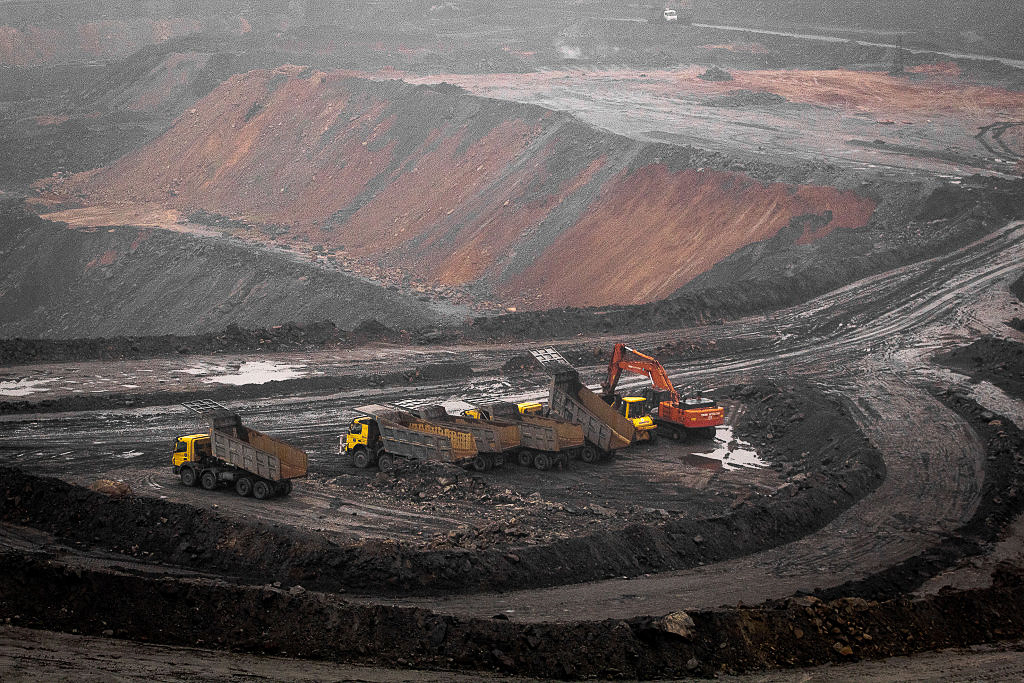
In the state of Odisha, idling trucks are harbingers of destruction. Photo: Yousuf Sarfaraz / SOPA Images via Getty Images.
~~
Elephant matriarchs used to step fast and nimbly around the thick trees and knotted brush of Odisha’s forests, leading their herds in search of food along routes they learned from matriarchs past, walking the same paths year after year. But now, construction on a massive scale has turned their regular commute into a game of Chutes and Ladders from hell.
There’s no need for a matriarch to take her time when she knows the way, but lately the terrain she’s used to no longer looks like she remembers. Strange, growling yellow creatures knock down trees and gouge enormous holes where her herd used to spend their evenings. She guides her family in a new direction, but the trees end abruptly at a thick black streak, where hunks of metal shudder past at speeds faster than she can even run. She pauses, silent, and her herd does the same. They stare out at the road, shrouded by the last line of the forest, so still that their legs blend in with the trunks of trees. The matriarch watches, waits. When at last it’s quiet, she eases onto the asphalt.
After several crossings, she learns it’s easiest to move at night, when there are fewer speeding obstacles. She makes the necessary edits to her mental map, which she now has to do all the time. These days, she moves tentatively, whipping her head around at the sound of a snapped branch or a wild boar rummaging in the brush, noises she hardly used to notice. The matriarch trudges into an open field, leading her family from one canopied patch to the next, and discovers the ground is covered in enough paddy for the entire herd. Another mental note. She’ll be back.
The matriarch has seen humans before, but now she walks past them on new swirls of asphalt that loop through crops and trees, or she looks down and sees them stepping through bushes that line the road. People have never scared her before. They’re so small. But she used to know when to expect them, and now they pop up anywhere. Sometimes they get too close to the herd’s calves. Sometimes they stand in front of her, waving a stick of fire. This makes her nervous, annoyed, even angry. She doesn’t understand what they want, and so, sometimes, she charges.
It doesn’t help that elephants can’t see very well. They are more than smart enough to get around electric fences, which are illegal, but only once they know the fences are there. Pressing ahead on an unfamiliar route in the middle of the night, they sometimes trip on a wire, and the jolt can kill them.
Each death of an elder elephant comes with a loss of institutional memory, according to Haree Krishna, who works for the Zoological Survey of India and is studying for a doctorate in elephant conflict and ecology. Some scientists believe elephant herds have become more erratic as a result. Without many matriarchs to guide them, the young ones may have started to probe all over Dhenkanal, and now farmers can find them munching through their fields on any given day.

Two Asian elephants, one younger and one older, get close to a body of water in Kaziranga National Park, Assam, India. Throughout eastern India and beyond, the premature deaths of older elephants by human causes have, according to some scientists, led to erratic herd behavior. Photo: Sandesh Kadur / Alamy.
~~
Sumit Kumar, who was Dhenkanal’s head forest officer until recently, was in charge of making residents feel protected, but he also believes that “the notion that [elephants] can’t be a part of the landscape is not acceptable.”
“The future of wildlife,” he said, “is how you manage conflict.” Which is exactly what Dhenkanal’s forest department is trying to do.
On a midnight ribbon of road under a lightless sky last November, a group of Dhenkanal forest officers set a small drone on the asphalt and, with a whine that sounded like a distant chainsaw, launched it straight up in the air. Hovering above them for a moment, its red and green lights twinkled like Christmas decorations against the tar-black canvas, and then, with a buzz, it shot off in search of a tusker that officers believed was nearby. Now that it was dark, their thermal-imaging drone was their best shot at spotting him.
Everyone crowded around the pilot, who held a Nintendo Switch-like device with a bird’s-eye view of the forest. Warm-blooded animals show up well against a landscape that gets much cooler after sunset, and everyone was trying to spot a white lump so big that it had to be an elephant. The drone’s hum faded until the only sound was shoes scuffing the road’s graveled edge. Officers mumbled to themselves, pointed to something on screen, and told the pilot to go this way or that. Ten minutes went by, then 20. The drone passed over a smattering of bright blobs, but they were far too small. Probably boars.
The pilot told the drone to come back. It hummed overhead and touched down with a light clatter. That was it. Everyone shuffled toward their respective white jeeps parked along the roadside. And then in the distance, someone began to wail. Or maybe it wasn’t a person. It was too consistent. Was it the elephant alarm?
Suddenly, everyone was sprinting, jeep doors thunking closed as people piled inside. The drivers sped toward the siren and, in a few seconds, skidded to a stop in front of five or six volunteers, all of them howling or waving their flashlights at a copse of trees some 50 meters away. For a moment, nothing happened. Then from behind a tree emerged two enormous white tusks that quickly slid back into the brush.
Something people don’t understand about elephants, said Kumar, is that they are mostly silent. “We’ve had numerous operations where you don’t hear a single whisper and suddenly see an elephant standing 15 meters from you,” he said.

An Asian elephant in a forest in eastern India. Despite their enormous size and ability to trumpet loudly, elephants often move surprisingly quietly. Photo: Subhash Sharma / Zuma Press via Alamy.
~~
Forest departments across India are underfunded and understaffed. In Kumar’s former district, there aren’t nearly enough officers to keep up with the region’s traveling herds, and the officers who do work in Dhenkanal often have to sleep in their jeeps several nights a week so they can drive off as soon as they get a call on the radio or hear the shrieking elephant alarm.
Radio collars on the matriarchs and tuskers would allow the department to keep track of most elephants via GPS. But at $5,000 apiece, they are out of the question. More thermal drones would also help, but they go for around $2,200 to 3,200. The department has instead installed around 160 low-cost sirens across Dhenkanal that can be heard from about a mile away. Each is attached to a light pole and comes with its own telephone number that anyone can call to set it off. Officers have enlisted volunteers to help keep watch at night, and these groups all message via WhatsApp. They’re paid the equivalent of $11 a month.
For forest officers, there’s a sense of futility. People in Dhenkanal know the siren is a warning to stay inside, but many still try to shoo elephants away from their crops. When red-eyed officers roll up to see how they can help, they’re often forced to stand there while villagers shout at them to do something, because what is there to do?
“If you know anything about elephants,” Kumar said, “you know they are extremely difficult to control.”
Matriarchs protecting their herds are one thing, but male tuskers raging with hormones are the most terrifying. Tranquilizer guns only have a range of about 40 yards, and so officers sometimes find themselves trudging through knee-deep muck for several minutes just to get close enough to take a shot.
“If the elephant charges,” Kumar said, “you’re gone.”
And hitting the elephant isn’t some great success. Officers then have to load a 6,000 to 12,000-pound creature into the back of a truck and cart it somewhere else, all while knowing that elephants have an extraordinary sense of place and will likely return.
According to Kumar, half of Dhenkanal’s officers leave after one or two years.
The forest department’s budget and staffing are overwhelmed, but even if they weren’t, their current focus would still leave them battling symptoms instead of the cause. Because none of these efforts addresses the true reason people and elephants have found themselves at war here.
~~
Something ominous is spreading.
Between the mid-1990s and early 2000s, as India’s economy became more export-friendly, conglomerates such as Tata and the Aditya Birla Group started mining eastern India’s iron and stone and shipping it to China, which was then experiencing an infrastructure boom.
These firms, always in need of new territory to excavate, used their newfound wealth to pressure India’s politicians to ignore environmental laws, which opened the region’s forests to quarrying. By the 2010s, the need to keep up cash flow had driven mining operations into woodlands surrounding the districts of Angul and Dhenkanal — prime elephant territory, already being sliced up by irrigation canals the government began to dig in 2011.
Mining companies can usually slide into new areas by convincing locals that their presence will benefit them, because in at least one enormous way, it often does.
“In areas where mines are present, there is no other significant job,” said an assistant manager at the Adani Group, a sprawling Indian conglomerate that controls a significant portion of the nation’s mines. Even local farmers, he said, often abandon their fields for the relative stability of a daily wage, though that tends to happen in regions where people have long tried to coax crops from dry, rock-studded ground that looks nothing like the fertile fields of Angul and Dhenkanal. (The manager requested his name not be used in the story, as he says Adani employees are not allowed to speak to the press.)
As bulldozers and excavators rumbled in, pits began to hollow out the region as if it were being blasted by a slow-motion artillery barrage. Mines leaked toxic waste into rivers, groundwater, and the surrounding soil, withering lush forests into ashen, barren land. With their habitat either chewed up or eradicated, elephants set out to find new territory.
“Earlier, [conflict] was almost absent,” said Biswajit Mohanty, secretary of the Wildlife Society of Orissa — using Odisha’s former name. “Now it has become very acute.”
The society conducted a satellite image study of Angul and Dhenkanal and found a tenfold increase in quarries between 2011 to 2021. Mohanty thinks it’s hardly a coincidence that the region’s sharp rise in human and elephant deaths happened over that same period.
~~
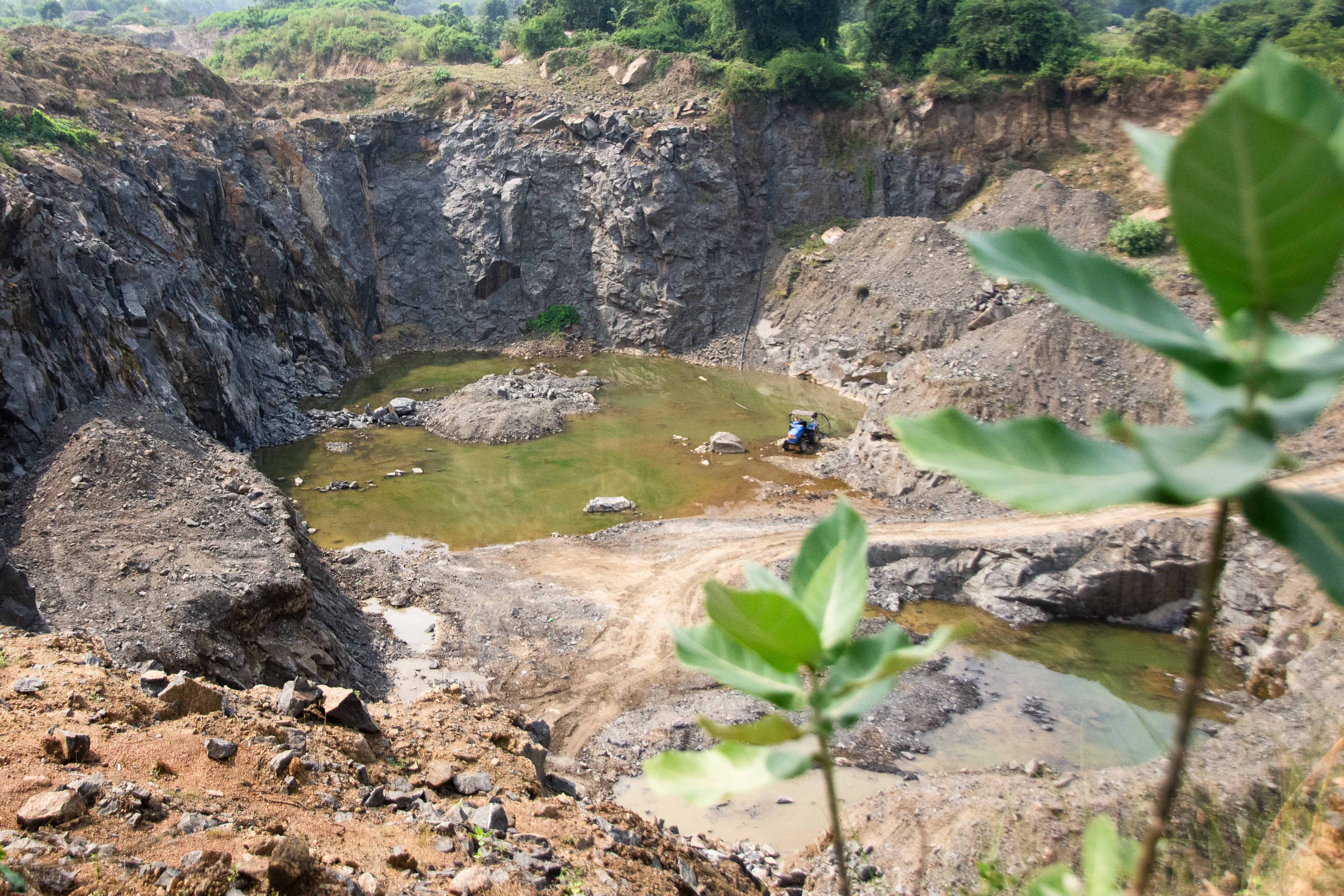
In Odisha, green water pools at the bottom of a mining pit. As mining operations continue in the area, elephant habitat continues to decrease. Photo: Colin Daileda.
Twenty minutes outside Bampa, just off a short road that does its best to give drivers the experience of a cowboy riding a bull, the ground opens into a gaping hole edged with dark walls that slice more than 300 feet into the earth. Ponds of green and brown water pool at the bottom, bubbling up from cracks in the ground.
Right next to this idle stone mine is a flat patch of land that instantly seems out of place. Low, spiky, thin-trunked trees poke from the ground like green fireworks, noticeable because they’re not growing anywhere else. They’re an invasive species easily chopped down for firewood, and they have a tough time staying upright through a strong storm. Mining companies are legally required to restore landscapes after their quarries are used up, and workers had planted them atop a mountain of packed rubble, though no self-respecting biologist would argue that this former quarry had been restored.
Several major mining companies highlight their own restoration efforts. But ecosystem restoration is almost unimaginably complex. Soil and vegetation differ from one chunk of ground to the next, explained Krishna, the scientist from the Zoological Survey of India. Even scientists who study these areas may not know exactly what kinds of soil and plant life exist in one part of the forest as opposed to another. If mining companies were actually going to rejuvenate landscapes, they’d have to pay for expensive and lengthy studies just to understand how to do it, then they’d have to pay scientists to monitor their work over the 10 to 15 years it would take for the ground to look anything like it had before. It’s much cheaper to just fill a quarry with dirt and scatter easy-growing seeds — though many firms don’t even do that. Once a mine is used up, they just say that it isn’t, allowing them to ignore restoration.
Indian mining interests wield enormous influence. One of Tata’s offshoot brands is the main sponsor of the New York City Marathon. Prime Minister Narendra Modi was a guest at a Bangkok celebration of the Aditya Birla Group’s 50th anniversary in 2019. Trying to stop them from digging is akin to trying to stop Amazon from delivering packages.
~~
“My heart comes out from my body and starts trembling.”
If a war must be fought, perhaps this is the one that ought to be. It would be a war where government officials are willing to engage in a more daring battle, one that pits them against industry. They’d have to shift their focus from attacking symptoms to going after what is really forcing humans and elephants to slaughter each other.
While landscape restoration is far from a perfect solution, Raman Sukumar, a zoologist and ecologist at the Centre for Ecological Sciences in Bengaluru, thinks it’s a feasible one that would provide people and elephants with enough space to free themselves from constant conflict.
Mines and their roads split forests into fragments, like a panel of glass dropped on the floor. Reconnecting habitat is a bit like gluing the glass back together: It won’t ever look the same, but it’ll serve roughly the same purpose.
“If you don’t do [landscape restoration],” said Rajiv Ranjan, a former principal chief conservator of forests for the state of Karnataka, “these kind of conflicts are going to remain.”
It’s “very, very critical” that forest officers enforce restoration on the ground, Sukumar said. However, doing so is risky. Sahoo, the Bampa-area forest officer, is well known to everyone in his territory, but miners still stop by whenever he visits even one of their stagnant quarries, and “mining mafias” across India are linked to a lot worse than checkups.
Though they’re called mafias, they’re more like mobs of men intent on keeping scrupulous eyes away from illegal or quasi-legal digs, and they’ve been tied to the intimidation and murder of activists, journalists, and forest department officials across India. In 2025, in the southern Indian state of Tamil Nadu, anti-mining activist Jagabar Ali was riding his motorcycle home on a quiet road when he was run down by an oncoming truck. In January, an alleged member of a sand mining mafia in the northern Indian city of Dholpur plowed into forest officer Jitendra Singh with a tractor as Singh was scoping out an illegal mine, killing him.
Of course, Dhenkanal’s mines already cause plenty of death without any mob violence, but it would be nearly impossible to hold operators liable when an elephant tramples a villager or gets electrocuted while searching for something to eat. Still, Upasana Ganguly, who heads wildlife corridor projects at the Wildlife Trust of India, a nongovernmental organization, thinks politicians need to hold mining companies accountable if people and elephants are going to reach some kind of détente.
“In some areas, obviously, they need to enforce things more,” she said. “As NGOs, we will try, but the bigger responsibility relies on the government.”
Peace requires political will. Where that will meets resistance, peace may even require conflict.
India’s wildlife situation is unique. Nowhere on Earth are this many people packed into such a small space with this many elephants. And the clashing demands of environmentalists, mining companies, real estate developers, and different levels of government often prevent negotiations from turning into anything more than meetings. That said, if anyone does decide to pry a real restoration budget from corporate pockets, they’ll have more than enough legal backing. Courts across India have ordered the replanting of woodlands all over the country, but justices can’t march Adani, Tata, and the Aditya Birla Group out to their barren mines and force their employees to start sprinkling seeds.
Until someone does, the loss of life — whether human or elephant — gets chalked up to a disingenuous cliché: the price of progress. But what might it look like if the companies paid a price for progress, too?
Colin Daileda
Colin Daileda is a freelance journalist in Bangalore, India, who writes about climate change and environmental degradation, but really he is mostly a person who eats doughnuts and plays basketball.