
Support Hidden Compass
Our articles are crafted by humans (not generative AI). Support Team Human with a contribution!
Yvonne looks up at the broken facade of the cliff. A white helmet covers her brown hair, and worry etches her face. Petite and fit, she hopes to scale this old smuggler’s route into Switzerland on France’s eastern border but finds herself holding back out of fear.
She can’t delay any longer. After securing her climbing harness, she grabs a hanging rope and begins a slow ascent, the treads of her boots gripping mossy limestone outcroppings. I watch my wife from above, her face intense and focused as she mutters, “I can do this. I can do this.”
Eighty-two years earlier, Yvonne’s mother, Edith, set out to climb this same smuggler’s route with blistered feet, ill-fitting shoes, and no ropes to hold on to. Edith had been running for her life: a frightened 18-year-old traveling with false identification and evading German patrols. As she faced the cliff, Edith heard rustling leaves from below and turned to see a man climbing toward her. Gestapo! She threw herself behind a rock in terror. What had happened to the boy posing as her brother, and the woman who had promised to guide them to safety?
~~
“There is no one with whom I am able to converse so freely as with you, my diary, and especially here, now, where I am so motherless and alone.” — Edith Moser, December 29, 1943
Edith wrote these words the day after her 19th birthday, five years into a nightmare that no one, let alone a child, should have to endure — yet she did.
Edith’s journal is still in remarkably good condition, considering all it has been through. It’s simply made: lined paper bound in a plain, orange-brown oak tag cover. Edith wrote TAGEBUCH (“diary” in German) and her name on the front in the decorative way any teenage girl might. The paper is yellowed but still flexible and strong.
Growing up in northern Germany, Edith’s Jewish family had been affluent. Her father had been a piano prodigy and, later, head salesman for his family’s paper company. Her grandfather was a respected attorney, and her great-uncle owned a famous brewery.
Edith adored her older brother Kurt. He was tall and gangly, wearing wire-rimmed glasses and an easy smile. While Edith loved to swim and play tennis, Kurt preferred reading and playing his harmonica.
The Mosers lost nearly everything to the Nazi regime — their freedom, dignity, even their citizenship. After Kristallnacht in November 1938, Edith’s parents made a heart-wrenching decision, one which I suspect they regretted for the rest of their lives: They sent their children into the care of the Committee for Assistance to Jewish Refugee Children in Belgium, hoping to protect them while awaiting scarce U.S. visas. Edith was just 14 years old.
Miraculously, visas arrived in July of 1939, and the parents sailed from Germany to England, intending to collect their children and continue on to the States. They had open tickets for the Cunard White Star ships sailing from Liverpool to New York.
But Britain declared war a couple of months later on September 3 and borders closed — leaving Edith and Kurt stranded in Belgium.
~~

Edith Moser loved to swim. In this photo from 1941, she floats in a swimming hole near the grounds of the Château de La Hille in the Ariège region of France. Photo: Courtesy of the United States Holocaust Memorial Museum.
I never met Edith. She died of cancer in 1989, two years before I met Yvonne. I only know Edith through her writings and Yvonne’s memories. She was a force to be reckoned with: petite, athletic, and outspoken, even blunt. She had a strong German accent but loved languages and passed that passion on to Yvonne, who jokes that her mother taught her French “in the back seat of a car.” When Yvonne was a girl, they sometimes laughed themselves into a heap of teary giggles.
Sometimes, at the kitchen table after breakfast, Edith would tell Yvonne about her experiences during World War II and about the horrors of the Holocaust: death camps, happy marching music, Dr. Josef Mengele’s medical experiments.
Yvonne was too young to process what she heard, and her mother’s trauma became her own. Years after her mother’s death, she wrote:
Mother, I see the world through your eyes —
horror, fear, a world gone berserk.
And I, daughter of a Holocaust survivor,
have never lived through a war
but I carry the memories with me.
Yvonne struggled with questions she couldn’t answer: How could people commit such atrocities? And why didn’t anyone try to stop them?
She worked hard to come to terms with the grief and anger she’d inherited, but the need to distance herself from her mother’s past remained. When I planned a trip to France to research her mother’s wartime experiences there, Yvonne didn’t want to join me.
When I brought up the idea, she replied, “I heard about it my entire life. I’m done!”
~~
Her only hope was to jump.
In group homes just outside Brussels, Edith and Kurt awoke at dawn on May 10, 1940, to the thunder of bombs dropping on the city. Looking out their windows, they would have witnessed a sky filled with the white parachutes of German paratroopers.
Their Belgian sponsors evacuated them by train in cattle cars, on a multiday journey to southern France. Along with about 90 other children, Edith and Kurt eventually found themselves in the farming hamlet of Seyre, where they would live in a donated two-story, unheated brick barn previously occupied by goats.
A month into their stay, after France fell, Seyre became part of “Free France,” controlled by France’s collaborationist government-in-exile, based in the city of Vichy. Germany requisitioned most crops, milk, and meat to feed its military machine. Seyre’s poor farmers barely had enough food for themselves, let alone to share with a hundred refugees.
Led by an idealistic Belgian communist, the children learned to work together. The older ones, like Edith and Kurt, Les Grands, cared for the youngest, Les Mickeys, named for Mickey Mouse. Still, Edith and the other children spent nearly a year sleeping on dirty straw, eating cornmeal gruel almost exclusively. Later in life, the thought of eating polenta turned Edith’s stomach. They struggled with malnutrition, skin sores, lice, and jaundice. To make things worse, Edith learned in a letter from her mother that her father, who had been arrested in England and put aboard a ship bound for Newfoundland with more than 1,000 other internees, had drowned in the North Atlantic.
During the record-cold winter of 1940-41, the outlook for the children was grim. But the Swiss Red Cross, Children’s Aid (Secours Suisse) began bringing clothes, powdered milk, and, occasionally, rounds of cheese — gifts that likely saved some of the children from succumbing to hunger, disease, and cold.
~~
As I stand in the barn’s lower level in September 2025, I admire the colorful, Disney-inspired images painted by Les Grands that still decorate the chipped plaster walls. Yvonne stands beside me, taking photos. I was thrilled — and relieved — when she decided to join me on this trip, smiling and saying, “You’ll need a translator.”
The barn is now owned by two young families who converted the upstairs into beautiful apartments for themselves, but they have preserved the lower level. Outside, on the old brick wall, a sign reads, “Here in 1940 and 1941, one hundred young Jews fleeing the Nazi regime were sheltered by the de Capele family of Hautpoul, in collaboration with the people of Seyre.”
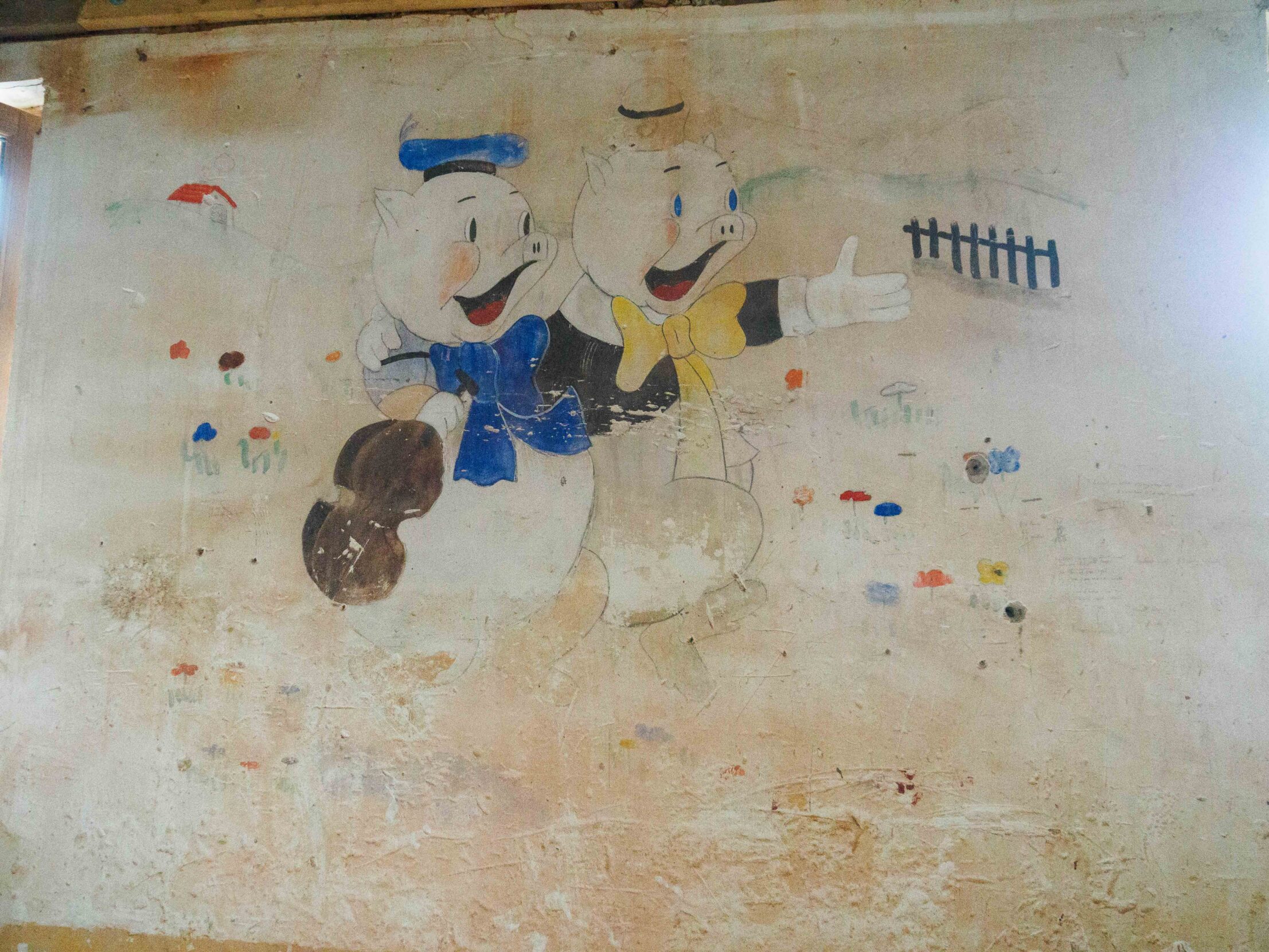
In Seyre, France, nearly 100 WWII refugee children found shelter in an unheated brick barn, where this mural has been preserved. The youngest children were called Les Mickeys, after Mickey Mouse. Photo: Mike Bernhardt.
~~
Farmland and green rolling hills dominate the Ariège region of France near the Pyrenees, about an hour’s drive south of Toulouse. As our car turns down a long, tree-lined driveway, I glimpse the turreted towers of Château de La Hille — a medieval castle turned bed-and-breakfast. My skin prickles. Yvonne says only, “This is weird. This is really weird.”
The château’s current owners also manage a nearby museum dedicated to its history. In the spring of 1941, in this once-abandoned castle, the Secours Suisse found a new home for Edith and her fellow young refugees.
Here, the children began a relatively idyllic life learning French, English, and mathematics. They had proper beds and ate nutritious food from a football field-sized garden. Yvonne and I have a photo of Edith smiling as she floated on her back in a nearby, tree-shaded swimming hole, and another of young boys engrossed in a game of tug-of-war.
But the photos don’t show the anguish the children felt over their parents’ fates as more and more of their letters to Germany were returned, stamped: “Departed without leaving a forwarding address.” Nor can we see how they had become family to each other.
Then in August 1942, two dozen armed gendarmes — French police — arrived before dawn to arrest everyone over the age of 16.
~~
I, daughter of a Holocaust survivor, have never lived through a war but I carry the memories with me.
As the colony’s Swiss director stood helpless, the gendarmes loaded nearly four dozen of the La Hille children at gunpoint into buses and took them to a nearby concentration camp called Le Vernet. Edith’s older brother, Kurt, was among them.
Remarkably, Edith wasn’t. She happened to be visiting another Secours Suisse camp on the Mediterranean coast, where she likely volunteered to help care for orphaned infants.
Thousands of Jews from across France were being gathered, at Germany’s request, into similar camps to await deportation. The barracks around Kurt and his companions were filling with men, women, and children.
The La Hille refugees were released thanks to the efforts of the Secours Suisse, but not before watching the other prisoners being loaded into cattle cars.
According to The Museum of Friendship, 220 people, including 46 children, were deported from Le Vernet to Poland that day. None of the children survived.
~~
My training in grief support — I am a certified grief educator and a grief support volunteer — has helped me to understand that when Edith told her war stories over and over again, she might have been trying to process her trauma. When searchlights used for advertising crisscrossed the sky above her Northern California town, she experienced visceral terror, likely a symptom of post-traumatic stress disorder. Fortunately, Edith did find a good therapist near the end of her life, a woman who helped her begin to heal.
In the last few years, I’ve also come to understand why I have lived with a vague sadness since childhood, and why I have always been drawn to stories of grief.
My Paris-born mother was 12 when Germany invaded France. She and her Polish-Jewish parents also fled to the south — sometimes safe, sometimes disappearing into the forest for days to avoid German patrols. Unlike Edith, my mother didn’t talk about her wartime experiences until I was an adult, and even then, she shared little. Yet I think I inherited her trauma anyway.
Telling Kurt and Edith’s stories is a way of giving voice to what I carry in myself.
~~
Edith adored her older brother Kurt. He was tall and gangly, wearing wire-rimmed glasses and an easy smile.
After the Le Vernet incident, illusions of safety within the castle vanished. And once Germany took control of Vichy France in November 1942, danger increased exponentially. Kurt, 20 years old and in hiding on a nearby farm, needed to escape.
In June 1943, a Spanish woodcutter referred Kurt to a passeur — a smuggler — to guide him and three other young men, boys really, over the Pyrenees into Spain. The passeur was expensive; the border was so thick with German patrols that others wouldn’t even consider the job.
They gathered one night in a nearby village and began walking south, hoping for freedom, knowing their lives depended on the instincts and trustworthiness of their guide.
~~
Six weeks earlier, 26-year-old Anne-Marie Piguet had arrived at Château de La Hille as a caregiver for the children.
Anne-Marie grew up in the Risoux forest, a vast border region on the Swiss side of the Jura Mountains bordering France. Her mother was devoutly Protestant, her father a forest inspector who monitored logging and the health of what she called “the magical forest … where the trunks of the spruce trees stand like the pillars of a cathedral.”
Anne-Marie questioned her family’s religious beliefs, but not the values they’d taught her: kindness, respect for people different from oneself, putting moral duty above legal duty. Her desire to help displaced French children brought her to the Secours Suisse as a teacher and counselor.
Weeks after Anne-Marie’s arrival, a scrawled postcard arrived at the château that would change her life:
“Our smuggler was a dirty traitor,” it read. “After fleecing us, he delivered us to the Gestapo. We are on our way to Drancy [Germany’s primary transit camp for deportees, just outside Paris], and from there… Our final greetings to everyone at the château.”
It was signed Charles, Kurt, Werner, and Fritz.
All four of the boys were ultimately transported to Auschwitz. Only Werner Epstein survived.
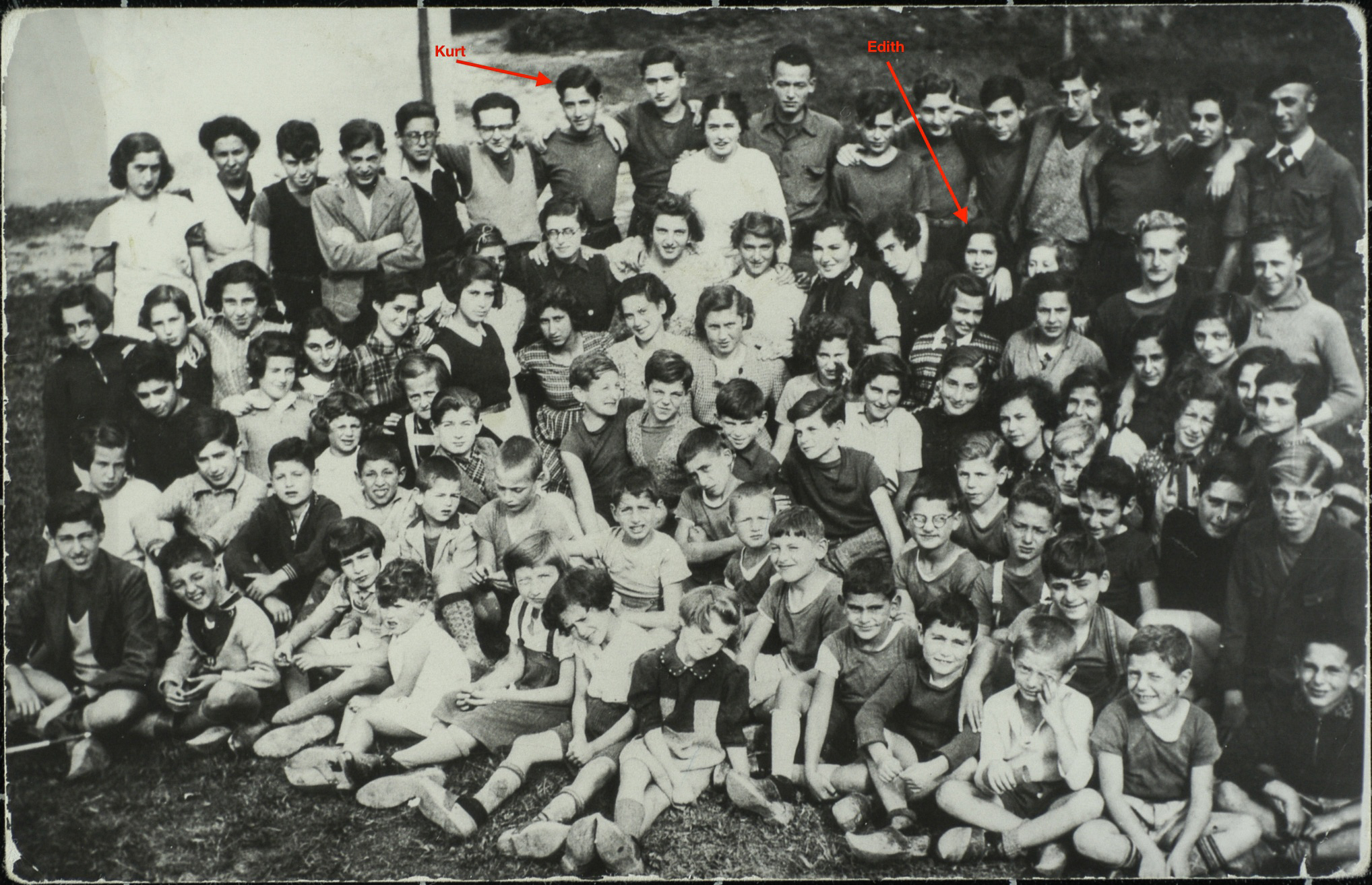
Both Kurt and Edith appear in this group photo of the La Hille refugee children, taken in Seyre in the fall of 1940, before the children were moved to the Château. Three years after this photo was taken, Kurt was betrayed and taken to Auschwitz, where he eventually died. Photo: Courtesy of Mike Bernhardt.
Horrified by the news, Anne-Marie committed herself to finding a way out of France for the remaining Les Grands.
Coincidentally, she had three weeks of scheduled vacation. She wanted to visit her parents, but even for Swiss citizens, entry into Switzerland had become nearly impossible. Why not find a way up the Jura cliffs? She’d never done it, but her parents lived on the other side — and she could scout a potential escape route for the children.
~~
The border region Anne-Marie had to cross was within the “forbidden zone,” an area Germany had designated as off-limits to almost everyone. Trespassers could be arrested, even shot.
Anne-Marie wrote in her 1985 memoir that she went anyway, feeling exhilaration at “taunting the brutal force of Hitler’s blind anti-Semitism.”
After two days of travel, she arrived in the tiny village of Chapelle-des-Bois at the edge of the forbidden zone, below the cliffs. She walked casually along the road, heart racing. An armed German sentry watched her but, incredibly, didn’t ask for identification or question her.
When she was out of view of the sentry, Anne-Marie turned east toward the looming forest, disappeared under barbed wire and into the trees, and began to climb. She didn’t know the way up — but she found one.
When Anne-Marie arrived at her parents’ house, she explained what she was hoping to do for the La Hille children. She just needed someone to help her move them through the forbidden zone and up to safety.
~~
Hélène Cordier, a widow, had raised her three daughters, Marie-Aimée, Victoria, and Madeleine, to be piously Catholic. They were poor, but their small farm, nestled at the foot of the Jura cliffs and nicknamed Sous-le-Risoux — “under the Risoux” — was paradise for the girls. Victoria, the youngest, rapturously described in her own memoir the joy with which she explored and played in the forest, following the mountain goats, feeling “drunk with freedom and fresh air.”
Small smuggling operations had existed in Chapelle-des-Bois for centuries. The cliffs seemed impenetrable, but there were secret passes known only to locals. One of them, called Gy de l’Échelle, was a dangerous, 50-foot rocky ascent at the top of the steep, thickly forested hill that rose right behind the Cordier house. The “Gy” was invisible, completely hidden by trees.
While Anne-Marie was finding her way to the top of the Jura cliffs, 24-year-old Victoria and her older sister Madeleine were living in the town of Champagnole, about 17 miles northwest of Chapelle-des-Bois.
Victoria was a liaison agent for the Resistance, picking up documents from networks in Lyon and Paris and smuggling them back to her mother’s house. She climbed the Gy hundreds of times, passing her intelligence to a Swiss agent, who delivered it to the Allies.
Victoria risked arrest every time she crossed into the forbidden zone. Sous-le-Risoux was often watched, even searched. Had she been caught, she would have been tortured and deported. Yet she delivered more than documents across the border, without compensation: Victoria guided Resistance members on the run, Frenchmen avoiding German conscription, and eventually, Jewish refugees. Madeleine worked as a notary and forged identification papers. When her sister was away, she too smuggled people over the Gy.
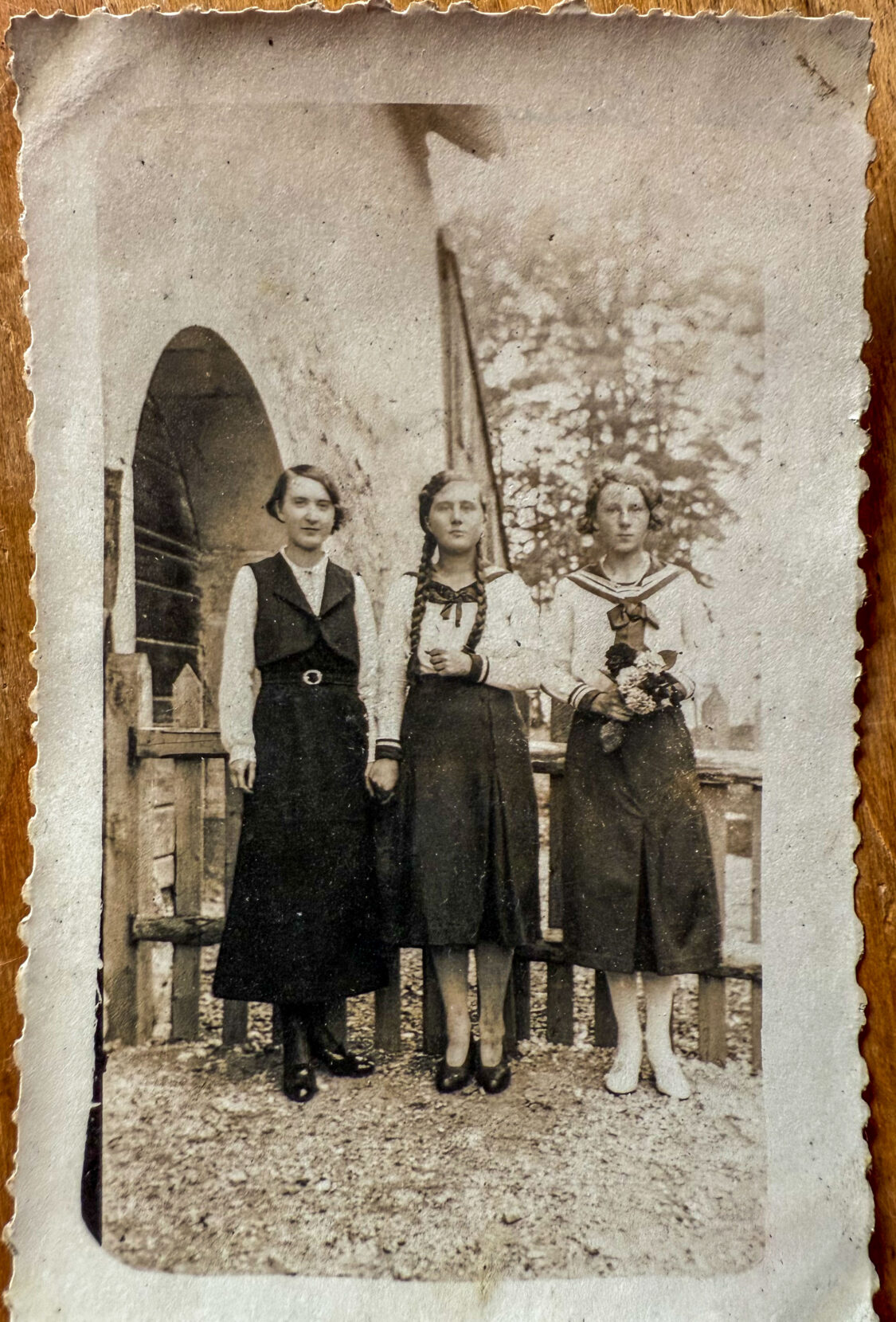
The Cordier sisters in 1934: Marie-Aimée, 20 (left); Madeleine, 17 (middle); and Victoria, 15 (right). Like her younger sisters, Marie-Aimée also helped smuggle refugees across the border, but she was in poor health by the time Anne-Marie began looking for a way to rescue the La Hille children. Photo: Courtesy of Hélène Martin.
~~
When Anne-Marie, the lapsed Protestant, was introduced to devoutly Catholic Victoria, the two felt an instantaneous bond. Victoria later wrote about Anne-Marie, “It was impossible to meet you without being charmed. With you, no danger was insurmountable. We immediately bought into your plans.”
Those plans were straightforward: Anne-Marie would organize the route from La Hille to the Cordier sisters’ apartment in Champagnole. From there, Victoria or Madeleine would smuggle Les Grands to Switzerland.
~~
On Wednesday afternoon, October 27, 1943, Edith and another La Hille teen, Manfred Kamlet, set out for Champagnole with packs on their shoulders. Manfred’s nickname at the château had been “Vulture” because his nose was large and crooked.
Manfred already had a false ID, but Anne-Marie had to arrange one for Edith. That afternoon in a café, a man slipped it into Edith’s bag. Because she looked so young, she became 15-year-old Monique Hermet. Though a year younger, Manfred posed as her older brother.
Edith’s French had a strong German accent, and Manfred, who apparently spoke much better, insisted that she stay silent. She was terrified they’d be caught as he blithely schmoozed and talked politics with passengers on the train to Lyon, including a uniformed police officer.
German soldiers boarded their unlit train near midnight, checking papers. Barely able to breathe, Edith pulled out her false ID and handed it to one of the soldiers, who examined it by flashlight as she sat in petrified silence.
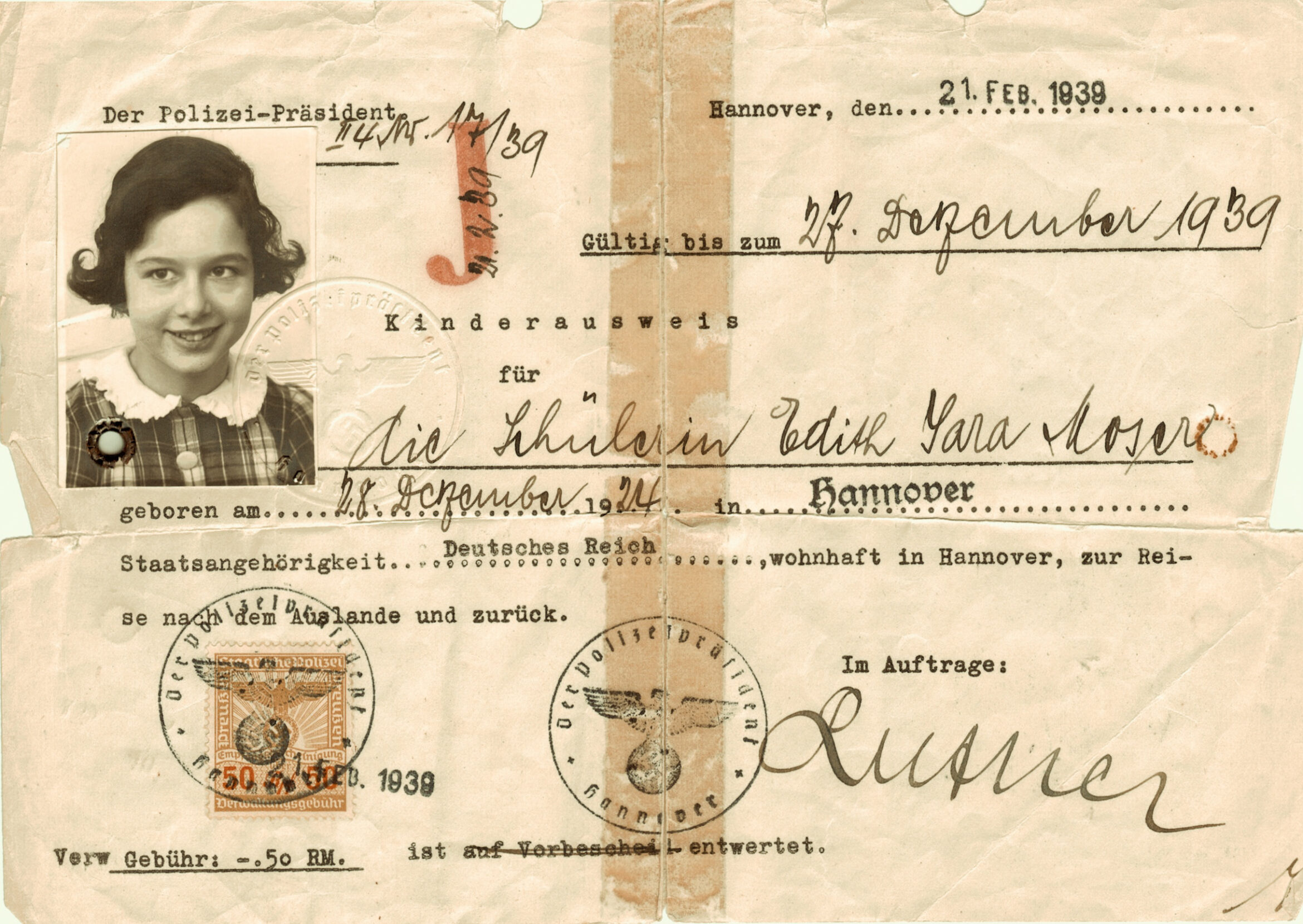
Edith Moser’s German travel document from 1939. Image: Courtesy of Mike Bernhardt.
Long after the soldier returned Edith’s ID and moved on, she still struggled to calm herself. They continued north from Lyon by train and bus with almost no food or rest until Friday night, when they stood alone at the threshold of a stranger’s apartment, known to them only by the number on the front door.
The teens knocked, praying that whoever lived there could be trusted. The door opened, and Madeleine Cordier hurried them in.
~~
About six months before our trip to France, I sat at my desk with Edith’s journal, mulling over her entries. She had struggled to decide whether to attempt the escape offered by Anne-Marie. I can imagine the trepidation she must have felt after her brother’s deportation. “Did I not have obligations to my mother, to not throw myself foolishly into some danger?” Yet she knew that staying in France was equally risky.
I studied the journal, a map, and a book called The Children of La Hille, trying to piece together what had happened — to fill in the gaps of Edith’s account. A far-fetched hope took shape: If I could identify the town with the farmhouse, I could visit and find someone who knew where the Cordiers had lived. Then I could visit the house — assuming it still existed — and try to retrace Edith’s intended escape route.
During my research, I learned of an organization called Alliance Liberté, whose primary mission was to keep the memory of the smugglers, including the Cordier family, alive. The answer I received to my query left me stunned. Yes, Hélène Martin had replied, Sous-le-Risoux was still there. She was Victoria Cordier’s daughter, and if we visited her in Chapelle-des-Bois, she would guide us up the cliffs herself.
~~
Hélène is a wiry, athletic woman of 70 with frizzy gray hair, warm, expressive eyes, and a quick smile. Her face is tanned from spending a lifetime outdoors. The first time we meet, we all hug like long-lost friends: Yvonne, Edith’s daughter; Hélène, Victoria’s daughter and the niece of Madeleine; and I, witness to a meeting I hadn’t imagined possible.
As we get to know Hélène over three days, we discover that she and Yvonne have something unexpected in common: As a child, Hélène also heard far more from her mother about the brutality of the Nazi regime than she could bear.
~~
Three days into their journey, Edith and Manfred took an evening tram with Madeleine to the village of Foncine-le-Bas and began their long walk. Edith wore snow pants and a ski mask against the cold wind.
She looked up at the starry sky as a bare sliver of moon set behind her. Her father was dead, her brother deported, and her mother was in England, impossibly far away. Gazing upward, Edith thought, “I wonder if Mama is also looking at those stars and is thinking of me.”
Following a horse trail that climbed into thick forest, the group slowly made their way toward Chapelle-des-Bois in near-total darkness. Hours later, on a paved road, they neared the point where German soldiers patrolled.
Terrified, Edith prayed: “God in heaven, protect us and give us courage.”
The border region … was within the “forbidden zone,” an area Germany had designated as off-limits to almost everyone. Trespassers could be arrested, even shot.
Leaving the road again, the trio crossed a marshy field at the edge of the woods. Edith tripped on rocks and sank to her knees. Madeleine told Edith and Manfred to wait under the trees while she scouted ahead. They lay on their bellies, shivering in the cold and wet, until she returned and signaled: Let’s go.
They scrambled on all fours, dragging their packs. Then, one by one, they crawled across the road. On the other side, they trudged through a soggy pasture, hidden from the German guard post, before finally arriving at Sous-le-Risoux around 4 a.m.. Edith was so exhausted she vomited.
~~
Under a cloudless morning sky, Yvonne and I meet Hélène and a dozen Alliance Liberté members. They’re all here because of Edith and our visit. We follow Edith’s overnight route to the Cordier family home.
From the former tram stop in Foncine-le-Bas, we traverse a paved road to a trail into the forest. About a mile in, a mossy footbridge crosses a fern-lined brook under the forest canopy. Edith couldn’t know, in the darkness, how beautiful her surroundings had been. She only knew that her pack was getting heavy, and no wonder: We climbed almost 1,900 feet before leveling out.
The trail leaves the forest and opens into another road bordering fenced, bright-green pastures. Cows graze before us, their bells gently clanging. To our right, close to the edge of the forest, the grass is yellowed, marshy, and pitted with basketball-sized chunks of limestone. Past that, across the D46 road and a rise of pasture, half-hidden by trees, is the stuccoed, wood-beam farmhouse called Sous-le-Risoux. For us, it has been a pleasant 7-mile hike. For Edith, it had been the culmination of a grueling four-day journey, yet her safety was still elusive.
~~
Madeleine and her mother were away at Mass when Edith awoke late Sunday morning. Outside on the main road, German soldiers patrolled with dogs. Had Edith known, it surely would have stopped her from opening the curtains of her second-story window to view her surroundings.
She looked out, admiring lush pastures and forested hills. Then she saw the soldiers and jumped back.
“Had they seen me?” she wrote in her diary. “They knew exactly who lived in the house.”
Edith continued watching them surreptitiously, wondering how she and Manfred would escape without being caught. She went down to the kitchen, but every step hurt: Her feet were swollen and blistered from the night before.
After the Cordiers returned from Mass and the group ate lunch, the soldiers were farther away. It was time. Edith and Manfred followed Madeleine out the back door, running across the small backyard and into the trees.
“I had never climbed so fast,” Edith wrote. “My heart was pumping like a machine … we slithered from one tree to the next. It was so steep that I barely dared look down.” They grabbed roots and branches to avoid falling backward.
“All of a sudden, the woods stopped and we stood in front of a steep rock wall.”
“Don’t lose courage, the worst is behind us,” Edith thought. Then she heard a noise and threw herself behind a rock outcropping. She watched, petrified, as a man came rushing up the steep, forested hill. Above her, Madeleine and Manfred had disappeared.
“Now, the man was quite close to me,” she wrote. “He was in civilian clothes. So, he was a Gestapo guy. Father in Heaven, save me! I began to shake all over.”
~~
Yvonne and I meet Hélène and her group on a cool but sunny Sunday morning to retrace the final stretch of Edith’s flight. We set out from Sous-le-Risoux across the grassy backyard and into the forest.
Edith hadn’t exaggerated the challenge of climbing that heavily wooded slope — it’s at least 45 degrees. But in the 1990s, a trail was cut across it. We switchback gently for a half hour through spruce and beech trees that fall away steeply below us while others soar upward.
“The magical forest … where the trunks of the spruce trees stand like the pillars of a cathedral.”
The forest ends abruptly at the foot of the broken limestone cliffs of the Gy de l’Échelle, where Edith once hid and prayed for a fate different from her brother’s.
~~
Edith stared at the man in terror. But he barely glanced back and climbed even faster, clambering up the cliffs and over the edge.
Eventually, Edith stood up, still frightened and, I imagine, confused. She called out quietly to Manfred but got no answer. Why had they left her so alone? She continued upward until she found herself paralyzed before a 2-meter fissure.
“If you stay put, the Germans get you for sure,” she eventually told herself. Her only hope was to jump. She leapt across the fissure, barely catching the far ledge before losing her balance, grabbing roots and struggling to find her feet again. She caught her breath and kept going, slipping on rocks and dripping sweat. Finally, she reached the top and found herself alone on a forested ridge.
Now what?
Edith heard her name and saw Manfred and Madeleine in the trees, beaming at her. With them was the man who had rushed past Edith — another smuggler who had been equally frightened of her. There was also a burly, bearded man who said, “I am Mr. Piguet, Anne-Marie’s father, and wish to guide you farther into Switzerland.”
Edith knew then that whatever the future might hold, she was saved.
~~
One by one, with safety ropes, helmets, and the luxury of time, we scale the Gy. Yvonne finds her footing where the stone gives way to soft earth and offers me a tentative smile and a thumbs-up. Everyone applauds when she reaches the top.
On the ridge above Gy de l’Échelle is a large laser-cut steel sign dedicated in French, German, and Hebrew to the Cordier sisters and the La Hille children they saved. I ask Hélène and Yvonne to pose for a photo in front of it. They smile, and then Yvonne’s eyes tear up. Hélène pulls her into a gentle embrace and kisses her forehead as Yvonne rests her head on Hélène’s shoulder.
Watching these women embrace at the top of that cliff, where Hélène’s aunt had risked her life to offer help and Yvonne’s mother had risked her own to accept it, my eyes also burn with tears.

On the ridge atop the treacherous cliffs of the Gy de l’Échelle, a sign commemorates the refugee children who fled the Nazis, and those who led them to safety. Here Hélène Martin (left) and Yvonne Lefort (right), daughters of two of the sign’s honorees, embrace. Photo: Mike Bernhardt.
~~
At midday, we return to Sous-le-Risoux. Awaiting us is a long row of covered tables brimming with cheese, charcuterie, bread, fruit, and wine. Twenty-seven people, ages 10 to 94, sit for a picnic as a bagpiper plays Le Chant des Partisans, the anthem of the French Resistance.
Afterward, Yvonne stands up at the table and speaks to the group in French. She describes what happened to her grandparents and uncle during the war and how burdened she felt by what her mother told her. She’s never shared these things with strangers before.
“But now I have positive stories of people who risked their lives to save Jews.” She chokes up and pauses, then continues in a breaking voice. “I’m going to go home with my own memories now, not just my mother’s.”
~~
“Don’t lose courage.”
What would I do to help someone in danger? What would you do? A few of us discuss these questions at the picnic.
Would we hide people in our homes, risking a neighbor’s betrayal? Would we have guided the La Hille refugees over the Gy and chanced being shot or tortured? How do we weigh our own safety against that of innocent children?
I ask Hélène why her mother, her aunt, and her grandmother endangered their lives for Edith and the other La Hille refugees — as well as more than 70 others.
She takes a drag on her hand-rolled cigarette and thinks for a moment.
“Their faith required it,” she says. “My mother taught me that if we can do something, we must do it, and that there is always something we can do.” She shrugs. “Many people in France did the same.”
Hélène pours me a regional wine, vin jaune. I relish its nutty, oxidative flavor and look around me, only half-understanding the French conversations but feeling deeply moved by the community that has gathered to celebrate Edith and our visit. Someone offers a toast: “À la liberté!” To freedom.
Standing before the picnic tables, Hélène speaks to the group’s youngsters: “There is always hope, even if you don’t know where help will come from. The children of La Hille didn’t know anyone here, but they had to trust that they were in good hands …”
Edith’s story is bigger now. It’s the story of everyone here at the picnic, of everyone who risked their lives to help strangers, and of the courage it takes to accept that help when we don’t know what the price might be.
“There are some bad hands,” Hélène admits, “but most are good.”
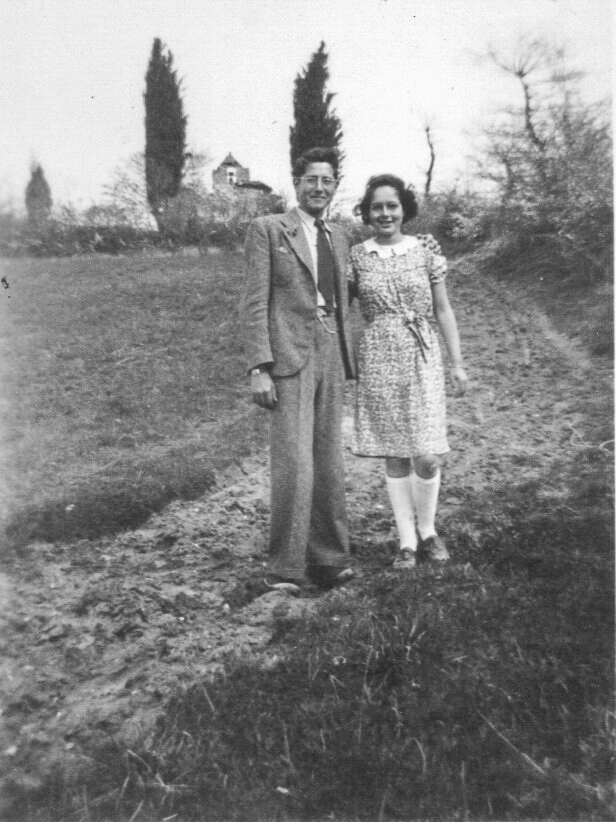
Kurt and Edith Moser pose for a photo likely taken in late 1942, mere months before they would each put their lives in the hands of strangers in search of freedom. Photo: Courtesy of Mike Bernhardt.
The excerpt of Yvonne Lefort’s poem, “The Aftermath,” that appears in this article is from the book Voices of the Grieving Heart.
Mike Bernhardt has also chronicled the stories of Edith Moser’s parents in his award-winning 2023 Hidden Compass feature, “The Tides of War.”
Mike Bernhardt
Mike Bernhardt is an award-winning writer who loves cooking Thai food for friends, or sitting by the Canal du Midi and eating duck cassoulet.