
Ad Free. Reader Funded.
Hidden Compass is on Team Human. This article was not written by generative AI. Support the journalist and editors of this piece with a direct contribution!
% of $ Goal
Total number of contributions so far:
0
Total amount raised for journalists
$0
"One thing I really appreciated about working with Hidden Compass is that it's a space where there is time for nuance and complexity. By donating, that's what you're supporting. You're able to help us as writers, but also as an outlet, continue to tell these kinds of stories."
- Anna Polonyi, Hidden Compass Journalist
"The reason why I contributed was because the article that I read really resonated with what I was feeling. I felt like the author was in my head... It just moved me and I felt like I needed to do something."
- Hidden Compass Reader
The long, honey light of late June gleams through the beech trees. Life blooms all around us. It is another perfect summer evening in Eastern Europe. Yet a sense of urgency hangs thick in the air.
Sweat drips off the foreheads of a group of men in white lab coats as they hurriedly unload the contents of a van — ornately carved oak chairs, cellophane-bound wooden objects, bubble-wrapped frames — into what appears to be a residential home.
An hour earlier, while at a downtown hot spot known for beautifully plated cuisine — green borscht with foraged sorrel and smoked catfish, steamed snails served with beer bread, fresh heirloom tomato salads with blackberries — I had gotten a call about the van’s impending arrival. It was a tip from my friend and fellow journalist Margaux.
Stylishly dressed women, some with tiny dogs in tow, filled the restaurant. The gentle chinking of wine glasses punctuated smooth jazz music. I had just ordered a Negroni.
Margaux, sensing my hesitation over the phone, snapped me out of my reverie: “They won’t wait for you. Come now!”
The van had made the harrowing journey here from Sumy, a frontline city more than 186 miles away in northeastern Ukraine, under threat of drones, artillery shelling, and landmines.
The least I could do was leave my drink behind and take a taxi to the Kyiv suburbs. After all, what the van carried amounted to so much more than mere objects.
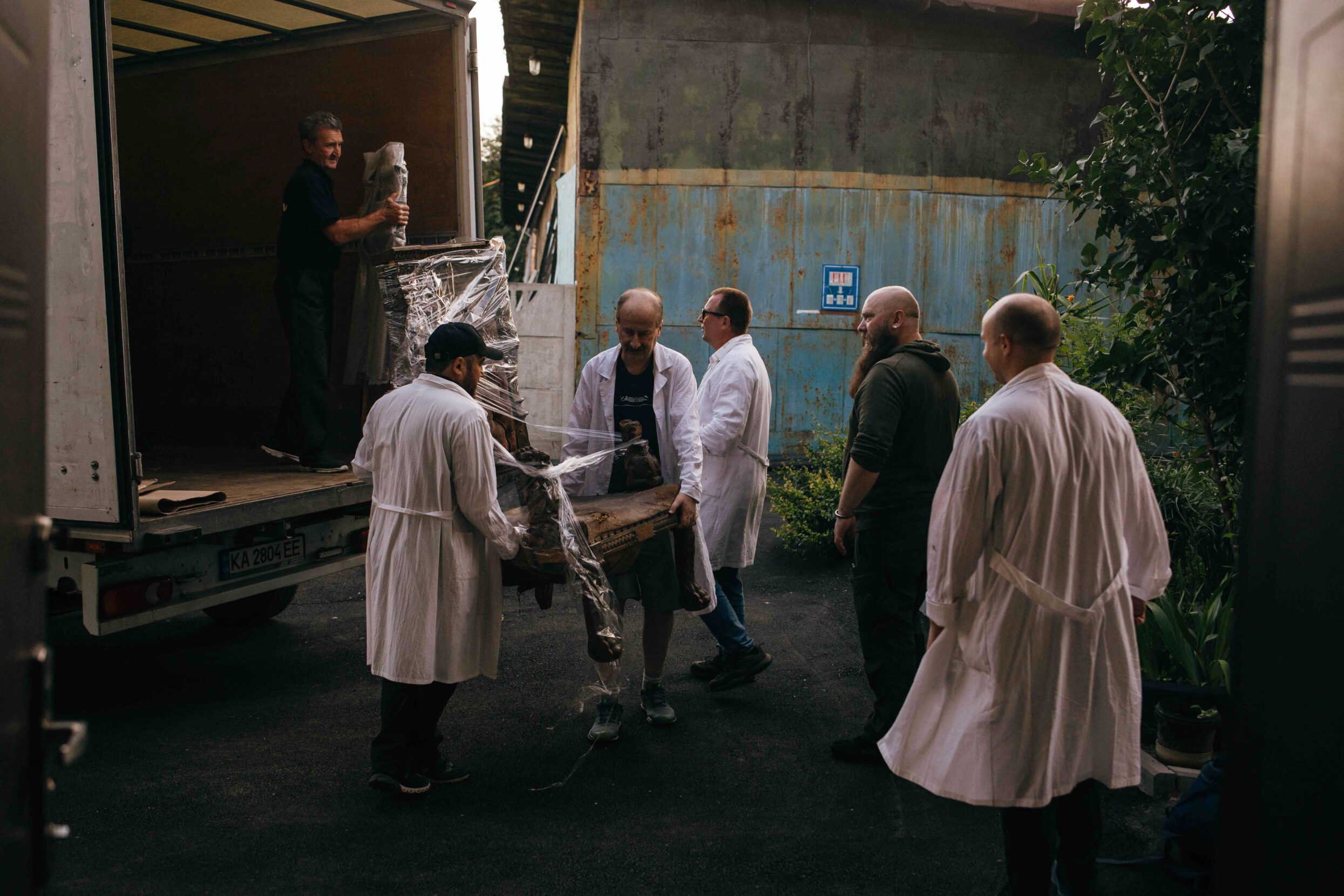
At an undisclosed location, artwork and artifacts from Ukraine’s museums on the war’s frontlines are unloaded for safe keeping. Photo: Kang-Chun Cheng.
~~
In the bloodbaths across eastern Ukraine, sacrifices happen every hour as Ukraine’s soldiers struggle to keep the soldiers and mercenaries of the world’s biggest country at bay amid the deadliest war in Europe since World War II. But away from the front lines, art restorers and museum curators confront more existential questions.
How much does art matter when lives are at stake?
What can they save so future generations might understand what it has taken to survive against so many odds?
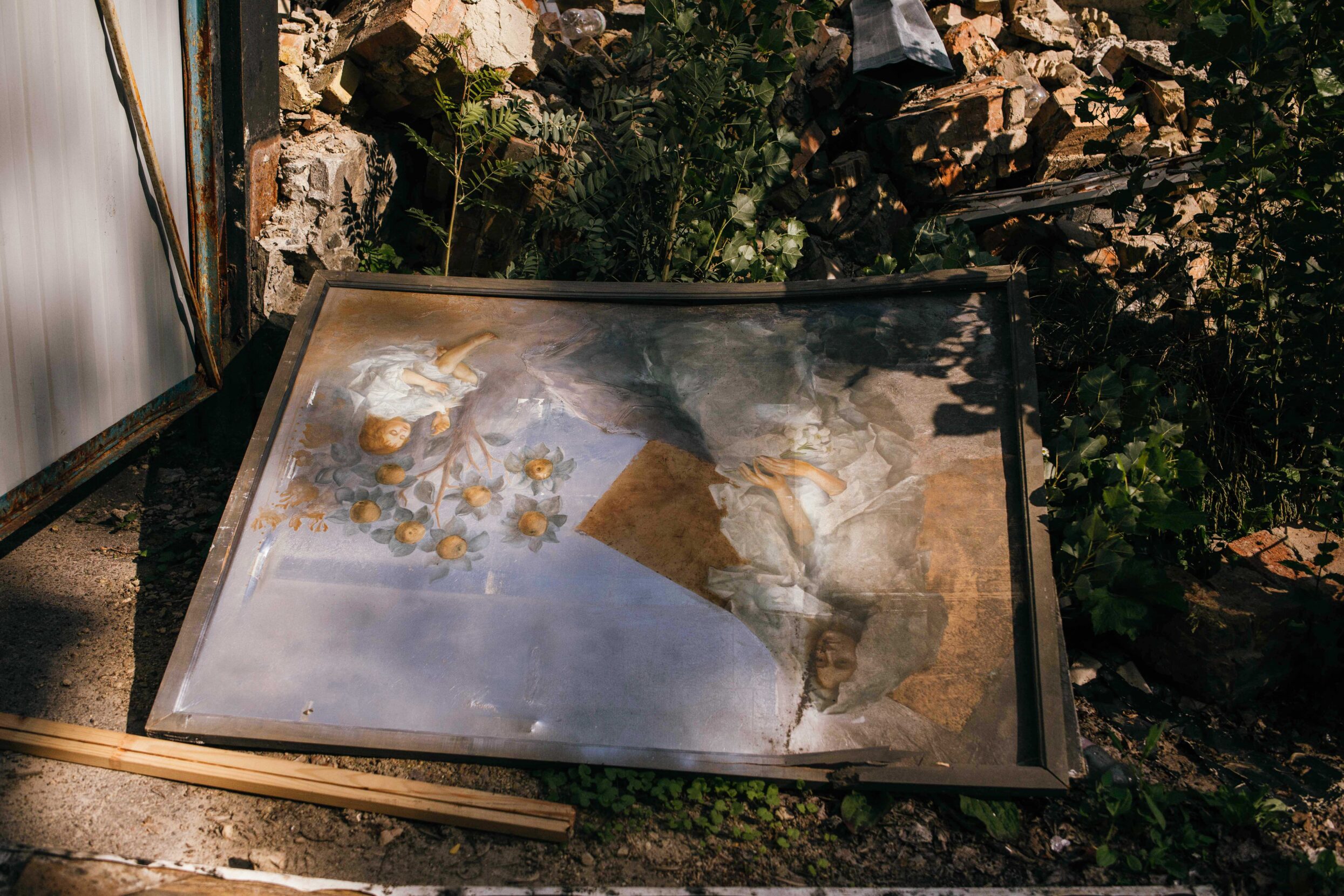
Damaged artwork sits among rubble. Photo: Kang-Chun Cheng.
As an independent photojournalist in Ukraine on a reporting fellowship, I am grappling with my own role here. I know that the devastation of drone strikes and death tolls aren’t the whole story. So I set out to gather as many fragments as I can, trusting that together, a more expansive picture will emerge.
~~
Sandbags, serving as shock absorbers, line the bases of windows near city centers across Ukraine. Along the eastern front, hundreds of miles of fishing nets have been installed over roads as a layer of protection from drones loaded with munitions that kill soldiers and civilians alike, with abandon. In a war where tactics and weapons are developing at mind-bending speeds, all levels of deterrence are taken seriously.
To carry out Russian President Vladimir Putin’s agenda of revisionist history, Russia has been shown to target cultural institutions and heritage sites specifically. According to UNESCO, 545 verified sites — libraries, places of worship, and an archive among them — have been shelled or otherwise devastated across Ukraine as of July 29, 2026.

Large swaths of the Mykhailo Boichuk Kyiv State Academy of Decorative-Applied Arts and Design sit in ruins following a March 2024 airstrike. Named after the prominent Ukrainian painter and monumentalist Mykhailo Boichuk, the school paid the price when a Russian missile intended for a nearby target was intercepted. The attack occurred while students were in class. Though no one was killed, significant portions of the campus were destroyed, including the school’s heritage museum and historical archives. In the immediate wake of the strike, students and UNESCO worked to salvage artwork. Today, with the continued support of UNESCO, rebuilding is underway. Photo: Kang-Chun Cheng.
“We’ve been constantly overloaded,” says Oleksandra Kovalchuk, who originally founded her nonprofit, Museum for Change, to support and modernize Ukraine’s museums in Odesa. After the 2022 invasion, the mission shifted to preserving Ukrainian culture.
Kovalchuk estimates that some 12 million to 20 million heritage objects are at risk. “It’s always urgent,” she insists. In 2024, the projected cost of rebuilding Ukraine’s culture and tourism sectors exceeded $9 billion, money that the nation does not have. Areas along the front lines, including Donetsk, Odesa, and Kherson, have suffered the most damage.
Kovalchuk’s message is clear: Safeguarding the treasures of the past is an essential part of preserving the story of a people.
~~
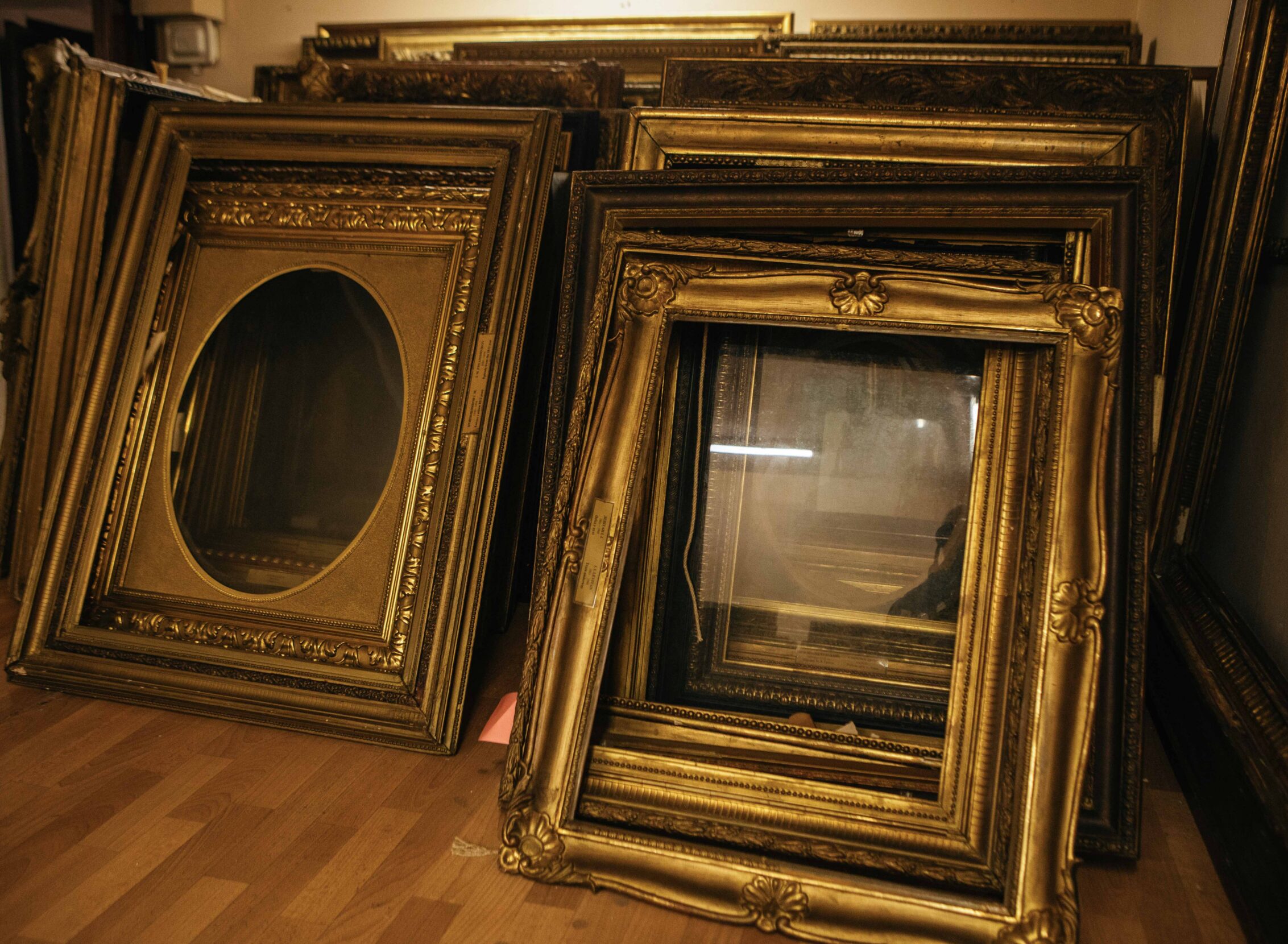
Frames that once held priceless works of art sit empty in the basement of the Odesa Fine Arts Museum. Their contents have been whisked away to safety, as museum curators, restorers, and others work together to preserve the nation’s cultural heritage. Photo: Kang-Chun Cheng.
In the early hours of Feb. 25, 2022, one day after Russia’s full-scale invasion of Ukraine began, employees of the National Fine Arts Museum in Odesa shuffled through the eerily desolate halls and began dismantling exhibits. They dislodged sculptures from podiums as quickly and carefully as they could and pulled paintings from frames and rolled them up, assigning each frame a number corresponding to the paintings.
They worked without any breaks for that first week, knowing that every hour could save something irreplaceable. What they had most feared had finally come to pass. The museum sent the first batch off by train to friendly museums across Europe.
“We were emotionally prepared,” says Kateryna Kulai, the museum’s 39-year-old director, about her team’s tacit understanding of the geopolitical friction that culminated in the war, which caught many Ukrainians off guard. “The [museum] started preparing for evacuations in late 2021.”
I’m standing with her outside the museum’s mulberry– and terracotta–colored exterior, looking up at a corner of the ornate, 19th-century roof damaged by a missile attack in November 2023. A sultry breeze blows in from the Black Sea.
Inside one of the exhibition halls, I am drawn to an empty gold frame. A scaled-down facsimile has been stuck to the wall in the place of the missing painting — “Portrait of Kyriak Kostandi,” a moody portrayal of one Ukrainian artist by another, Mykola Kuznetsov, that was stowed away during the February 2022 evacuations. Both men are often deemed Russian artists, but the curators here are careful about provenance.
“It’s about the memory of these artists’ resistance. They fought for our identity.”
I follow Kulai to the museum’s basement and then down a curving staircase into 200-year-old grottoes, carved out of the natural coastal cave. Her wavy blonde hair frizzing in the extreme humidity, she lights up as she shares the museum’s intriguing history. Her face, though, is lined with fatigue. Twelve years of war — four years since the full-scale invasion — take their toll.
Dozens of empty frames — their gilded detailing coated in dust — stack up on the cool stone floors. At present, roughly three-quarters of the museum’s 10,000 pieces have left Odesa. These subterranean passages once led to the Black Sea. In the 1940s, civilians and artwork alike took refuge here from Nazi bombings.
“It’s funny how history repeats itself,” she notes.
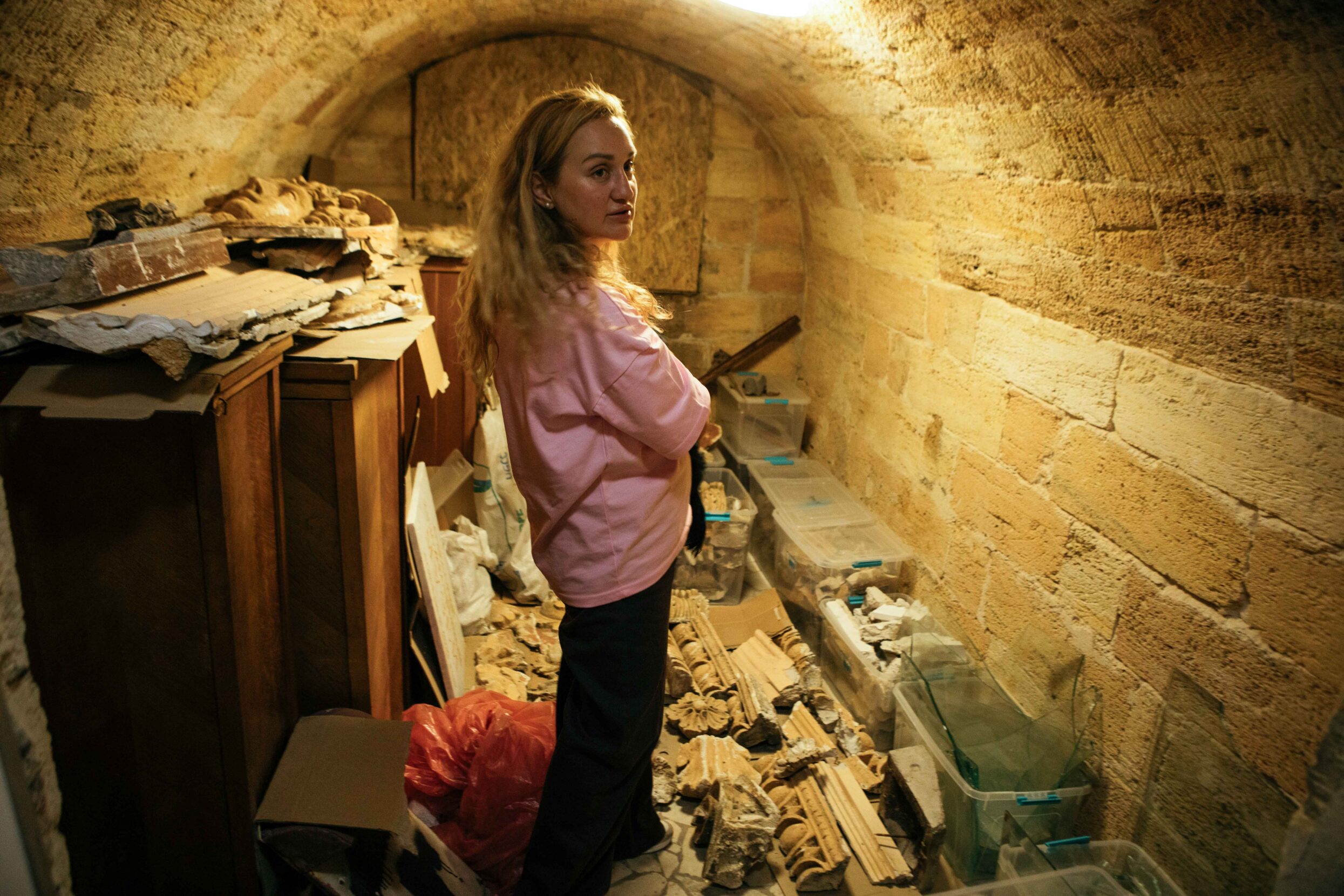
Kateryna Kulai stands amidst the damage in the Odesa Fine Arts Museum, where she serves as director. Like many of Ukraine’s museums, this one sustained damage in a Russian airstrike in November, 2023. Photo: Kang-Chun Cheng.
~~
Putin’s obsession with capturing Odesa is both ideological and strategic. The city, with its pastel-hued, neoclassical architecture, is a major port.
Before the war, 90% of Ukrainian grain — more than 60 million tons a year — passed through Black Sea ports. The Ukrainian army has accused Russia of planting naval mines to target Ukraine’s economy, thus jeopardizing the cascade of countries downstream, throughout the African continent and the Middle East in particular, which depend on food aid from Ukraine.
There’s also Odesa’s unique cultural mix, its centrality having welcomed Greek, Italian, Georgian, Turkish, Arabic, and other traders. And then there’s its defiance, the very energy that Putin seems so determined to quash.
“It’s a close community here, with unique stories and dialects, yet it is very cosmopolitan,” Kulai tells me. As it is with everything else in Ukraine, the war has warped the city’s value into something ominous.
~~
To carry out Russian President Vladimir Putin’s agenda of revisionist history, Russia has been shown to target cultural institutions and heritage sites specifically.
In the city of Lviv in western Ukraine, I meet up with Marta Sloboda, who was born and raised here. We have been connected through a mutual acquaintance.
“It’s like we’re a bone in Russia’s throat,” Sloboda tells me matter-of-factly. “Putin just can’t stand that we exist and wants to wipe out everything that we are, every trace of our identity.”
We’re at a restaurant run by an acclaimed Ukrainian chef, seated at a table outside on the cobblestone streets that’s perfect for watching people as they stroll past. Many of them are young women in sundresses, iced drinks in hand.
Later, I amble past the 17th-century Boim Chapel, the sole surviving structure of a grouping of six chapels that stood on a family cemetery here during the Renaissance era. Flanking its facade, a few sculptures have been wrapped and caged. In an instant, I am pulled back into the stark uncertainties of wartime. Centuries of endurance are no match for a Shahed glide bomb, an Iranian-designed weapon that weighs about as much as a baby grand piano.
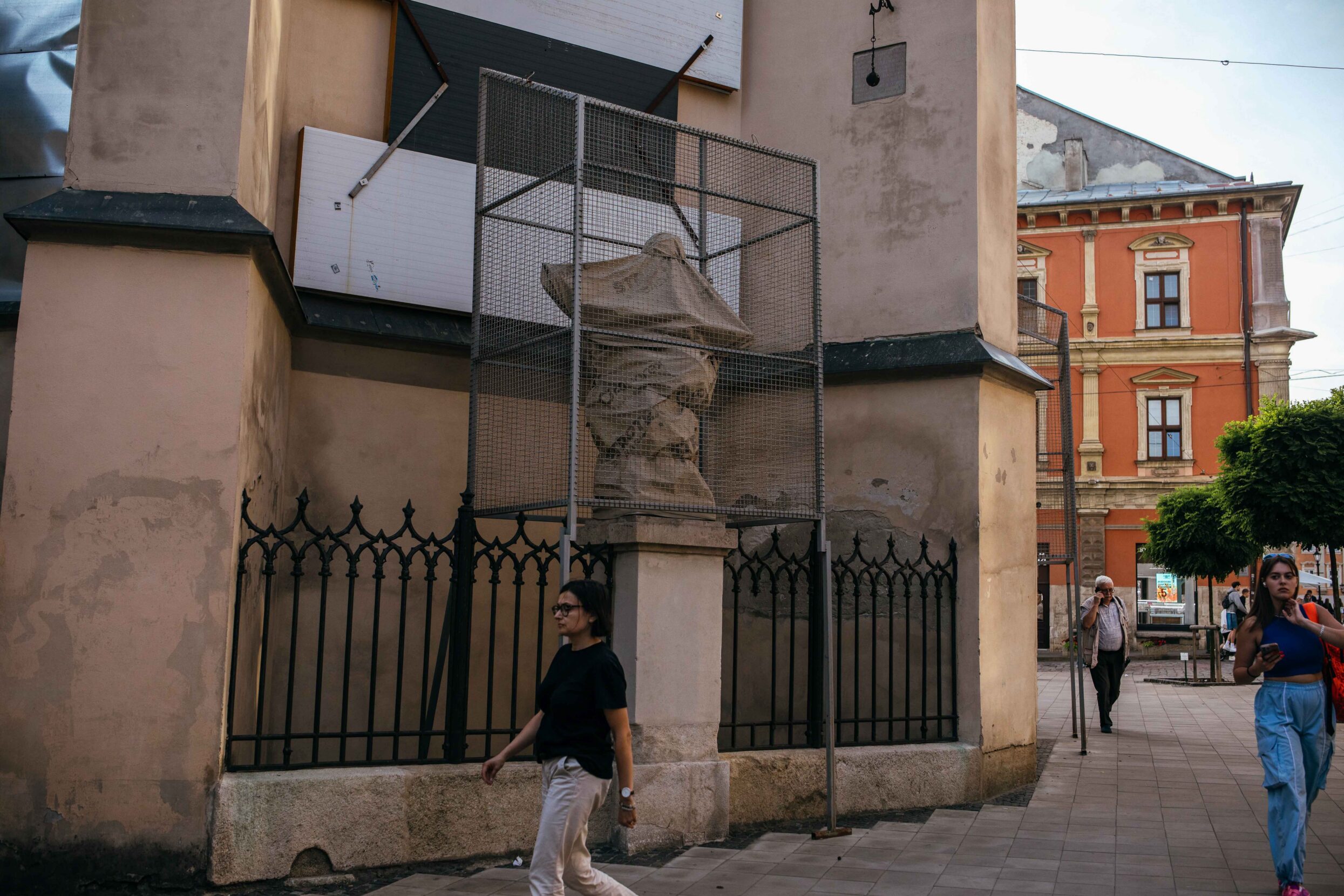
In Lviv, Ukraine, sculptures outside a historic church are wrapped and ensconced in metal cages to help protect them from damage. Photo: Kang-Chun Cheng.
Since my arrival in Ukraine, I’ve been keeping an eye out for public art ensconced in metal scaffolding, installed across the country as enemy airstrikes escalated, with the hopes of protecting it — or at least keeping its pieces in one place — should a nearby strike cause indirect damage.
I stop to photograph the scene, noting that most people walking by barely give the sleeping sculptures a glance. They’re too busy living.
~~
Back in the suburbs of Kyiv, no one speaks until the haphazard jigsaw of priceless, centuries-old treasures has been fully unloaded from the van.
Then comes the break, literally and emotionally — some banter and cigarettes. We go outside to the garden to savor the last of the evening light. The frenetic energy has calmed. Some of the men have stripped down to white undershirts, reveling in the cooling breeze.
Sofiia Zakusylo, a 24-year-old conservator-restorer for the Kyiv-based National Research and Restoration Center, wears a white lab coat, her hair straightened and makeup flawless.
Earlier, inside a makeshift storage room, she gently unwrapped a piece of newspaper to reveal a tarnished, three-pronged arrowhead — a Scythian artifact, from the legendary warriors who prowled the grasslands of Eurasia on horseback before arriving in the land that is now Ukraine around the eighth century B.C.E.
Surrounding us was a hodgepodge of stringed instruments, a small boat, fragments of ceramic plates, and a 15th-century bench placed upside down atop a piano — just some of at least 100,000 objects in that room alone.
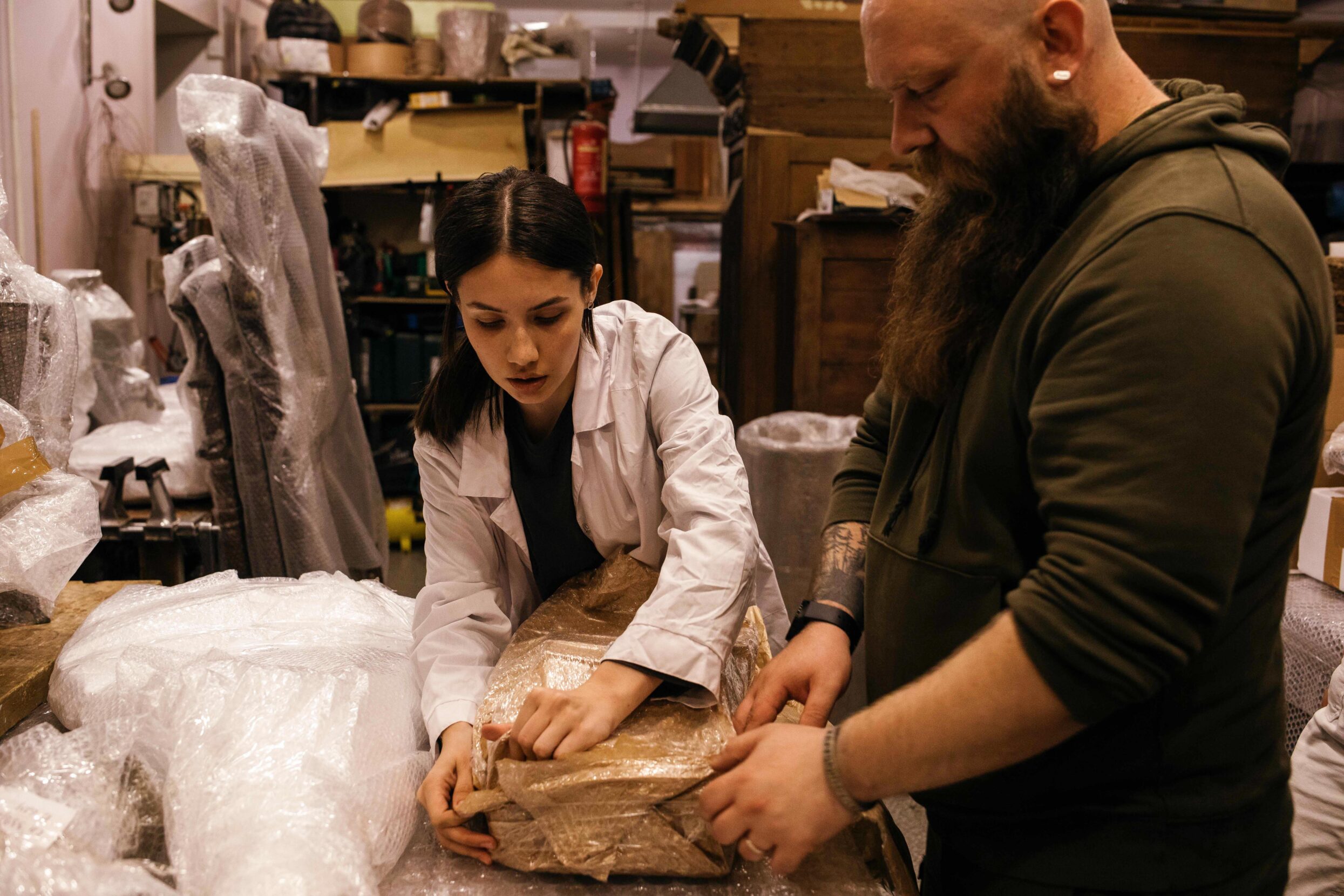
After unloading the pieces of Ukrainian heritage whisked out of the war’s direct path, the work of cataloging the treasures continues. Photo: Kang-Chun Cheng.
The Center’s previous focus was solely on the act of conservation. But the invasion gave Zakusylo and her colleagues a renewed mandate: to get there before the Russians did.
She and her colleagues have been removing art from Sumy since 2024 and, by her estimate, have successfully saved the majority of objects from the city’s museums.
“Every evacuated and restored item carries great significance,” she says, “as it represents a part of our history, our roots, and our continuity as people.”
Some 12 million to 20 million heritage objects are at risk.
Taking a pull from her vape, Zakusylo tells me that the war is so overwhelming, so brutal, that she uses her restoration work as a way to calm her thoughts and emotions. The material act of conservation — cleaning, repairing, and putting together wooden artifacts — gives her a glimmer of hope.
~~
Just a few weeks before my visit, the eastern facade of Kyiv’s St. Sophia Cathedral was damaged by the shockwaves of nearby explosions. Still, the cathedral remains open, its climbing roses carefully tended to and the cream-colored marble steps as immaculate as ever.
In the arched hall, the lighting is subdued to a perfect dimness and warmth to showcase the cathedral’s Byzantine grandeur — soaring spaces, marble inlay, the works. Built in the 11th century to rival the splendor of the Hagia Sofia in present-day Istanbul, Turkey, St. Sophia was the first Ukrainian site to be awarded World Heritage status.
I am completely in awe. There is so much to see, from the polished marble floors to the original frescoes and glittering mosaics covering the vaults and domed ceilings.
Just after I climb a winding stone staircase to the second floor, an air raid alarm blares. I ignore it, as the majority of Ukrainians do, but the cathedral plays by the book. All visitors are ushered out.

Parishioners stop in to pray at the Odesa Cathedral of God’s Transfiguration. Photo: Kang-Chun Cheng.
Outside the cathedral’s gates, I meet Catarina Buchatskiy, whose dark brown hair falls down to her waist and whose brown eyes sparkle as she tells me about the nonprofit she co-founded, the Shadows Project. The organization’s wartime work includes the distribution of protective gear, similar to the apostles’ cages I saw in Lviv, meant to shield historical monuments and precious art from attacks.
Of course, there’s only so much that can be done. It’s not as if a building can be sent to safety.
On June 15, 2026, a large overnight drone strike sparked a massive fire across the roof of Kyiv’s 11th-century Dormition Cathedral, considered one of the nation’s holiest sites. Ukrainian President Volodymyr Zelensky described the attack as “one of the biggest Russian crimes against Christian culture today.”

The Cathedral of God’s Transfiguration, a significant Ukrainian Orthodox church in Odesa, was severely damaged by Russian airstrikes. It is just one of hundreds of religious and cultural sites targeted or otherwise damaged in the ongoing war. Photo: Kang-Chun Cheng.
With such inherent vulnerability in mind, the Shadows Project also partnered with St. Sophia on a digitization project to preserve its thousand-year-old graffiti — much of it, she tells me, written in Ukrainian.
There is a Ukrainian alphabet etched about four feet from the floor of the cathedral — low enough, Buchatskiy explains, that it was likely left by a child. “It could have been a school exercise that children scratch on the walls, the way we write on our desks today, or a kid who was just starting to learn the alphabet.”
Russia often claims that the Ukrainian language doesn’t exist but, rather, is a dialect of Russian, she explains. Buchatskiy says that St. Sophia’s markings, however, predate Moscow. “So this inscription is a powerful testimony against that propaganda narrative.”
Funding shortages have paused the Shadows Project’s digitization project, so, for now, the organization advocates for Ukrainian heritage in other ways. The current priority is the “Stolen Art Campaign” — correcting mislabeled artwork in places such as the Museum of Modern Art in New York City, the Tate Modern in London, and the Centre Pompidou in Paris, where Ukrainian artists are still listed as Russian.
~~
With just a few days left in Ukraine, I want to meet as many artists as possible. A Ukrainian photographer recommends that I connect with Nastasiia Leliu, a multimedia artist at the helm of a community project in Kyiv’s Podil neighborhood. I join the 28-year-old at a small, serene park there, and we walk to a community tea cafe on the park’s edge. She takes me straight to the back wall, where there’s a mosaic she has been painstakingly restoring for more than a year.
In a minimalist palette of green, blue, and yellow, an array of broken pieces depicts Aesop’s fable: the stork who teaches the fox a lesson by offering him a meal in a long-necked vase, which he can’t eat from. Created by an unknown Ukrainian artist in the 1960s — when the country was part of the Soviet Union — the mosaic had been part of an old building slated for demolition when a construction worker posted about it online.
When Leliu saw the post, she says, she thought to herself, “Shouldn’t this mosaic, which has survived so much history, be kept intact for posterity, for public enjoyment?”
She enlisted help from her younger brother, and they used whatever tools — a hammer, chisels, a cordless angle grinder — they could find to chip off the ceramic pieces while keeping the art intact, persevering despite the frigid temperatures that numbed their fingers.
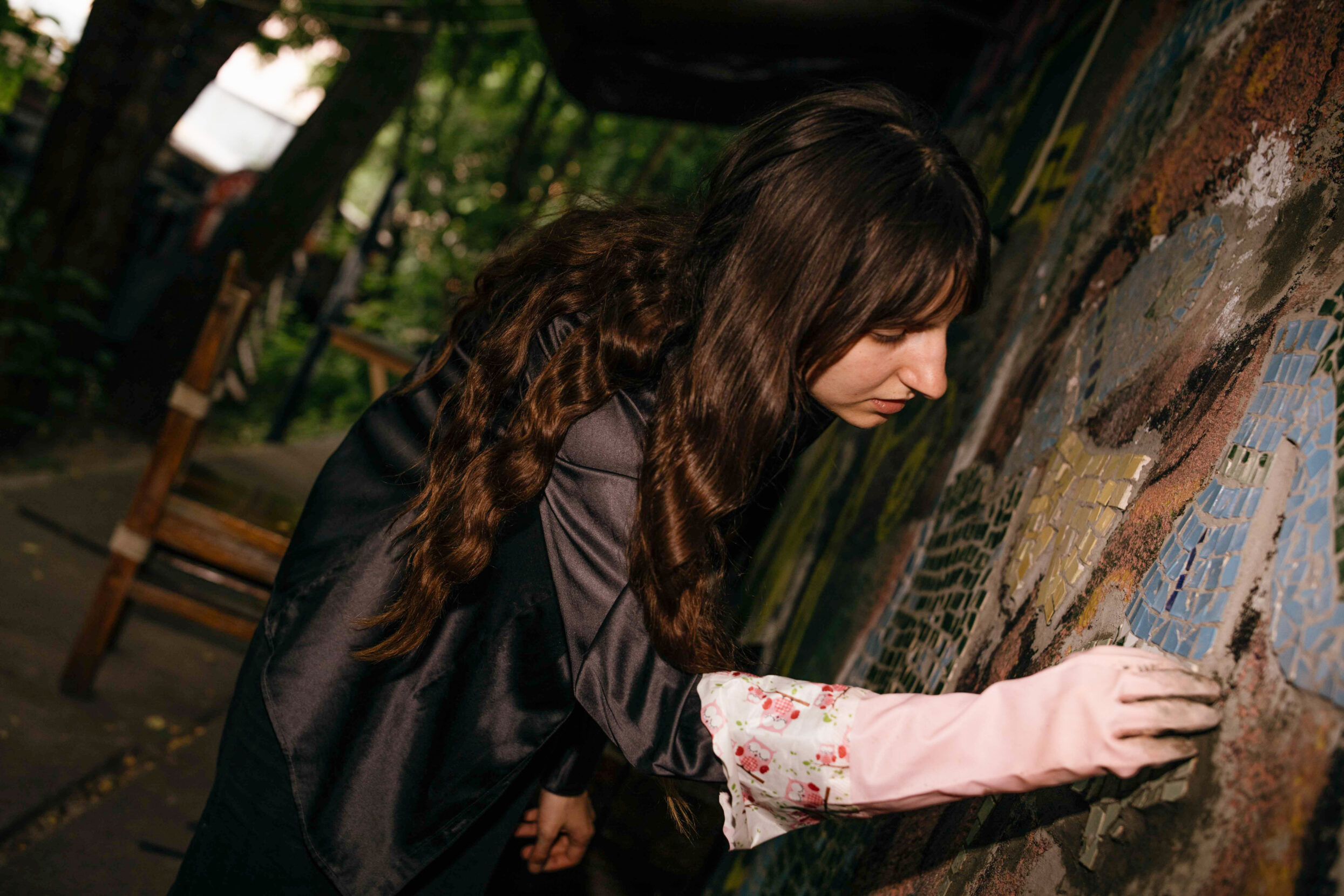
Nastasiia Leliu painstakingly reconstructs the Aesop’s fable mosaic in Kyiv. Photo: Kang-Chun Cheng.
Leliu, who studied monumental art at the National Academy in Kyiv, says she has always been drawn to the power inherent in the Soviet era’s massive public works. The government controlled art, from topic to style. Anything controversial was repressed. Yet some artists managed to create authentic art, despite the authoritarian constraints. She rattles off a few names from that era that inspire her: Fedir Tetianych, Halyna Zybchenko, Gryhoriy Synytsia.
Given the painful history, she understands that it can be easy for Ukrainians to write off things from the Soviet era, especially now, and that older generations, like that of her parents, may find such memories too traumatic to process.
“I understand that sometimes it’s easier to just destroy everything,” says Leliu, whose family fled their hometown of Luhansk, an occupied city in the eastern Donbas region, during the 2014 war.
“But [destruction] is the same instrument that the Soviet Union used to distort memory. How history is portrayed, how identity is presented — these are complex topics. We should approach such things with more depth.” She pauses, pulling on gloves.
“For me, it’s about the memory of these artists’ resistance. They fought for our identity.” As she talks, she mixes the concrete adhesive that she will use to paste the salvaged mosaic pieces to the wall with painstaking care. Her work continues.
~~
The levka, so white it appears fluorescent, has been dabbed across the creases of the canvas, sparkling like fractured light against the painting’s muted neutrals.
Volodya Semkiv, 43, a Lviv-based sculptor, has invited me to his studio. I pass a couple of high-rise apartment blocks on the approach, thinking about how tall buildings are particularly vulnerable to airstrikes, and meet him as he’s moving a rough-hewn wooden sculpture to his minivan.
“I have a show in town I’m preparing for,” he says, shaking my hand. Dressed casually in red shorts and a T-shirt, Semkiv sports a beard and baseball cap, and leads me to the studio that he shares with a fellow artist and friend. Inside, it feels like a house of treasures. Afternoon light pours through the long windows, onto the army of sculptures and statues on the wooden shelves, all coated with a light layer of dust. The atmosphere is calm, nearly sleepy — as if we’ve stepped through a portal, and are now removed from the rest of the war.
When Russia invaded in 2022, Semkiv says he felt caught between worlds. “Should I join the army, or should I draw?” he remembers asking himself.
At first, remaining an artist while others were fighting gnawed at his conscience. “But after a few exhibits, I saw how much people needed this,” Semkiv shares. “It made me think about all the ways that we’re different from Russia, what we are desperately trying to hold on to.”
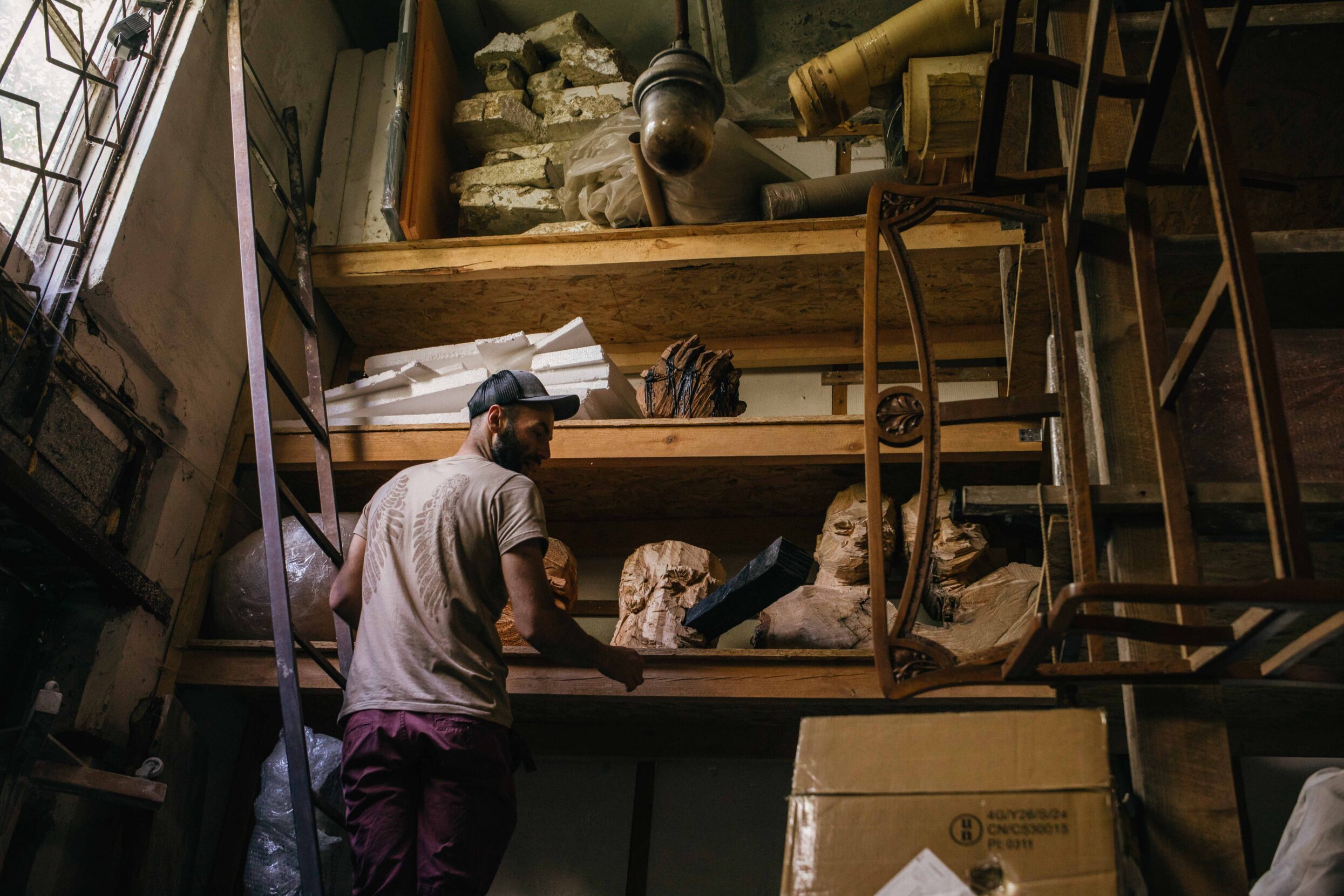
Volodya Semkiv in his studio in Lviv. Semkiv is an artist, a teacher and a father who has accepted that right now, his role in fighting for Ukraine is to make and exhibit art. Photo: Kang-Chun Cheng.
The father of two young children, Semkiv also works as a teacher, so he has a deferment from mobilization — for now. “Few people want to join the army now because everyone understands that it’s a one-way street, but someone also has to defend the country.”
According to Semkiv, most Ukrainians consider defeating the enemy their highest collective priority. Everything else is ancillary, he says, as he gives me a tour of the studio. No one knows how long deferments will last under these conditions, adding: “I accept fate.”
He loads a few pieces into his car for an exhibition. One of his favorites, “The Touch,” depicts a body imprint on the ground, inspired by the three days after Jesus’s crucifixion, when his body lay dead in the tomb, before his resurrection. “It’s the place where the body touches the ground — hopeless Hope.”
~~
Nearly six months after the van from Sumy arrived in Kyiv, I am back in Ukraine visiting the studios of the National Research and Restoration Center, where the work of that June day continues. Yulia Troshyna, 21, is restoring the base layer of a 19th-century piece rescued from the front lines.
“I’ve been working on this for a few months — it will take at least half a year to restore,” she says.
She fills cracks in the damaged painting with levkas, a mixture of fine alabaster powder, calcium carbonate, and glue, which will dry and harden before she paints over it. “Sometimes it’s impossible to know what the original painting looked like,” Troshyna explains. “So I try to be historically accurate, but also can take a bit of artistic license in the re-creation.”
The levka, so white it appears fluorescent, has been dabbed across the creases of the canvas, sparkling like fractured light against the painting’s muted neutrals. The unsettling feeling of processing the extreme dichotomies of war resurfaces, as it does whenever I’m in Ukraine or thinking about the people here: Soldiers are being killed by drones and missiles, while art restorers such as Troshyna devote meticulous attention to ancient paintings — and while I document all that I can.
However different the work, we are bound by the same mandate — the perpetuation of culture and identity.
Troshyna pauses her work, and we both gaze at the painting. A young David with cherubic cheeks has his arms raised above his head in victory, still grasping the slingshot that has defeated the gargantuan Goliath, his large mass lying in a sprawl beneath the boy’s feet. David’s eyes reveal assuredness — as if to say, “I knew we would win.” In the backdrop, soldiers stare at David with utter shock and bewilderment. A triumph against all odds.
I take a photograph.
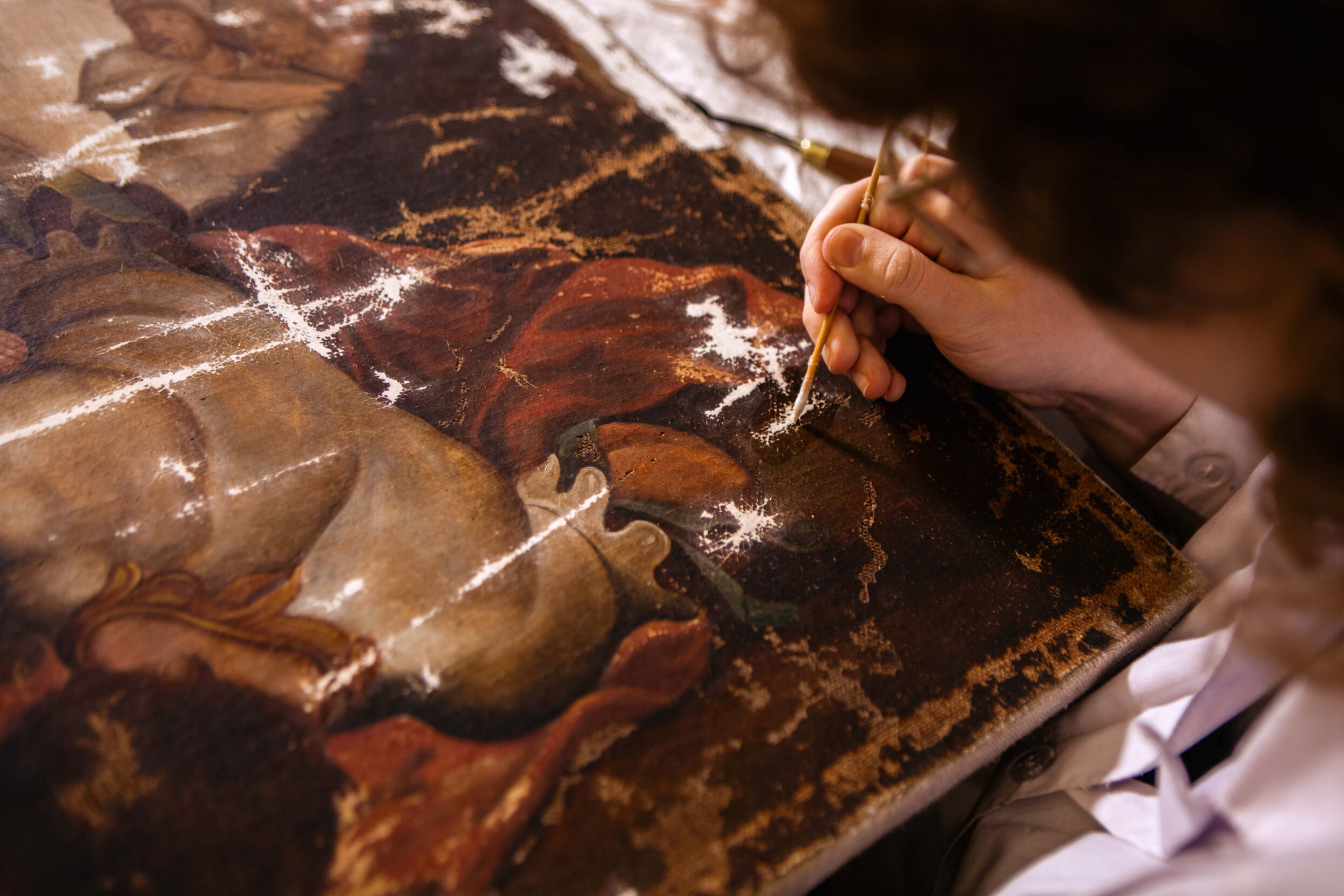
Yulia Troshyna restores the base layer of ”David slays Goliath” at the National Research Restoration Center of Ukraine in Kyiv. This is a 19th century painting of unknown provenance, which was evacuated from one of Ukraine’s museums in Sumy in the northeast. She’s filling spaces in the painting with levkas. When the mixture dries and hardens, she will paint over it. Photo: Kang-Chun Cheng.
Reporting for this story was supported by the International Women’s Media Foundation’s Women on the Ground: Reporting from Ukraine’s Unseen Frontlines Initiative in partnership with the Howard G. Buffett Foundation. Additional reporting for this story provided by Svitlana Vlasova.
Kang-Chun Cheng
Kang-Chun (KC) Cheng is a photojournalist based in Nairobi, Kenya, reporting on environmental and social issues around the world.