

Ad Free. Reader Funded.
Hidden Compass is on Team Human. This article was not written by generative AI. Support the journalist and editors of this piece with a direct contribution!
% of $ Goal
Total number of contributions so far:
0
Total amount raised for journalists
$0
"One thing I really appreciated about working with Hidden Compass is that it's a space where there is time for nuance and complexity. By donating, that's what you're supporting. You're able to help us as writers, but also as an outlet, continue to tell these kinds of stories."
- Anna Polonyi, Hidden Compass Journalist
"The reason why I contributed was because the article that I read really resonated with what I was feeling. I felt like the author was in my head... It just moved me and I felt like I needed to do something."
- Hidden Compass Reader
This story has been published in the 2025 Pathfinder Issue of Hidden Compass. While every story has a single byline, storyteller proceeds from patronage campaigns in this issue will go collectively to Team Rebel Reef.
“Three, two, one … go!”
The small, wooden fishing boat creaks as I backroll off the side into the azure waters of Tela Bay, Honduras, in May 2023. Even after hundreds of scuba dives on different Caribbean coral reefs, I have no idea what to expect — and that possibility leaves me intrigued and obsessed.
The corals here defy what we know from coral science, I’ve been told. The reefs are thriving. Nobody knows why. The possibilities of adventure and discovery beckon as I reorient myself beneath the waves.
A month earlier, I would’ve told you that the story for coral reefs has been mostly written, and that our collective chance to change that ending looked slim. Indeed, the scientific projections for these ecosystems are almost universally poor: Warming oceans threaten corals around the world and all the diverse and beautiful creatures that call them home. I’ve studied this trajectory, and fought against it for decades as a renewable energy lawyer, scientific diver, and coral restoration practitioner.
But now, I find myself here in Tela, eyes wide open, eager, and almost hopeful, for these mysterious reefs to prove me — and the world — wrong.
~~
We glide effortlessly over mounds of coral and grooves of sand, and I am astounded by the seeming living contradiction before me: Endless hills and patterns of every kind of coral I can imagine are here, thriving right next to a city with tens of thousands of people. I see species that died off years ago in the Florida Keys, where I live, and things in colors and sizes I didn’t know could exist. “It’s unreal. I couldn’t stop staring at it,” I later say, remembering the moment. “It was insane.”
“This is why we do this. For them.”
We round a corner, and Antal Borcsok, a local dive shop owner and this reef’s most staunch champion, is almost rushing because he’s so excited. The wonder that’s taken over his whole life since discovering this reef nearly 15 years ago unfolds before us as he grabs my arm and pulls me along, happily humming into his regulator.
Suddenly, he lets go and zooms ahead, before spinning around to lie on his stomach in the sand right next to a huge shadow. His head sits playfully in his hands, and his fins cross behind him, like a child eagerly waiting for the adults to figure out his very obvious secret.
I swim closer, until the water’s haze gives way to rich details in the shadows: leaves and waves of coral polyps, all fat and plump; tube worms with their feathery appendages; and fish of all shapes and sizes cruising between the layers of life. There is so much to see and experience.
Wow. This whole thing is ONE coral. I shake my head in disbelief as I peer beneath each layer.
“Casita,” as we’ve come to call her, is a giant Orbicella faveolata coral, maybe 500 years old. Corals are technically animals, and most are hermaphrodites, including Casita. Still, I like to personify and gender Casita because she’s my favorite coral in the entire world, and I love her.
She remains the biggest and healthiest coral I’ve ever seen. At over 80 feet across and 25-30 feet tall, she’s the size of a small house — hence the name. I’m blown away as I reflect on how much change she’s witnessed, on how long this colony has stood here in Tela, unknown and unassuming.
Back on land, we rinse the salt off our gear and bodies. Christian Carias, Tela’s first certified divemaster, recaps what feels like a scientific impossibility and an environmental miracle: “One of the things that I really, really love about this reef is that things that are affecting other reefs are not affecting Tela. That’s why they call it El Arrecife Malportado, which means, ‘The Misbehaving Reef.’”
The sparkle in his eye tells me that there’s more to his story.
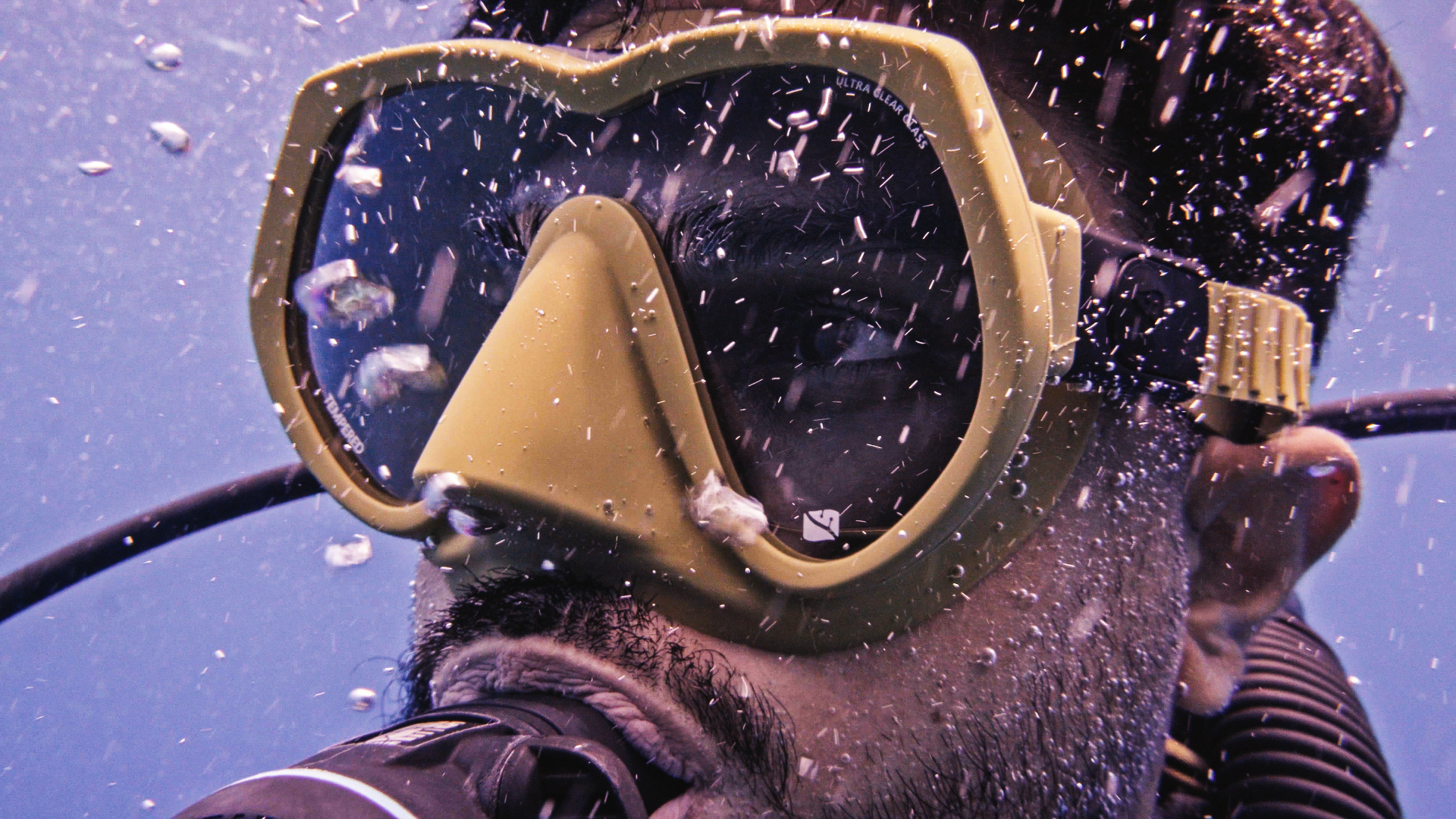
Rebel Reef expedition leader Christian Carias, the first dive master in Tela, Honduras, has a special connection to El Arrecife Malportado. Photo: Patrick Krum.
~~
When we arrived the night before, the city overflowed with colors, sounds, lights, and movement: Performers in swirling skirts and horse costumes trotted about, while singers from all over the country crooned to the adoring crowds. Young and old flooded the town center to celebrate the 499th anniversary of Tela’s founding. The date actually commemorates when Spanish conquistador Cristóbal de Olid landed here and established the town, Antal told us.
“Honduras was conquered, not colonized,” he explained as he weaved us through the crowds to get a better look at the dancers. “The Spanish didn’t stay and establish roads, infrastructure, and things like that that would help us. That stuff became the groundwork for future governments elsewhere. But for us, they just came and took our resources and left.” More softly and more pained, he added, “So it’s no wonder Hondurans still think there’s nothing here worth staying for.”
I sensed the hurt in his words. Antal has dedicated his life to bringing attention to Tela’s rich natural resources, and specifically to these corals. He’s keenly aware that people can only protect what they know, and they know what they’re taught. So, in Antal’s eyes, the survival of his beloved reef hinges upon more people knowing about it and caring enough to fight for its survival. Tela’s relative obscurity (compared to nearby international dive destinations Roatan and Utila) and the reef’s actually hard-to-believe and inexplicable health leave it vulnerable to skepticism, overdevelopment, agricultural and urban pollution, neglect, abuse, and the worst fate of all: abandonment by the people of Honduras.
That’s why, when he read author Juli Berwald’s book about corals, he emailed her cold, inviting her to come see for herself. When Juli casually mentioned Tela to me, I couldn’t snooze the wonder that her little mention had planted in my brain. And so, I tagged along with Juli for her second visit, which is how Antal ended up hosting us on this anniversary.
Through Antal, I also come to understand the nuance of what the historical disregard has meant to his nation. To know one’s country “wasn’t even worth colonizing,” a fate that itself certainly brought terrible ills along with benefits, has created a crisis of identity and self-worth in Honduras. The young people are told that “their country is crap,” Antal says, so, by the time they are able to, they leave.
Immigration and economic studies support his claims. A comprehensive 2019 study on migration by Creative Associates International (CAI) revealed that 32% of Hondurans intended to migrate – the highest of the three Central American countries assessed. As the third-lowest-income country in the hemisphere (surpassed only by Haiti and Nicaragua), Honduras cannot offer much to its people in terms of economic opportunity or security. The Norwegian Refugee Council (NRC) has been working in Honduras since 2014, and a 2024 article noted that nearly 30% of the Honduran population is in need of humanitarian assistance. The NRC research listed poverty, gang violence, political persecution, unemployment, and lack of opportunity as the driving factors behind the mass migration out of Honduras.
And so, as Antal laments, youth – respondents aged 18 to 29 — have few incentives to build a future in Honduras. The same CAI study found that nearly 52% of young women surveyed planned to migrate, along with 40.7% of young men surveyed.
Defiantly stubborn, Antal wants to give them reasons to stay.
Like the reef that moves him to tears, Antal wants Honduras and its people to challenge their odds and to remain resilient. His weapon of choice is outreach, inspiration, and wonder.
~~
The reefs are thriving. Nobody knows why.
Just one week of diving on this miraculous reef leaves me feeling more hopeful than years of work in coral restoration.
Most corals prefer perfectly clear waters without nutrients, relying on photosynthesis by the symbiotic algae within their tissues to produce up to 90% of their energy. In Tela, this relationship wouldn’t work: The rainy season here makes the water cloudy and turbid for more than half the year. The algae wouldn’t be able to photosynthesize enough in these waters to support life at the scale that exists here in Tela. And yet, Tela’s misbehaving reefs thrive in these conditions that would be inhospitable to most other corals. Maybe that’s why so little science has been done here: People cannot believe that corals could survive these conditions.
How could nobody know about this place?
I am so moved by the richness and health of Tela’s reefs that I immediately know we must take action. So when we return to the United States, Juli, another friend, Heather Kulkhen, and I establish Tela Coral as a US-based nonprofit with the mission of facilitating science and storytelling about Tela’s incredible ecosystems to ensure their longevity.
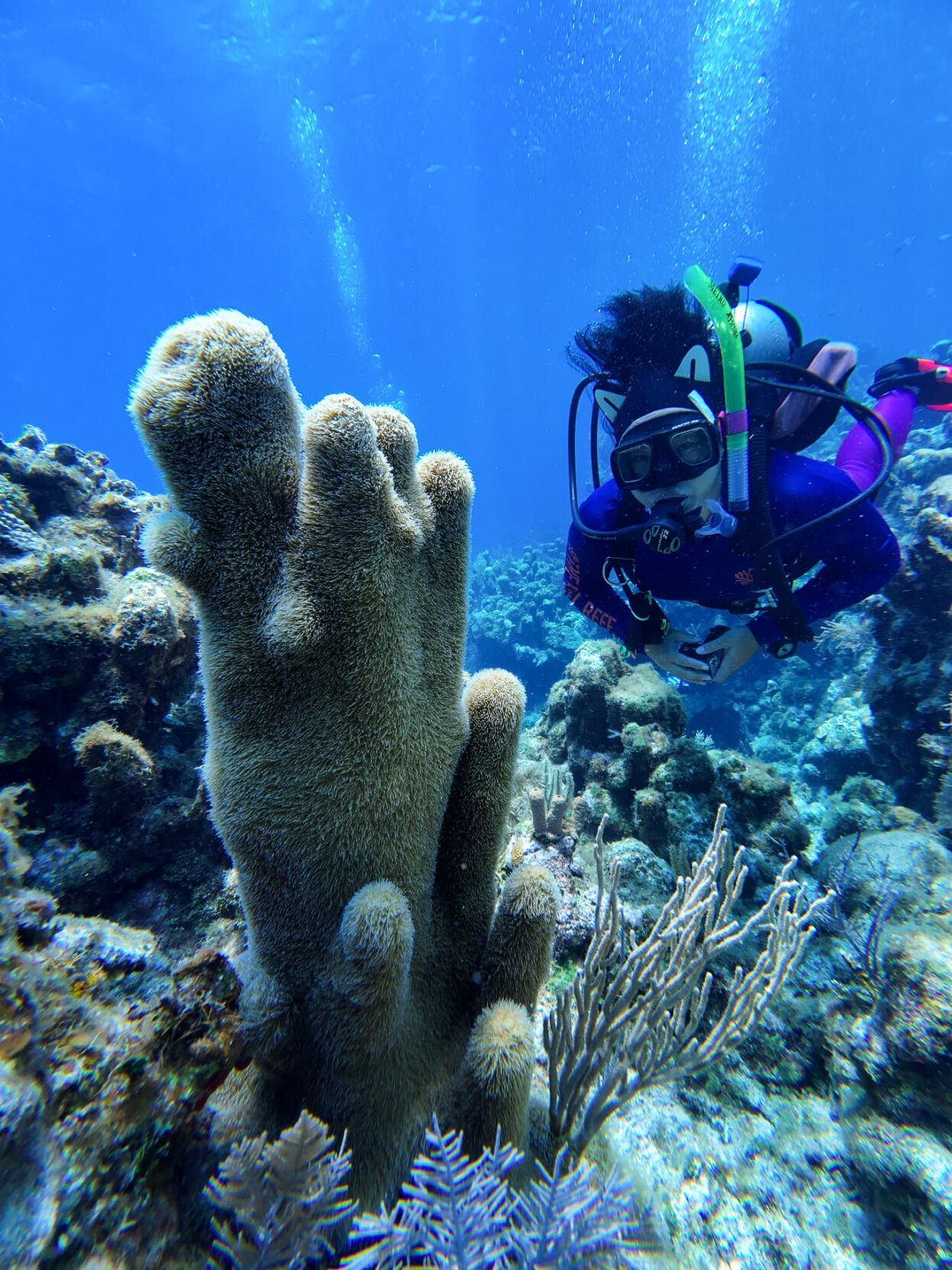
The author, Pathfinder Tiffany Duong, observes a pillar coral in the waters off the coast of Honduras. Photo: Caribbean Reef Guardians.
~~
A few weeks after our eye-opening first visit to Tela, Antal texted in despair. Something was happening on the reef.
Christian was one of the first to observe it: a milky white substance floating over the corals for three days; then, a large patch of reef began to die. The rusty oranges and browns of healthy corals gave way to white skeletons and then the cruddy brown of turf algae that comes in after death. Christian told Antal, who went out to survey the damage. He couldn’t stomach the destruction. This reef, his beacon of hope against so many big, bad, hard things in his world, was not invincible.
How long would the death last? How far would it reach? Nobody knew.
After Antal’s desperate messages, we were speechless. How could this be? We were just there, and it was a wonderland of life and abundance. So wonderful, it would have been impossible to believe if we hadn’t seen it with our own eyes. And now, it was dying? Just like that?
We returned later that year with bated breath. In particular, I wanted to see Casita, who lived in the “death zone,” the part of the reef that experienced this mass-mortality in June.
She’s my favorite coral in the entire world, and I love her.
When we dropped down in October, the reef was muted instead of the vibrant greens and purples that had greeted us in May. The Agaricia lettuce corals looked like they’d been bombed out, now crumbling and brown with decay and algae. My usually calm mind quickened with anxiety as we got closer.
Antal had warned us that he hadn’t been back to Casita because he feared she didn’t survive.
~~
A couple of years later, when we committed to making a film about Tela, our director, Brynne Rardin, knew she wanted to feature Christian. She’d been there in October 2023, after the mass mortality event, as Christian guided us to survey what happened, and — importantly — what remained.
Instead of lamenting the losses, he focused on the reef’s resilience. Yes, there was a significant death, but there was still so much life. The reef wasn’t invincible, but it was still sly, and mysterious, and full of unanswered questions. Brynne saw that same mischievous sparkle in Christian that had caught my eye when he’d first introduced me to The Rebel Reef.
After our Pathfinder Prize win, in one of our first pre-production interviews with Christian, the “Aquaman of Tela” confided that the ocean had saved him. I often say that, too, because I credit the sea with rescuing me from a life I would have hated. Brynne also shares this sentiment. So, when Christian uttered this phrase that so many ocean lovers repeat, I expected a similar story. But what he shared next had us all in tears.
Despite two years of knowing and diving with him in Tela, he’d never mentioned the motorcycle accident in 2017 that nearly cost him his life. He was a new divemaster working with Antal, excited to share the reef with local students. One night, on his way home to eat dinner with his parents, a car crashed into him.
In an instant, everything that mattered flashed before him. He lay on the side of the road, bleeding and broken, as the mayor, fellow townspeople, and eventually his parents came to his side. He — and we — cry every time he describes the guttural shriek that his mom let out when she saw him.
Christian shared his life’s most challenging moments with a smile, full of gratitude and grace. His injuries were significant: At one point, an exposed fracture threatened amputation of his arm. He endured a dozen surgeries, with doctors warning him that he might never walk again, let alone dive.
“You live in Tela, you have the best medicine right there,” his doctor had instructed. “Go to the water.”
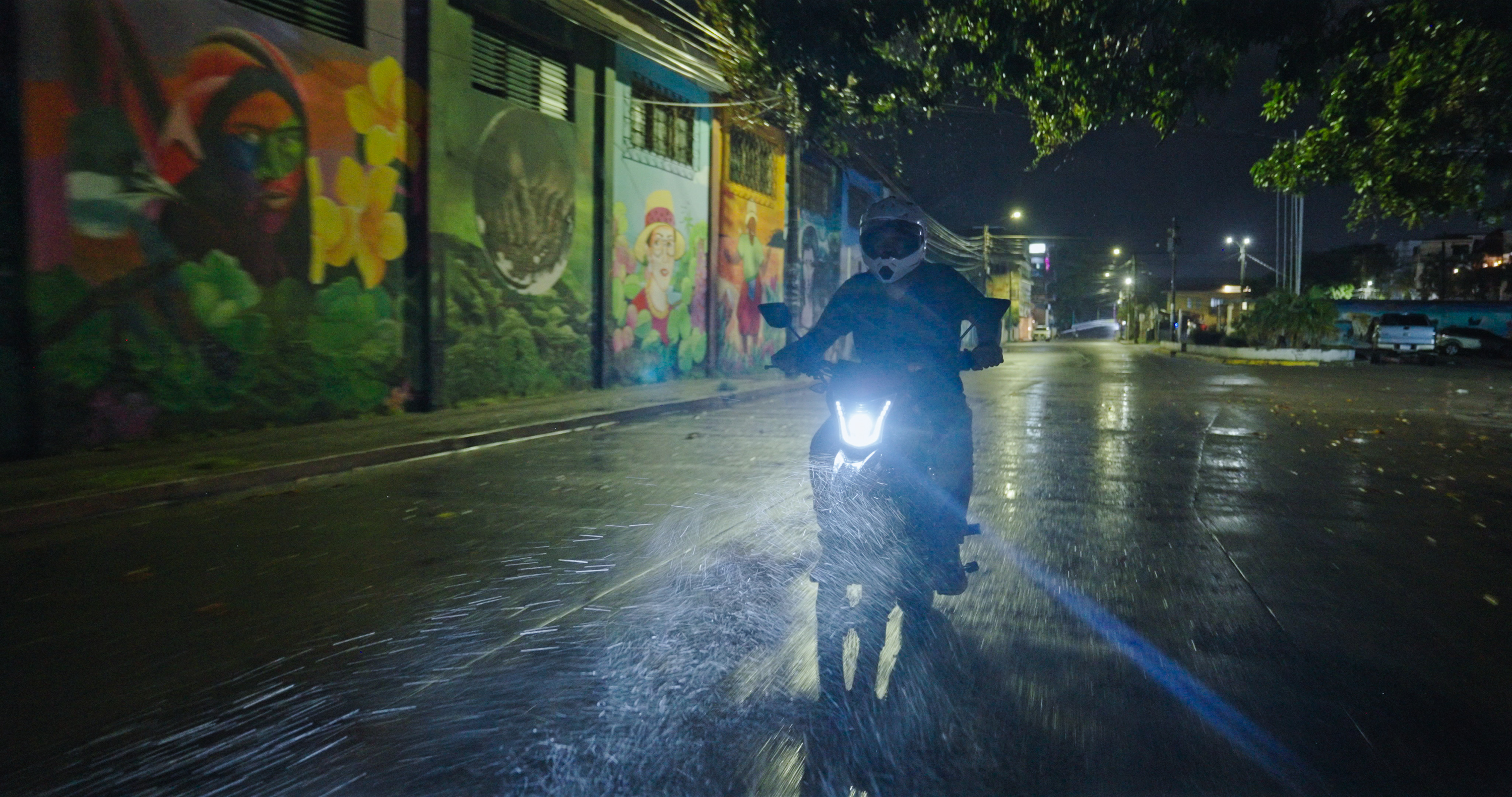
Christian rides his motorcycle on a rainy night. Photo: Patrick Krum.
Not fully believing, Christian went anyway, asking therapists, friends, and family to help him hobble to the water’s edge.
“I let the water touch me,” he confessed, “but it touched not only my skin, but my soul.”
Rapt, and in tears, he told us about his miraculous recovery, about relishing in life’s simplest joys — like standing to take a shower or eating without assistance — about keeping faith and a positive outlook, and about finally getting back to what he loved most: diving on this reef.
~~
As we round the corner, her looming shadow comes into sight. I catch my breath, every part of me hoping that she has survived.
With each kick, we approach her base, just as we had the first time we met her. Forgetting I am even underwater, I rush toward her like I would for an ailing grandparent in a hospital bed, needing the physical assurance that she’s still okay, still there with me. Finally, I see her bottom layers, now dead and overgrown with brown turf algae. Oh. I forget to breathe.
The simultaneous silence and screams inside of me fade as Antal inches up to Casita’s lowest layers. I note a change in his posture, a softening.
He lays his hand gingerly on a bottom layer and looks upward, at the top layers that are still alive, still fighting. She’s not dead. She’s still there. I don’t know what’s going through Antal’s mind at this moment, but relief, gratitude, and reverence flood mine.
Yes, this reef is not impervious and immune like we’d — perhaps foolishly — thought. But Casita has survived, and so has a significant portion of the reef. This means there is still a lot here to witness, to study, and to be inspired by. We might just have to look a little harder and believe a little more. Back on the boat, I am exuberant.
“Hope, still!” I keep saying. “HOPE, STILL!”
~~
During filming in May 2025, Christian’s parents invited our entire Pathfinder and science teams to their house for a thank-you party.
When we pulled up the dirt road to their white iron gate, the side courtyard was already set up with tables and chairs to accommodate all 22 of us. Cerveza in hand and a beaming smile on his face, Christian tended to the barbecue as he welcomed us in and told us to make ourselves at home. We feasted on the meat his parents had driven in the day prior as they doted on us all, making sure that we wouldn’t leave hungry, that we knew we always had a home here in Tela now, and that we knew there was more partying to be done.
It was a warm and intoxicating night, and we all quickly felt drunk on the love radiating from this family. Christian and his dad sang karaoke duets — so the latter could show off his English to us, the younger Carias joked. Easily, we recognized the same twinkle we know Christian by in his father’s eyes, too.
Toward the end of the evening, Christian’s dad took the karaoke mic and spoke from his heart about “his hero” — his son. He told us how, throughout Christian’s recovery, which was intense and long, Christian always smiled and was just grateful to be alive.
“We can all learn from the resilience of our son, and from the rebelliousness of our reefs, how to survive, how to keep going forward.”
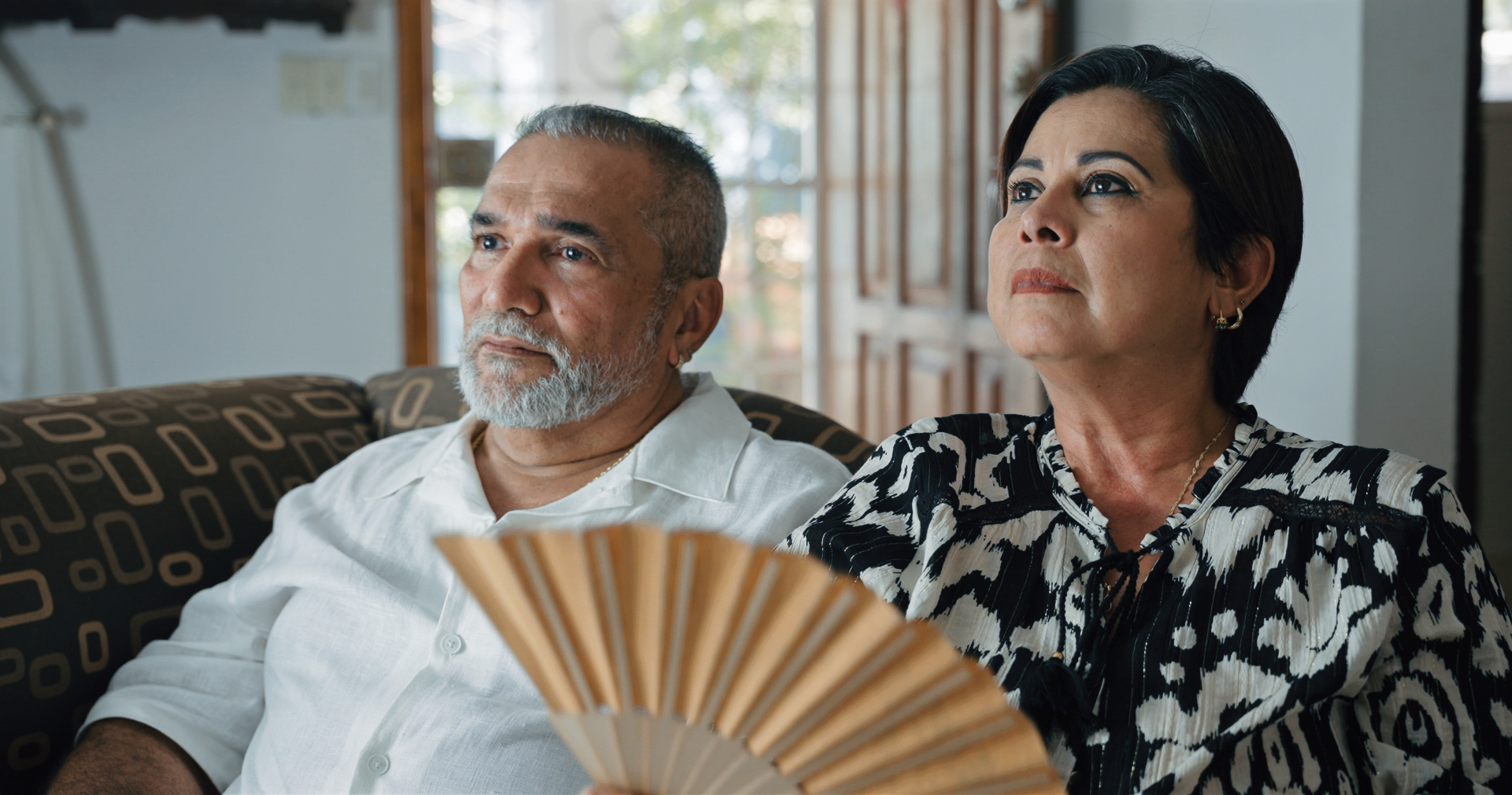
Christian’s parents welcomed the Rebel Reef team with joy and gratitude. For them, watching their son overcome his horrific accident was painful and inspiring. Photo: Patrick Krum.
~~
Our film team left that night buzzing.
Sitting on the second floor patio of our modest hotel, surrounded by fluorescent lights, power wires, and mosquitoes, we stayed up well into the morning to do justice to the story of Christian’s resilience and recovery, and that of the reef.
“This is why we make art,” said Director of Photography Patrick Krum. “This is why we do this. For them.”
~~
It was a wonderland of life … so wonderful, it would have been impossible to believe if we hadn’t seen it with our own eyes.
Back at the party, after the elder Carias’s emotional tribute, Christian’s mom took the mic. Softly, haltingly, she recounted how hard the accident was for their family and how strong her son was through it all. His strength had kept them going when they didn’t think that was possible. He has an immense spirit, too, she added. Her tears were barely noticeable above our own.
And then she thanked us, graciously and honestly, for our care, our time, and our work to share Christian’s story. She thanked us for believing in him and in Tela’s reefs.
Gracias por darse cuenta de mi hijo. Thank you for noticing my son.
“I know I’m his mom, but his heart is very special,” she said. “Thank you for seeing his heart.”
Tiffany Duong
Tiffany Duong is a 2025 Pathfinder Prize winner and the executive producer for “The Rebel Reef: Seeds of Hope.”