



Support Hidden Compass
Our articles are crafted by humans (not generative AI). Support Team Human with a contribution!
This story has been published in the 2025 Pathfinder Issue of Hidden Compass. While every story has a single byline, storyteller proceeds from patronage campaigns in this issue will go collectively to Team Rebel Reef.
As I stared at the fluffy white clouds over the blue expanse of sea, all I could think was that it would only take me three short hours to leave Houston behind, soar over the Gulf, and land in a country I knew almost nothing about.
This unexpected trip had started with an email from a stranger in 2022. A man named Antal Borcsok, who had read the book I’d written about coral, Life on the Rocks: Building a Future for Coral Reefs, reached out. I had never received an email like his before.
Antal wrote that he co-managed a coral reef in Tela, on Honduras’s north coast. At a time when the loss of coral reefs is rampant, I found what he told me hard to believe: This reef, he said, was not suffering from any of the ailments that plague today’s corals. No bleaching. No coral disease. No disease of sea urchins or sponges either.
On our first video call, his charismatic smile lit up the screen. He spoke rapidly, emotionally, and with a knowledge of and enthusiasm for coral reefs that streamed across the miles. Antal listed the diversity of corals that live in Tela and explained the reef’s environmental conditions.
“I don’t know why the reef is misbehaving.” He said almost no science had been done there. “But I have a lot of hypotheses.”
No one yet knows why the corals in Tela are healthy. Although Antal tried to get scientists to pay attention to the misbehaving reef, few had shown up, and those who had hadn’t stayed long enough to make headway. Despite Antal’s efforts, little science had been done there.
“Come see it yourself,” he said. “Just fly down. We’ll take care of the rest.”
I had one of those strange feelings that I rarely experience in life, when, for a split second, I feel like I’m being asked to make a decision that just might change everything. After I hung up with Antal, I found my husband making coffee in our kitchen.
“I think we have to go to Honduras?” I queried.
“Honduras?” he asked, unaware of my conversation with Antal.
“Yes.” It wasn’t a question any longer. I was certain I had to see this misbehaving reef, though I still couldn’t understand how its existence was even possible.
~~
The challenges today’s corals contend with stack one upon the other to make it nearly impossible to see how they can overcome them. And the stakes are high. Coral reefs, which take up less than 1% of the ocean’s area, are disproportionately important to our planet. They support a quarter of all marine life, some 830,000 species. Approximately a billion people worldwide rely on reefs. They are the coastline’s best defense against ever stronger storms, diffusing 97% of their energy.
These marine heroes are animals, cousins of jellyfish and sea anemones. Their superpower is an intimate partnership with single-celled algae, sometimes called zooxanthellae, or fondly zoox (rhymes with looks). These algae live inside the coral’s tissues and photosynthesize, making sugar, which typically provides 90% of the coral’s nutrition. That bountiful solar energy allows corals to build underwater cities of their limestone skeletons.
Except that the symbiosis has a weakness. When water temperatures rise 1°C (1.8°F) above normal highs for a prolonged period, the partnership dissolves. The algae leave. The coral, devoid of sugar, starves. Without the algal color, the coral bleaches, and we see through the clear coral tissue to its white skeleton. If water temperatures fall, the symbiosis can be reestablished. But if a few more weeks pass without a break in the heat, the coral dies. The process can be devastating. Half the world’s reefs have already been lost. In the Caribbean, the rate is as high as 80%.
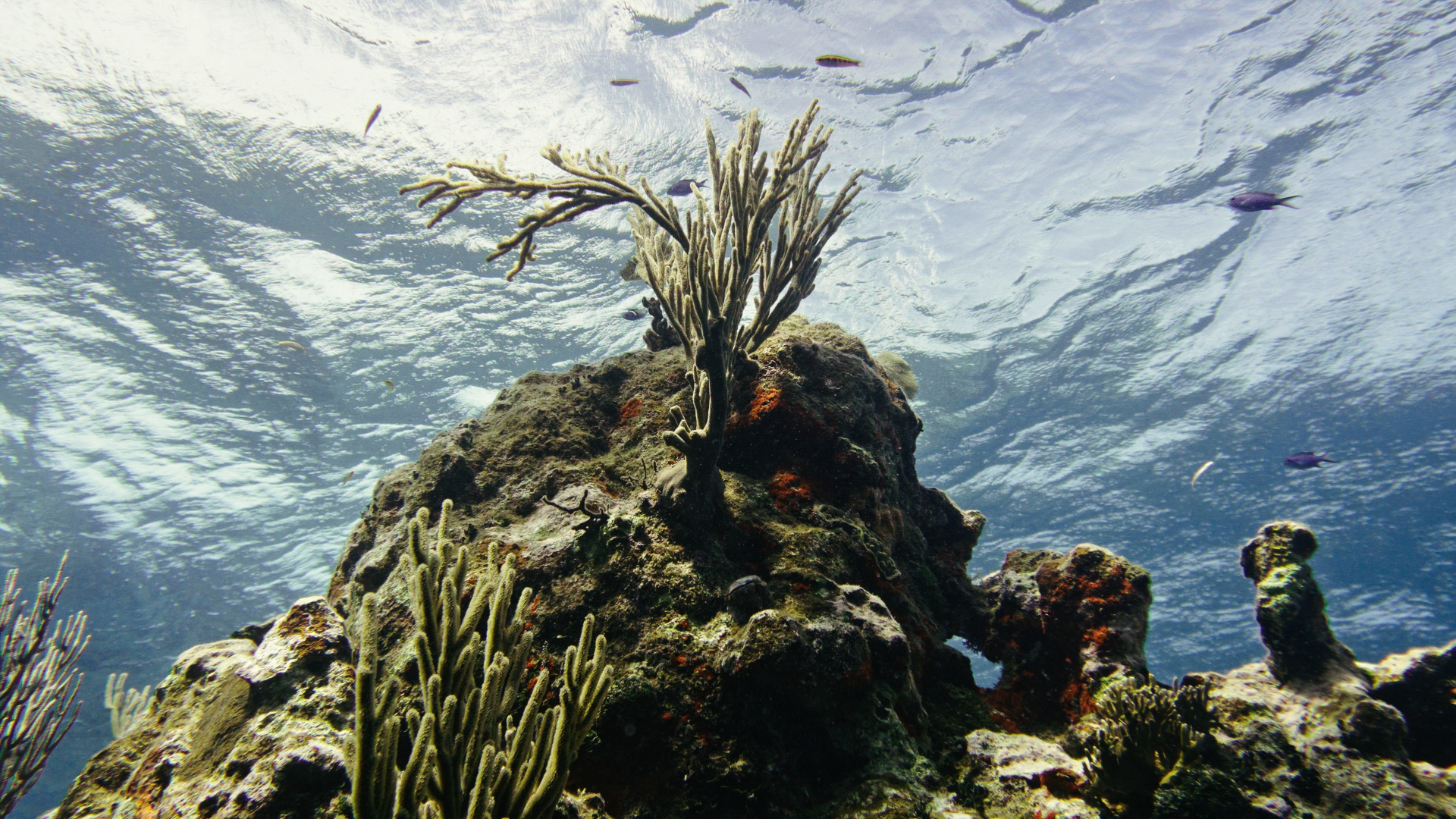
A coral formation sits beneath the water off the coast of Tela, Honduras. Photo: Patrick Krum.
Among the Caribbean’s most affected corals are Acropora palmata, the elkhorns. It’s one of two species that dominated the tops of reefs for hundreds of thousands of years. Hundreds of millions of colonies formed intricate, wild tangles where schools of fish dashed, snails cruised, urchins grazed, worms squirmed, lobsters clacked, and so much more.
Those thickets are gone. Acropora corals in Florida have just been declared functionally extinct. The only survivors are elkhorns taken from the ocean and now live in tanks on land.
In addition to the losses from bleaching, corals also face disease. Since 2014, a terrible plague has ravaged the Caribbean. Called Stony Coral Tissue Loss Disease, or SCTLD, it attacks half the Caribbean coral species and destroys coral tissue. The disease originated in Florida, jumped into the greater Caribbean, and reached Curaçao by 2023.
And it’s not just corals that face disease. A lynchpin of Caribbean reef health, spiny sea urchins, Diadema antillarum, mow down seaweeds that compete with corals for space. In 1983, in what’s often considered the largest modern marine mass mortality, Diadema populations cratered. Although abundances never fully rebounded, some recovery occurred. But in 2022, another disease front swept through, knocking down populations again.
Still, Antal had told me that the corals in Tela were, like some kind of coral superhero, resistant to bleaching and disease. He said there were plenty of urchins. He told me that there were still thickets (thickets!?) of elkhorn corals left. It all sounded fantastical.
~~
Three months after we first spoke, Antal and his wife, Alejandra Thompson, met my husband and me at the airport gate in San Pedro Sula, greeting us with hugs as if we were old friends. Antal is tall and lanky, wearing what I would learn was his standard uniform of a button-down tech shirt, rolled up to the elbow, and hiking pants. Alejandra, short with dark straight hair, was wearing stylish jeans and high heels. Like her husband, she has a smile that brightens a room. We loaded into their SUV for the hour-and-a-half drive almost due north toward Tela and the Caribbean Sea.
They dropped us at La Ensenada, a hotel with frogs chirping in a river near its entrance and peacocks strolling the parking lot. Antal owns and operates the dive shop located on La Ensenada’s property. He pointed it out to us.
“Meet here tomorrow at 7 a.m., ready to dive.”
~~
The sea lay flat and sparkled in the early sun. We organized our dive gear and waded into the shallow water where the dive boat was waiting. After we climbed aboard, Antal pointed us toward a dive spot called Barracuda’s Den in the center of the bay. Looking back toward land, the shoreline was a roller-coaster of mountains covered in rich green jungle.
… something remarkable happened.
After about twenty-five minutes, we tied up to a floating bleach bottle that marked the site where I’d get my first look at the Rebel Reef. A compass jellyfish greeted me as I descended about 35 feet to the sea floor. I was floating, amazed, above the thickest carpet of Caribbean reef I’d seen in decades. Soft corals waved like flags over a mosaic of brain, boulder, and maze corals, all highly susceptible to SCTLD. But I saw no sign of the disease.
Black spines poked out of the spaces between colonies, evidence of healthy urchins every foot or so. Rounded finger corals squeezed in beside the corals that look like fronds of lettuce. A lobster retreated to its den. Black and blue angelfish, red speckled snapper, and bossy neon damselfish darted in and out of crevasses.
This reef was all as real as Antal had claimed. I spun in a circle with childlike joy, recording the richness of a world I thought had faded from our seas.
~~
The next day, we climbed aboard the dive boat again and headed an hour west to the edge of Tela Bay to see the elkhorns. Because they prefer the shallows, I didn’t even need to flip off the boat to see that the health of these animals was unmatched anywhere else I had traveled. From the surface, their broad circular fronds, edged in white piping, overlapped with their neighbors like petals on giant flowers in a vast garden.
With my scuba gear on, I was swallowed up in the thickets – and, yes, they are thickets – of the regal corals. From the side, elkhorn boughs branched at regular angles. Gazing through the jungle, their forms came together in a breathtaking fractal V formation. We swam for hundreds and hundreds of meters through the groves. All I kept thinking was, These animals are basically extinct. I’m swimming with a massive herd of white rhinos.
~~
When my husband and I flew into Honduras, I’d watched out the window as the countryside came into view: lush jungle cut into quilt squares of agriculture. Snaking its way through the greenery was a thick, ochre, sediment-rich river. It may hold the clues to one possibility for why the corals here are so much healthier than their counterparts elsewhere.
Massive waterways drain most of Honduras and empty into the Caribbean within mere kilometers of Tela Bay. But there’s something about the rivers and their sediments that might help the corals. When we think of coral reefs, we often think of crystal-clear waters. That’s because corals exposed to more sunlight provide more energy to their zoox for photosynthesis.
But as ocean temperatures warm, scientists have observed that sunlight can be a drawback. Some reefs in more murky water survive heatwaves without bleaching. Like putting up an umbrella on a hot day, the sediments might act like a shade for the corals. Maybe that winding river I had seen from the sky provided protection against the blazing sun in a warming world.
That’s just one hypothesis.
~~
On our first day in Honduras, as we drove north, we passed through plantations that dominated 20th-century Honduras. The writer O. Henry, fleeing accusations of embezzlement in Texas, spent half of 1896 in this region. His first book, Cabbages and Kings, is set in a fictional country called Anchuria, but it is certainly Honduras. In it, he coined the phrase that’s come to be associated with corrupt governments (and, bewilderingly, a clothing retailer) in a toss-away sentence: “At that time we had a treaty with about every foreign country except Belgium and that banana republic, Anchuria.”
Antal had told me that the coral in Tela were, like some kind of coral superhero, resistant to bleaching and disease.
Honduras’s vast banana plantations of the past have been converted to palm oil, a more profitable crop in today’s markets. We drove past groves and groves of them, the patterns of tree trunks planted in rows shifting like a green and brown kaleidoscope.
These plantations, which have been streaming fertilizer runoff into Tela Bay for over a century, are central to another theory of why Tela’s corals are resilient. Having had decades of exposure to fertilizer runoff, perhaps they managed to adapt, using the chemicals, or the impacts of the chemicals, to their advantage.
If this theory is true, corals in Tela have become less dependent on their zoox due to plentiful zooplankton. Zooplankton, a vast menagerie of little crustaceans like copepods, amphipods, and isopods, as well as all kinds of invertebrate larvae, eat phytoplankton — the single-celled algae at the base of the ocean’s food chains. Phytoplankton need the chemicals present in fertilizer to grow and divide. So the fertilizer boosts the amount of phytoplankton available for zooplankton to eat. And while corals usually get their energy from zoox, they can also eat zooplankton. This is what scientists call heterotrophy: from the Greek “hetero-” meaning other and “-trophos” meaning feeder.
Maybe in Tela, heterotrophy has strengthened the corals’ immune systems, allowing them to better ward off disease or withstand higher temperatures. Or perhaps it’s something else about the symbionts entirely.
~~

Author and scientist Juli Berwald peers at a sample through a microscope. Photo: Patrick Krum.
Back in 1987, I snagged a summer job as an intern in a marine ecology class at the Marine Biological Lab in Woods Hole, Massachusetts. One of the students in the class was a lanky, blond, newly minted Ph.D. named Rob Rowan. Rob was trained as a classical geneticist working on fruit flies, but as an avid diver, he thought working on marine animals would be a lot cooler. Sitting in a lecture about coral one morning, we learned about zoox.
As I remember it, Rob raised his hand and asked the instructor, “How many species of coral are there?”
“Somewhere around 800 to 1,000,” came the reply.
“And how many different species of zooxanthellae are there?”
The instructor shook his head, unable to answer the question. “They all look the same under the microscope.”
“Has anyone done any genetics on them?” Rob asked.
“Not that I know of.”
Rob leaned back in his chair and crossed his arms across his chest as if to say, “I just figured out why I took this class.”
No one yet knows why the corals in Tela are healthy.
A few years later, Rob published the first major paper on zoox genetics in Science. He identified four genera, which he dubbed A, B, C, and D until algal taxonomists could assign official names. (Genera is the plural of genus. A genus can contain one or many species.) Today, 15 genera of coral symbionts are formally recognized, although the total number could eventually reach dozens. Rob’s A, B, C, and D are all still valid and have been given proper names, with the “D” group now known as Durusdinium.
Subsequent research revealed that Durusdinium was a newcomer to the Caribbean, originally from the Pacific Ocean. Over the last few decades, scientists have watched as corals in the Pacific began associating with Durusdinium instead of the symbionts they’d previously hosted, a process known as symbiont switching.
Durusdinium, it turns out, offers a hedge against corals’ weakness. Corals that host Durusdinium don’t bleach even on some of the hottest reefs in the world. Durusdinium may also provide protection against the devastating coral disease SCTLD. But there’s a trade-off: This zoox genus slows coral growth — in some cases by a half.
The trade-off might be worth it in today’s hotter seas. Corals could be adapting to grow more slowly rather than starve during bleaching. Tela’s corals, having suffered in hotter water than other corals, and which might be bolstering their growth through heterotrophy, might have been early adapters to the new zoox.
~~
After that first visit to Tela, the reef wouldn’t leave my mind. I told my friend Heather Kulkhen and fellow expeditioner Tiffany Duong about this remarkable place. When they came to Tela with me on a return visit, we knew we had to do something. Together, we founded the non-profit Tela Coral, whose mission is to bring science, storytelling, and community engagement to Tela’s rebellious reefs.
During our first official Tela Coral visit, Antal took us on an excursion to Los Micos Lagoon, one of Honduras’s largest, separated from Tela Bay by a narrow sand bar. The sand bar opens during the winter rains, and Antal wondered if the intermittent connection to the bay might impact Tela’s reefs.
The lagoon is surrounded by extravagant mangroves, and we puttered through channels in their intricate root systems. More than 300 bird species live among their boughs, and we saw three types of kingfishers and four types of herons within minutes.
It’s like trying to build the strongest poker hand when you don’t know what’s going to turn up next on the pile or what the other person’s holding.
Antal ran the boat aground on a beach, setting a squadron of birds aloft. “This sand is very strange,” he said. “I want to show it to you.”
While most of the sand in Tela is off-white, this beach was inky black.
“Feel it,” Antal said, grasping some in his hands and handing it to me.
It was odd: smooth and very heavy.
“I think this sand might be important to the reefs,” Antal said. “After storms, Tela’s beach is coated in this sand.”
I rubbed the sand between my fingers. Despite having worked in ocean research for thirty years, I’d never heard anything about sand and coral health.
“Think about it,” Antal continued. “We have hypotheses for what could be keeping the coral healthy. Sediment. Heterotrophy. Symbiont switching. But what about the urchins? Why are they healthy? It has to be something in the environment. At least consider it.”
So, I did. I took a vial of sand home to Texas and asked a geologist to analyze it. A few weeks later, I got a report. The black sand was composed of 23% titanium.
“That’s a lot of titanium,” the geologist wrote when he sent me the spreadsheet.
Those results sent Antal and me down a titanium rabbit hole. The sand probably contains titanium in the form of titanium oxide, TiO2. In the presence of ultraviolet light, titanium oxide produces oxidants, like hydrogen peroxide. Hydrogen peroxide, as anyone who’s ever treated a scratch knows, is good at killing bacteria. Perhaps, the black sand acts like a yearly wash with an anti-bacterial cleanser, slashing the pathogens that cause diseases in all reef animals — corals as well as urchins.
~~

A researcher reviews his data about the incrediidle Rebel Reef. Photo: Patrick Krum.
Now, inspired by the resilience of Tela’s corals, there’s a lot of exciting research happening. In November of 2022, I was writing an article about symbiont switching. I interviewed Andrew Baker, who leads the Coral Futures Lab at the University of Miami. Andrew had worked with Rowan on the groundbreaking zoox genetics work back in the 1990s. I mentioned Tela’s misbehaving reefs and asked if Andrew would investigate.
In July of 2024, Andrew and his students arrived in Tela and something remarkable happened. They placed elkhorn fragments in small tanks and warmed the water to see how hot the corals could handle. Their research is still unpublished, so it’s too early to draw any conclusions, but from what I’ve been told, Tela’s elkhorns were more thermotolerant than any other corals they tested.
Of course, Tela’s corals are not invulnerable to bleaching events — or any of the other threats facing corals around the world — but understanding their resilience could be a game changer in the fight to save coral reefs.
And Andrew isn’t the only scientist who showed up. This summer, Jonathan Jung from Max Planck Institute in Germany brought equipment to core through coral skeletons. (It doesn’t hurt the coral.) Like tree rings, coral skeletons record how much of a coral’s nutrition came from heterotrophy and how much from the zoox. As of publication, those cores have just been shipped back to Germany.
Half the world’s reefs have already been lost. In the Caribbean, the rate is as high as 80%.
Scientists from The University of Texas at Austin and from Scripps Institution of Oceanography at the University of California, San Diego came to Tela, too. They are studying heterotrophy in a different way. By looking at the molecular signals that a coral sends out to its digestive system, they will be able to quantify how much plankton the corals are eating versus how much sugar they are using.
Most exciting of all, Tela Coral partnered with Antal’s aquarium, Tela Marine, to purchase land on which to build the first marine laboratory on the mainland of Honduras. This land will be home to a biobank to protect Tela’s Rebel Reef and also provide us with the space we need to study the impacts of sediments and black sand on Tela’s corals. As of publication, fundraising is underway to make this much-needed facility a reality.
While we need answers about what makes Tela’s reefs resilient as fast as possible, I’ve discovered that this time in the unknown has its own enchantment. I find myself flipping through the various hypotheses like a hand of cards. I consider each of them to see which ones fit together, which will continue to protect Tela’s corals in the future — and which might be exportable to support other reefs. It’s like trying to build the strongest poker hand when you don’t know what’s going to turn up next on the pile or what the other person’s holding. So far, no possibility can be discarded.
Tela’s reefs have generated an exciting set of scientific hypotheses, but they’ve also created something perhaps even more magical: They brought together a group of scientists from across the world, who became deeply invested in understanding why these corals survive and how reefs elsewhere could be restored. They intrigued writers, filmmakers, and artists who have learned the story of this misbehaving reef and helped share its mysteries. They inspired donors and organizations who have stepped up to help us fund the new biobank and marine lab. They inspired Hondurans like Antal to celebrate their country’s natural inheritance, and to share that celebration with fellow Hondurans and the world.
From beneath the Caribbean Sea’s sparkling surface, the rebellious reefs of Tela have managed to call out to us up here on land with a message of resilience in ever more challenging times. The real magic is that we finally heard their call.
Juli Berwald
Juli Berwald is a science writer, ocean expert, and the co-founder of nonprofit Tela Coral.