



Support Hidden Compass
Our articles are crafted by humans (not generative AI). Support Team Human with a contribution!
When the tornado came, it came for brick houses and movie theaters, for churches and barns, for 300-year-old trees and 6,000-pound Chevy Suburbans. For 89 minutes and nearly 60 miles, beginning at 10:27 p.m. on May 16, 2025, the long-track EF-4 tornado, which was at times up to a mile wide, chewed its way across three southeastern Kentucky counties, leaving 19 people dead and more than 1,500 homes significantly damaged or destroyed.
It was one of the strongest tornadoes ever recorded in the area. But for years, a different storm has been gathering on the national horizon.
~~
On a sunny day in May, a week after the tornado, I drive into the Sunshine Hills neighborhood of London, Kentucky, flanked by twisted trees and power poles snapped like twigs by 170-mile-per-hour spinning winds. Many of the houses that were severely damaged by the tornado have already been razed. Rubble sits piled at the edges of property lines awaiting removal — the evidence of lives lived in this town of roughly 7,600 people — sofas and office chairs, porch railings and tattered U.S. flags. Residents come and go, salvaging what they can.
Of the 19 people who died as a result of this tornado, nine of them came from this neighborhood.
I’m in Kentucky as a volunteer disaster responder for the American Red Cross. It’s a role that, in the last eight months, has taken me from the aftermath of back-to-back deadly hurricanes in Florida, to the unfolding disaster of historic wildfires in Los Angeles, to this response in London, Kentucky, after storm systems spawned dozens of tornadoes in five states, including the long-track tornado that tore through Russell, Pulaski, and Laurel Counties.
Across the country, the frequency and intensity of natural disasters are increasing right as our federal disaster management structures are breaking down. Crucial agencies are short-staffed and in limbo. Communities are facing the prospect of lost federal funds for recovery and prevention. Even a week after the tornado in London, people were still asking questions about whether life-saving warnings went out the way they were supposed to. As the paradigm shifts, chaos reigns. It’s hard to know exactly what we’re going to lose. And a question that has followed me as a volunteer and as someone who lives in a disaster-prone county is: What are we actually facing?
Toward the end of my time in Sunshine Hills, I stand on the road in front of a home with tarping on the roof. Window screens lay bent and torn in the dirt; white paint has been stripped off the front of the house, revealing the wood beneath; the storm door looks as though it has been partially torn from its hinges; and what appears to be a two-by-four sticks out of a wall it clearly punched through. My eyes linger on the words spray-painted on the plywood used to board up the windows: “Do Not Destroy.”
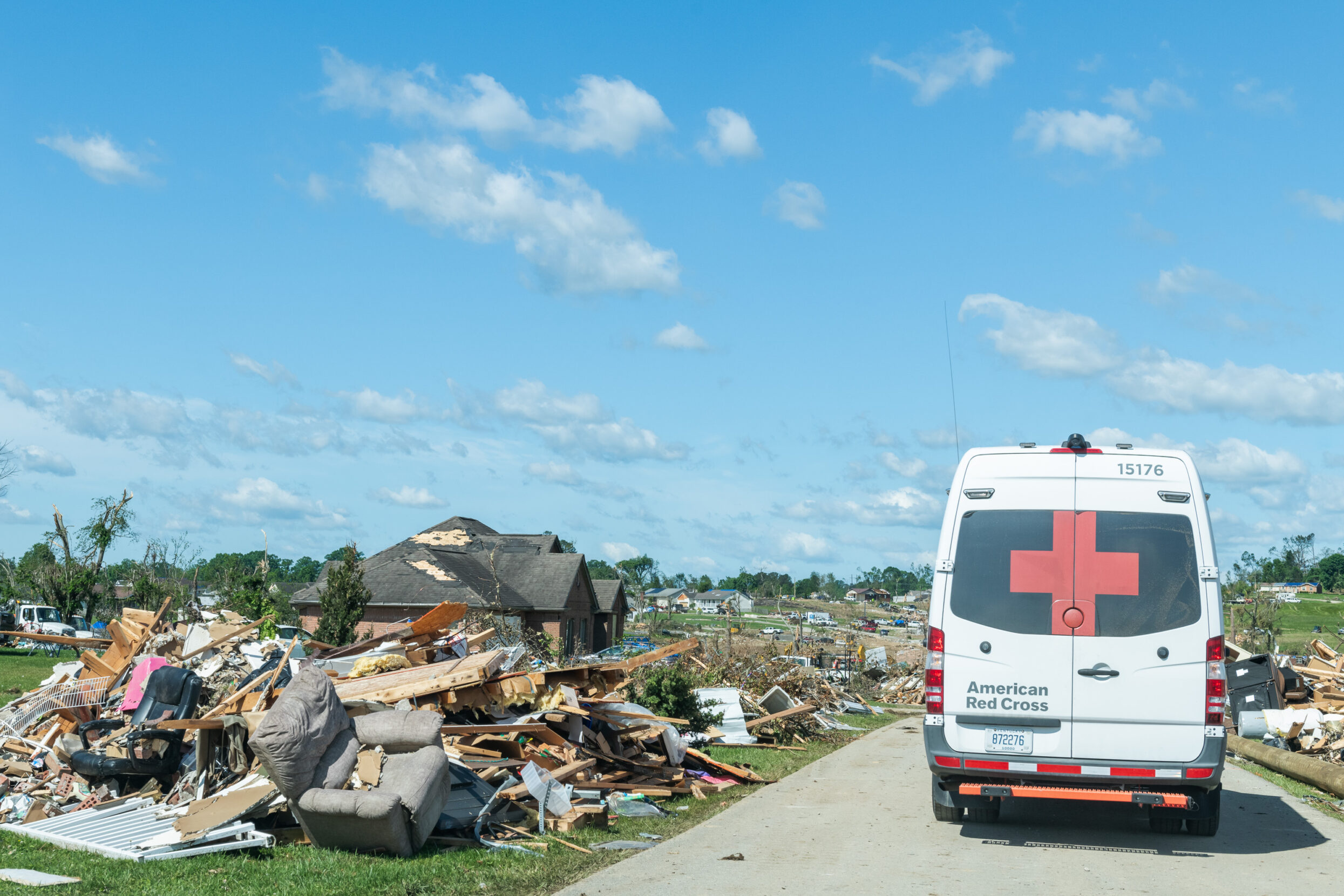
In the Sunshine Hills neighborhood of London, Kentucky, debris from a catastrophic tornado sits piled along the roadside awaiting removal. The Enhanced Fujita Scale is used to rate the intensity of tornadoes. The tornado that hit Sunshine Hills was an EF-4 (the highest rating is EF-5). Photo: Sivani Babu.
~~
I can feel a slight wheeze in my chest as I’m driven in a golf cart through what remains of the town that calls itself “Florida’s Last Frontier.” We bump and thud down a narrow road, wetlands stretching just beyond the growth that periodically blocks our view. It’s a sweltering, soggy day, with temperatures approaching 90° F, and the mosquitoes are out — the first ones I’ve encountered since arriving in Florida two weeks ago. The air is thick with dust and mold from the homes being razed after yet another hurricane has devastated this little town.
Horseshoe Beach is a map dot — an isolated town of about 170 on Florida’s Nature Coast. My guide this afternoon is Lisa Bregenzer. She’s a broad-shouldered woman with dark, wavy hair and a big hug for me, even though we’ve just met. In a surprising coincidence, we discover she spent some of her childhood in a California town about 20 miles from where I grew up.
As Lisa drives us through streets lined with debris, she stops at a park bench that has landed in a palm tree before we continue down an isolated stretch of back road. We pull up in front of an eerie tableau of devastation: A rug, broken glass, a door, a smashed television atop a wood and wicker headboard, and a matching dresser, upright with its drawers intact and folded bedsheets sitting on top.
In late September, Horseshoe Beach was hit by Category 4 Hurricane Helene, experiencing a catastrophic 15-to-18-foot storm surge that destroyed much of the town. Then, two weeks later, on October 9, 2024, it caught the northern bands of Category 3 Hurricane Milton, a storm that spawned a historic tornado outbreak on the opposite side of the state and dropped 10 to 15 inches of rain from Tampa to Daytona Beach. But these were just the latest catastrophes to hit Horseshoe Beach. A year earlier, Lisa and her husband Pete lost their home in another disaster, Hurricane Idalia. That storm was both an end — and a beginning.
“We had Hurricane Idalia in 2023, we had Hurricane Debby, we had a no-name storm, we had tornadoes … Hurricane Helene, and then Hurricane Milton … And all of that in the last 14 months? 15 months?” Lisa tells me.
As the paradigm shifts, chaos reigns.
Idalia, Debby, Helene, and Milton are part of a rapidly growing club: Disasters that cause a billion or more dollars in damage. In fact, the National Oceanic and Atmospheric Administration (NOAA) estimated that Milton caused $34.3B in damage and Helene more than twice that with $78.7B. Alarmingly, this spate of catastrophic disasters seems to be a trend rather than an exception.
From 1980 to 2024, there have been more than 400 weather and climate disasters — droughts, floods, freezes, severe storms, tropical cyclones, wildfires, and winter storms — that have each caused more than a billion dollars in loss (adjusted for inflation). According to NOAA, 33 of those disasters occurred during the 1980s, 57 in the 1990s, and 67 in the 2000s. From 2010 to 2019, that number rose to 131 billion-dollar disasters. And in the first half of this decade, from 2020 to 2024, we’ve already seen 115. In fact, the number of billion-dollar disasters in 2024 alone was 27. While there’s no reason to think the rate of such disasters will slow in the second half of this decade, we’ll no longer have the ability to easily know. Per the policies of the current administration, NOAA is no longer collecting this data.
~~
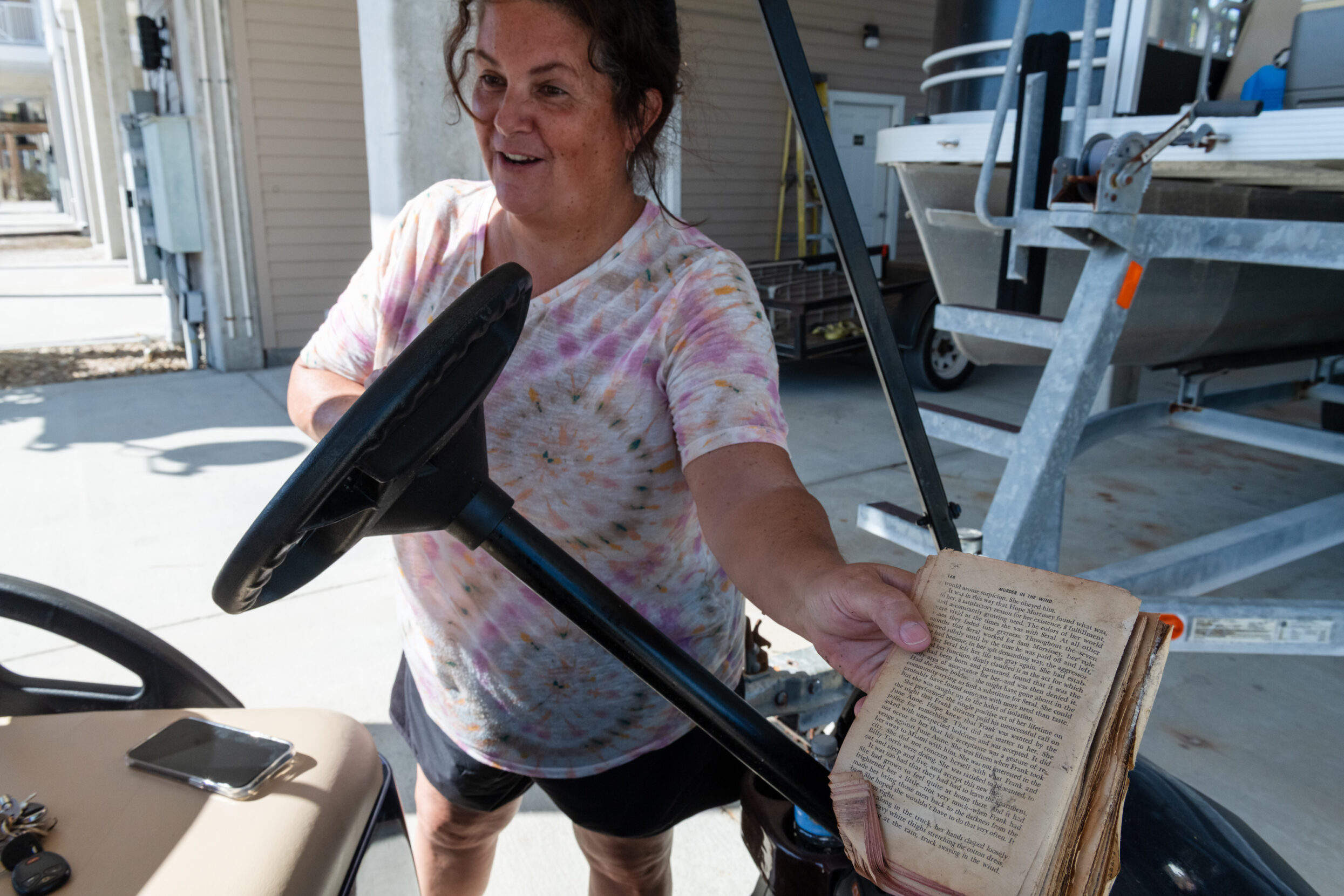
Lisa Bregenzer shows the author a book that washed up on her property in Horseshoe Beach, Florida, following a string of natural disasters. Photo: Sivani Babu.
As the day continues, Lisa tells me about losing her home — about finding it still standing after Idalia, only to realize that the inside had been filled with water. She talks of the mold that bloomed within 48 hours, the snakes that took up residence in the walls, and the love she and Pete and her parents before them had poured into that house with children’s heights marked on a pantry door. At one point, she shows me a book they found blown onto their property in the most recent storms: Murder in the Wind.
“That’s what happened here,” she says as she tells me how her small community feels different, more beaten down, less able to recover after multiple disasters.
“We’re strong — we’re Horseshoe Beach strong — but we’re human.”
And yet, Lisa and Pete are still here.
~~
Back in Kentucky, sixty-three-year-old Samuel Parker is lucky to be alive. He sits in a wheelchair in a parking lot outside the First Baptist Church of London, after spending nearly a week in the hospital. His white hair hides the wounds on his head, and his thick black hoodie hides the bruises on his body, but he ushers me over to look at them anyway, pointing out the staples concealed by his hair and pulling up his sweatshirt to show me the dark purpling on his torso. The clothes aren’t his. They were provided by shelter workers after he came there following his discharge from the hospital. And though he’s in the wheelchair because his knee is injured, that doesn’t stop him from using both legs to adjust his position.
After obliging a look at the staples and bruising, I sit back down, cross-legged on the toasty blacktop of the parking lot, and we continue our conversation.
Samuel tells me about the night the tornado hit, when, by his account, he was carried through the air and stygian night more than a mile from his home — and lived to tell the tale.
“I said, ‘Lord, I’m ready for the ride. Let’s go,’” Samuel tells me enthusiastically.
Perhaps that kind of perseverance can be learned.
Earlier that month, he says he’d finished paying off his home, which he describes as a 12.5-foot-by-26-foot cabin with a porch he loved sitting on. But around midnight on May 16, the tornado tore it apart and deposited Samuel in a tree — or perhaps a parking lot. Many of the details are unclear, lost in the chaos of disaster, but one thing is certain: Samuel’s harrowing experience was a close call in a night full of close calls for hundreds of people. But the unexpected close call people keep talking about includes a government agency.
~~
Disaster preparation and response are complex, and start long before a disaster strikes, but as the acute potential for catastrophes like floods, tornadoes, and fires develops, weather forecasts play a pivotal role in alerting people to danger.
Nearly 600 employees have left the National Weather Service in the last few months — some were terminated, others took a federal buyout, and still others were pushed into early retirement. This is part of the storm that has been gathering for years. In June, 126 new hires were authorized, and in early August, that number was increased to 450 new employee authorizations, but, for the moment, those hires are theoretical — the jobs have not been posted as of publication. The staffing shortfalls are still concerning. As of June 5, 2025, there were at least eight NWS offices that were so short-staffed they could no longer cover overnight shifts. One of those offices was in Jackson, Kentucky, some 70 miles from London.
Like NWS offices around the country, the office in Jackson relies on surge staffing — a stopgap method that pulls staff from other NWS offices to keep the lights on when extreme weather is expected. The method is as fraught as it sounds.
“We’re pushing our luck if we think the cuts … won’t cause a breakdown in our ability to get people out of harm’s way in the future. In particular, the loss this year of many of the weather service’s most experienced leaders — people with decades of experience in the particular weather vulnerabilities in local areas — poses a significant danger to the mission of protecting people and property,” writes Yale Climate Connections meteorologist and former NOAA hurricane scientist Dr. Jeff Masters.
In the end, the NWS did issue tornado alerts the night of May 16. In many cases, the alerts came in a solid 30-40 minutes before the tornado struck, providing people the opportunity to prepare and to take cover. Had that not happened, the results could have been far more catastrophic.
~~
Robert Lewin is a former CalFire Chief for San Luis Obispo County and former Director of the Santa Barbara County Office of Emergency Management. He and I also happen to serve together on our local Red Cross chapter board. When we hop on a video call together, he is on vacation in the northern Sierras. It’s July 5. This morning, halfway across the country on the heels of catastrophic flooding in Texas, state and local officials have just blamed NWS for failing to predict the severity of flooding that, so far, has left more than 100 people dead and dozens missing overnight. Much like in Kentucky, both of the NWS offices responsible for issuing weather warnings in the area are short-staffed. But Lewin isn’t ready to point fingers.
From floods, we turn to fires. For decades, Lewin tells me, NWS, which is housed within NOAA, has deployed “Incident Meteorologists” to wildfires. These fire weather forecasters have special tools and specific training in things like microscale forecasting and fire behavior, in order to provide on-site forecasts in support of fire management teams.
“They would send one of their meteorologists to fires here in California,” Lewin says, “so every fire of consequence that I went to, and we’re talking hundreds of fires, there was always a meteorologist there.”
“So, for example, they would say that the winds are going to come out of the east. It’s going to be an offshore wind. It’s going to be really strong,” he says. Lewin also acknowledges that meteorology is “a really tricky thing” and that these forecasts aren’t always accurate. As our conversation briefly returns to the situation in Texas, he draws on his own experience. He’s skeptical of the blame being levied at the NWS for the loss of life in Kerrville and the broader Texas Hill Country.
Lewin was the Director of the Santa Barbara County Office of Emergency Management in January 2018 when a debris flow in Montecito, California, killed 23 people. “[NWS] predicted a really horrible storm,” he says, but it couldn’t predict rainfall in the exact canyon that would trigger the flow. “Are they to blame for that? No, I mean, they’re doing the very best that they could, and they were really experienced meteorologists.”
In the hours and days that follow our conversation, the facts seem to back Lewin up. Despite budget cuts and staffing shortages, timely alerts were issued, and NWS officials report that both offices were fully staffed by temporarily moving employees from other locations.
It is a miraculous convergence of chance and effort that continues to allow the NWS to provide timely warnings before unavoidable and devastating catastrophes. But hurricane scientist Dr. Master’s words still ring in my head: “We’re pushing our luck.”
What’s more, weather forecasts and early warnings are only one part of a very large national disaster management puzzle — one that is being systematically dismantled.
~~
On May 7, 2025, Cameron Hamilton, then-acting administrator of the Federal Emergency Management Agency (FEMA), testified before a Congressional appropriations committee. Clad in a dark blue suit and red tie with his Navy Seal Trident pinned to his lapel, Hamilton broke ranks with the presidential administration: “I do not believe it is in the best interest of the American people to eliminate the Federal Emergency Management Agency,” he testified.

A park bench sits in a palm tree in Horseshoe Beach after a 15-to-18-foot storm surge devastated the town during Hurricane Helene in September 2024. As natural disasters unfold around the world with greater intensity and frequency, here in the U.S., our federal disaster management programs face a chaotic and uncertain future. Photo: Sivani Babu.
For more than 40 years, FEMA has been another part of the puzzle at the federal level. There are five stages of disaster management: prevention, mitigation, preparedness, response, and recovery. These include everything from training to infrastructure projects to evacuation plans to cleanup and small business loans as communities move through recovery.
Emergency managers around the country will tell you that “all disasters are local” — and for decades, FEMA has been supporting the local response at all stages, providing trainings for emergency managers, first responders, communities, and individuals alike; frameworks for communities to create mitigation plans; and grants to fund community resilience programs, to name a few. In recent years, and in certain communities, distrust in FEMA has grown, rooted partly in past failures and present, onerous bureaucracy. Throwing gasoline on that fire in recent years has been misinformation spread largely by members of the Republican Party and by President Donald Trump during his most recent presidential campaign.
Following Hurricane Helene, then-candidate Trump falsely accused FEMA of spending all its money to help undocumented immigrants. Others accused FEMA and government officials of wanting to seize land in communities damaged by the hurricane, and one congressional representative even endorsed the idea that weather control technology had been used to direct the hurricane to politically right-leaning communities. The misinformation and disinformation became so charged during the Helene response that FEMA temporarily suspended door-to-door operations after receiving word that an armed militia in North Carolina was “hunting FEMA.” Once the threat was investigated and an arrest was made, normal operations resumed.
This was the backdrop against which Hamilton became the agency’s head administrator, despite not having any experience with large-scale disaster response. He was vocal in his criticism of FEMA from the outset, but his testimony before the Congressional committee perhaps surprised the administration — because the day after he testified, he was fired. Beyond the chaos caused by the abrupt firing, FEMA lost roughly 25% of its full-time workforce, including many with crucial experience and knowledge. Also, billions of dollars in previously awarded grants to fund disaster mitigation projects are being withheld.
Rubble sits piled at the edges of property lines awaiting removal — the evidence of lives lived … sofas and office chairs, porch railings and tattered U.S. flags.
~~
Back home in Santa Barbara, California, in August 2025, I listen to a dove coo on an otherwise quiet night. It has been some nine months since I returned from Tampa and the Hurricane Milton response. In the northern part of my county, near the town where I grew up and where my parents still live, a wildfire has ignited. In three days, it has burned more than 72,000 acres — an area larger than Sacramento. The days have been smokey, and ash floats through the air like wispy snow flurries. Over the next two weeks, the fire will nearly double in size.
For months, I’ve followed the news of what’s happening at federal agencies — the decimation of scientific research, institutional knowledge, and critical resources. But when I think about the disasters I’ve responded to, and the ones I’ve experienced, it’s the seemingly small stories I can’t stop thinking about: The warmth and openness of Lisa and Pete, who had lost and overcome so much; the enthusiasm of Samuel, whose harrowing experience made him grateful for life. A chef in Kentucky who stepped up to feed his community after a deadly tornado; an 18-year-old kid in Florida who traveled from his home in Indiana to help people impacted by the hurricanes; friends who packed up my home in 108° heat in the dead of a powerless night when a nearby wildfire triggered an evacuation order while I was an hour away.
So far, the question I’ve been asking is: What are we facing? And the answer is that we’re facing disaster and uncertainty. It’s impossible to know what federal disaster management is going to look like next month, let alone years from now. Maybe the billions of dollars in grants will be distributed, maybe they won’t. Maybe the NWS will hire 450 new employees, maybe it won’t. Maybe FEMA will exist, maybe it won’t. But there’s another question, one that promises a bit of hope: How are individuals and communities going to respond?
~~
At home, I sit in an armchair with my laptop resting precariously on one knee as the fire rages on. It’s late, and the summer sky outside has grown dark after an ominously orange sunset, but I have yet to turn on a light in my house as I look at photos from my time with Lisa Bregenzer in Horseshoe Beach.
I pick up my phone to revisit the pictures she sent me months ago of a pink and orange sunset from her slice of devastated paradise. Even after all this time, she and Pete return to my thoughts frequently.
Despite losing their home in Hurricane Idalia, and then losing what they’d managed to salvage in Hurricane Helene, despite watching their community face threat after threat after threat, they were still warm smiles and hugs. They were still looking forward. They were still, as Lisa put it, “doing life.”
“Thankfully, we’re humble people, and it doesn’t take much: A sunrise, a sunset, the sound of birds, the dew on the ground. Just a simple life, but a happy life,” Lisa told me in Florida. Perhaps that kind of perseverance can be learned.

After losing their home in Hurricane Idalia in 2023, Lisa and Pete have survived a string of natural disasters, including tornadoes and three additional hurricanes. Photo: Sivani Babu.
~~
The capacity for resilience, says Dr. George Bonanno, is part of human nature. Bonanno is a professor of clinical psychology at Columbia University Teacher’s College, and his research focuses on how people cope with extreme adversity.
“It’s part of who we are. As a result of millions of years of evolution, we have a tremendous capacity to adapt, probably more than most creatures on Earth, maybe more than all creatures on Earth … We’re very flexible creatures,” said Bonanno on an episode of Speaking of Psychology, a podcast by the American Psychological Association.
Bonanno argues that resilience is not an innate trait. Instead, he describes it as “an effortful outcome that happens when people adapt themselves to the challenges of the situation they’ve been presented with.” This requires what he calls “regulatory flexibility,” a mindset and process that allows people to look at the nuances of their situation, react, and revise that reaction if they need to.
His research, which includes a study of people living in or near New York City during 9/11, indicates that we’ve chronically underestimated people’s ability to adapt and thrive after extremely adverse events. There’s hope in realizing this.
~~
In Tampa, on the heels of Hurricane Milton, I join members of several of Florida’s African Methodist Episcopal (AME) Churches and community organizations in the parking lot of Mount Olive AME Church. There are 18 churches and organizations represented, and stationed throughout the parking lot are pallets of water, diapers, shelf-stable meals, cleanup supplies, and more. In one corner of the parking lot, volunteers grill hot dogs and hamburgers for anyone who wants lunch. Over several hours, more than 300 cars line up down the block to drive in, pop their trunks, and let volunteers load their vehicles with emergency supplies. Reverend Gregory Gay of Mt. Olive AME, who also serves as a district disaster relief coordinator, directs traffic with what seems like nonstop energy. Despite the devastation this community has experienced, the mood feels surprisingly light.
“This is what we do,” says Jeffrey Thomas, of Tampa’s St. Luke AME. “It’s about helping the community. This is home.”
When I ask him if he was directly affected by the hurricane, he tells me that he didn’t have power for nearly a week. “Everyone was impacted in some way.” But even those who were impacted are here to help if they’re able.
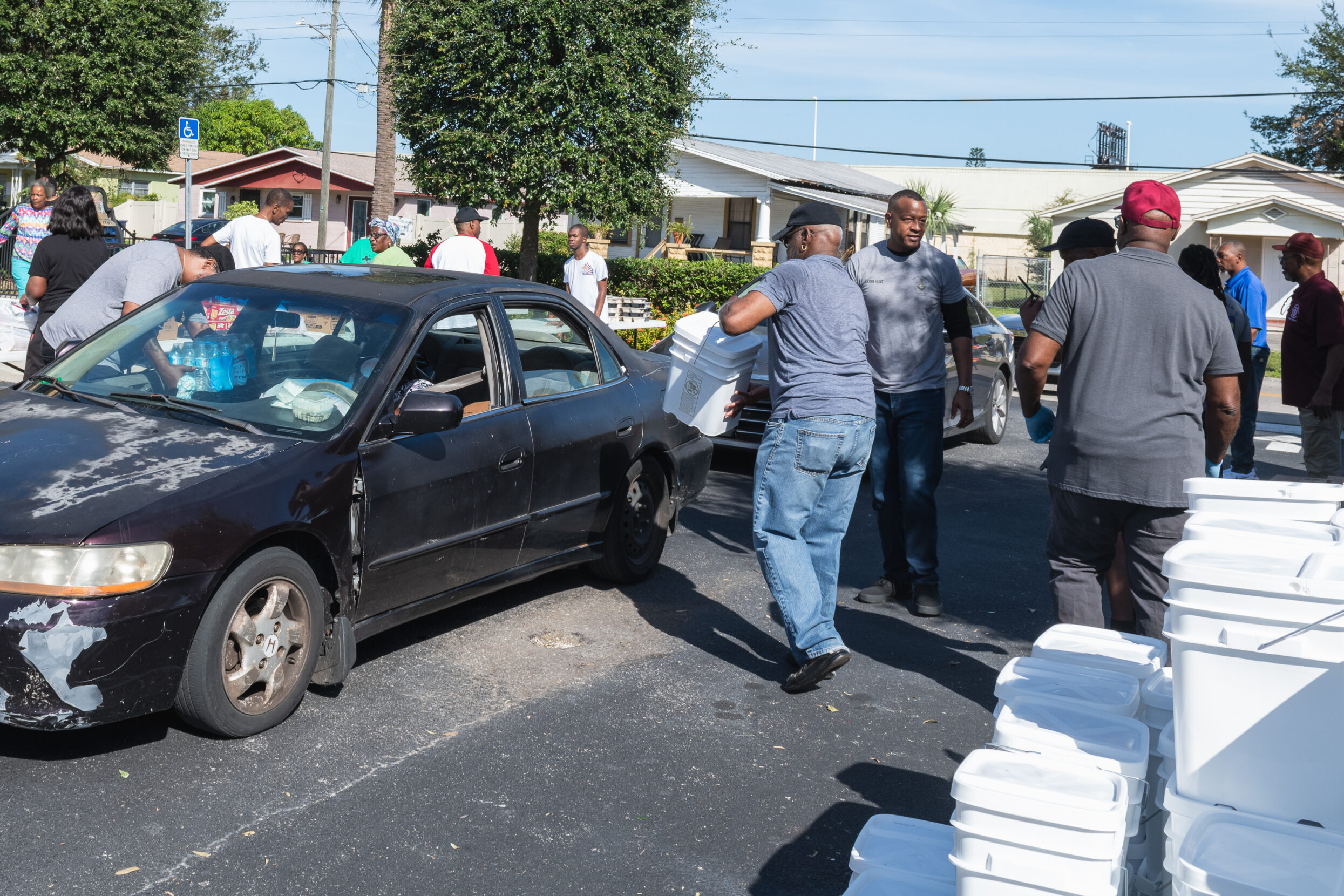
At Mount Olive AME Church in Tampa, Florida, volunteers from more than a dozen churches and organizations distribute emergency supplies in the wake of Hurricane Milton. More than 300 vehicles lined up to receive supplies as communities came together to help, despite many of the volunteers having been impacted themselves. Photo: Sivani Babu.
We can think of community resilience as the ability of a community to prepare (for disasters, natural or otherwise), adapt to changing conditions, and withstand and recover from disruptions. When it comes to vulnerable communities, challenges are often rooted in systemic factors that exist long before disaster even strikes. But, like resilience in individuals, the ability to cope can be strengthened in communities, too.
It’s work often done by non-profits and religious organizations, like the AME churches, which plan and train for disasters, partner with relief organizations, and serve as distribution sites for emergency supplies. Or local food banks, which work to reduce food insecurity before a disaster and then support the food needs of a community in the aftermath. Community non-profits are also at risk due to federal cuts, but there is potential promise for those that can form new partnerships and make up for shortfalls through donations, as well as funding from state and local governments.
So how will communities get by? Perhaps they won’t. Even when our political structures aren’t mired in chaos, not every community survives a natural disaster intact. Then again, maybe we have underestimated community resilience the way we have with individuals. More likely, the answer lies somewhere in the middle. Hope lies in the communities that surprise us — the ones that survive despite the odds and envision new paths forward.
In Sunshine Hills in London, Kentucky, I stood in front of a house with a three-word declaration on a boarded-up window: “Do Not Destroy.” It’s impossible to know what lies beneath — Wishful thinking? Denial? Defiance? Or maybe it’s simply a prayer.
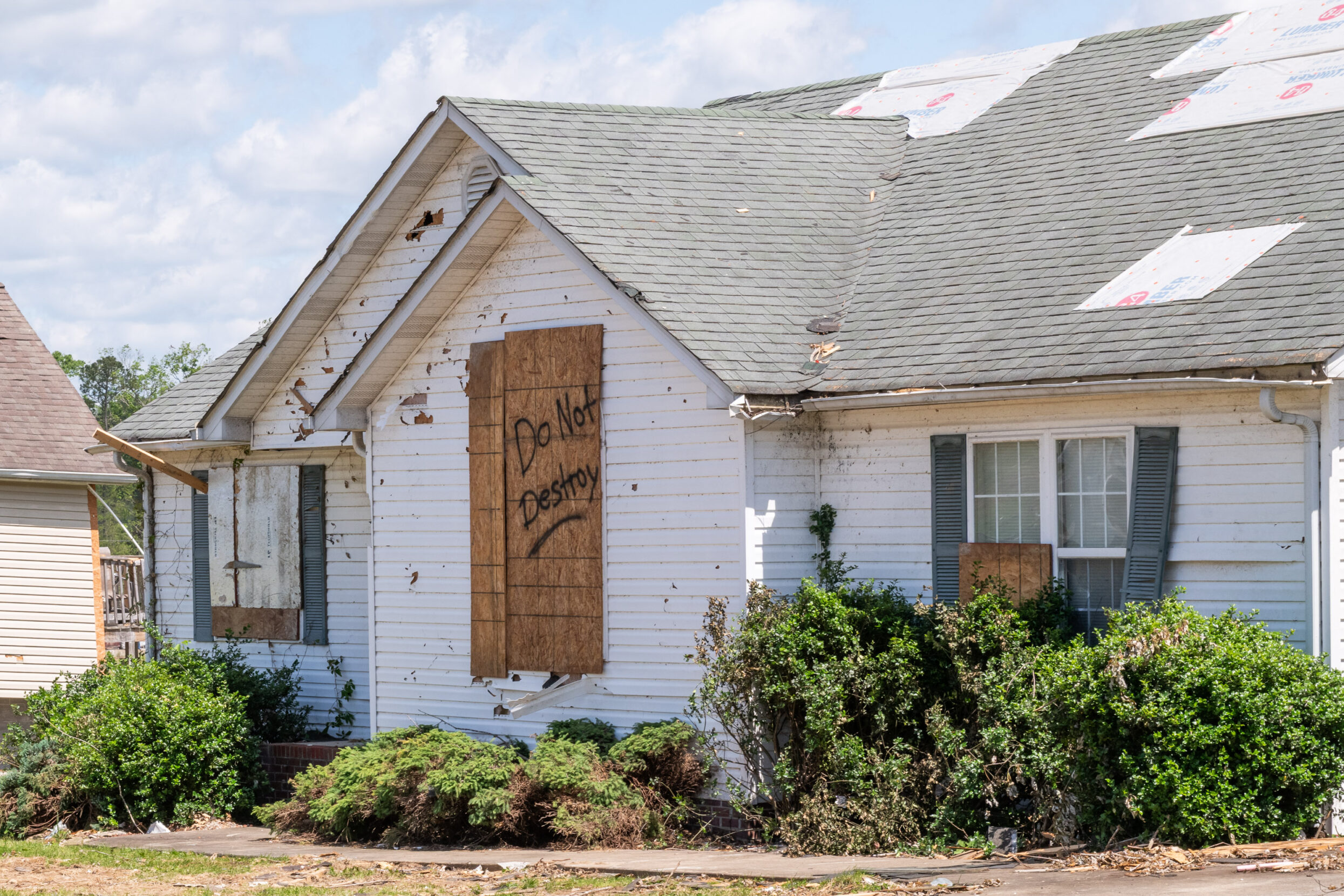
“Do Not Destroy.” Three words on a home the tornado didn’t take in Sunshine Hills. Photo: Sivani Babu.
Sivani Babu
Sivani Babu is the co-founder and CEO of Hidden Compass. She is also an award-winning journalist and nature photographer whose journalism, art, and exploration weave stories that offer perspective, context, and an awe-inspiring sense of scale to the human experience.