


Ad Free. Reader Funded.
Hidden Compass is on Team Human. This article was not written by generative AI. Support the journalist and editors of this piece with a direct contribution!
% of $ Goal
Total number of contributions so far:
0
Total amount raised for journalists
$0
"One thing I really appreciated about working with Hidden Compass is that it's a space where there is time for nuance and complexity. By donating, that's what you're supporting. You're able to help us as writers, but also as an outlet, continue to tell these kinds of stories."
- Anna Polonyi, Hidden Compass Journalist
"The reason why I contributed was because the article that I read really resonated with what I was feeling. I felt like the author was in my head... It just moved me and I felt like I needed to do something."
- Hidden Compass Reader
Freezing rain bombards the horse-mounted caravan in Mongolia’s northern taiga. In this boreal forest along the Russian border, pine trees and small shrubs give way to boulders and rock scree as pale blue lakes in the lower valleys disappear under a rolling blanket of clouds. Soaked, the archaeological expedition emerges into a high-altitude plateau of burgundy scrub called Mengebulag.
Through the nomadic grapevine, the expedition had heard that some of the region’s Indigenous Dukha families were camping here despite it being late in the season. But when the team crests the low rise, only compressed circles of dirt and dead grass indicate ortzes — teepee-like traditional shelters — have ever been erected here.
The team hops up and down to fight off the bone-chilling cold, huddling around, devouring lunches of bread, jam, and Kewpie mayonnaise. Canadian zooarchaeologist Dr. Morgan Windle and her Coloradan husband, Hans Whitefield, also an archaeologist, are on schedule, but it is only day two. They are leading the most remote Northern Mongolia Adventure and Discovery in Science (NOMAD Science) team expedition to date.
But on the trail, their archaeological agenda comes second — it is their Dukha guides, including Yadam “Ochiroo” Ochir, who call the shots. Ochir’s jolly disposition seems immune to the grueling circumstances. He still jokes, mimicking a pirate by popping on his sunglasses — one lens missing after his horse bucked him wallowing in a bog on day one.
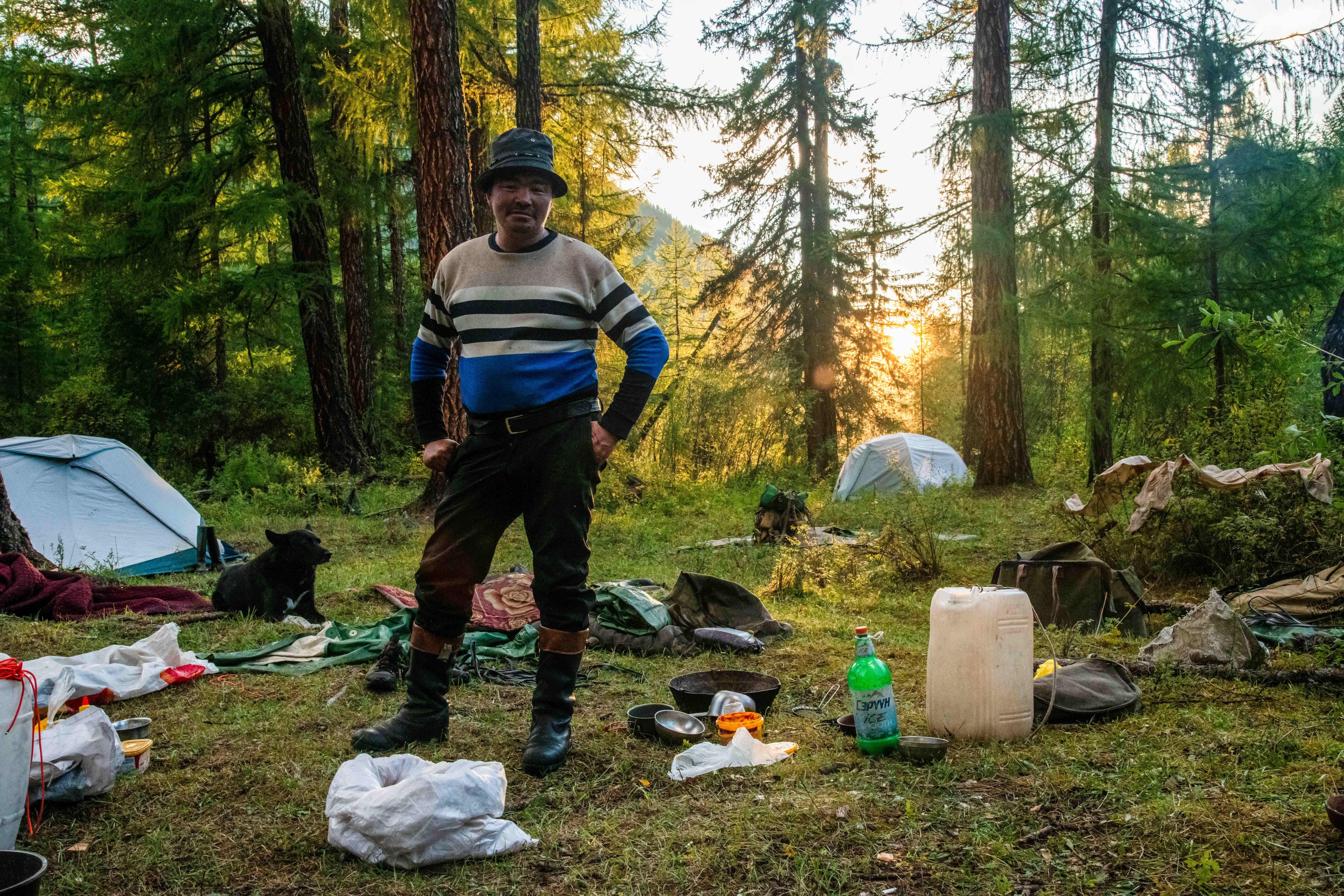
Dukha reindeer herder and expedition guide Yadam Ochir poses for a quick photo at camp. Dr. Morgan Windle leads the expedition, but it‘s the expedition‘s Dukha guides that make the decisions on the trail. Photo: Andrew Califf.
After a hurried and feral lunch, everyone mounts their horses again and rides on. The drone of rain joins a chorus of hooves crunching scrub and stumbling over rocks, and water drips off riding helmets. The taiga opens up at the edge of the plateau in the most stunning way: light breaking through angry clouds and shining down on a verdant green valley. Ortzes pump warm smoke into the misty air, texturing obscured peaks far in the distance, while haze shrouds foothills and pine trees, creating a matte distortion like an effervescent, smeared watercolor.
The sight is comforting; the riders can almost feel the warmth of the small stoves. There are still an estimated three, perhaps four, days of riding to go. But the graveyard waiting at the end of the journey will be worth it, they believe.
Windle, an archaeologist and the architect behind this mission, laughs and says, “We are doing all of this for bones.”
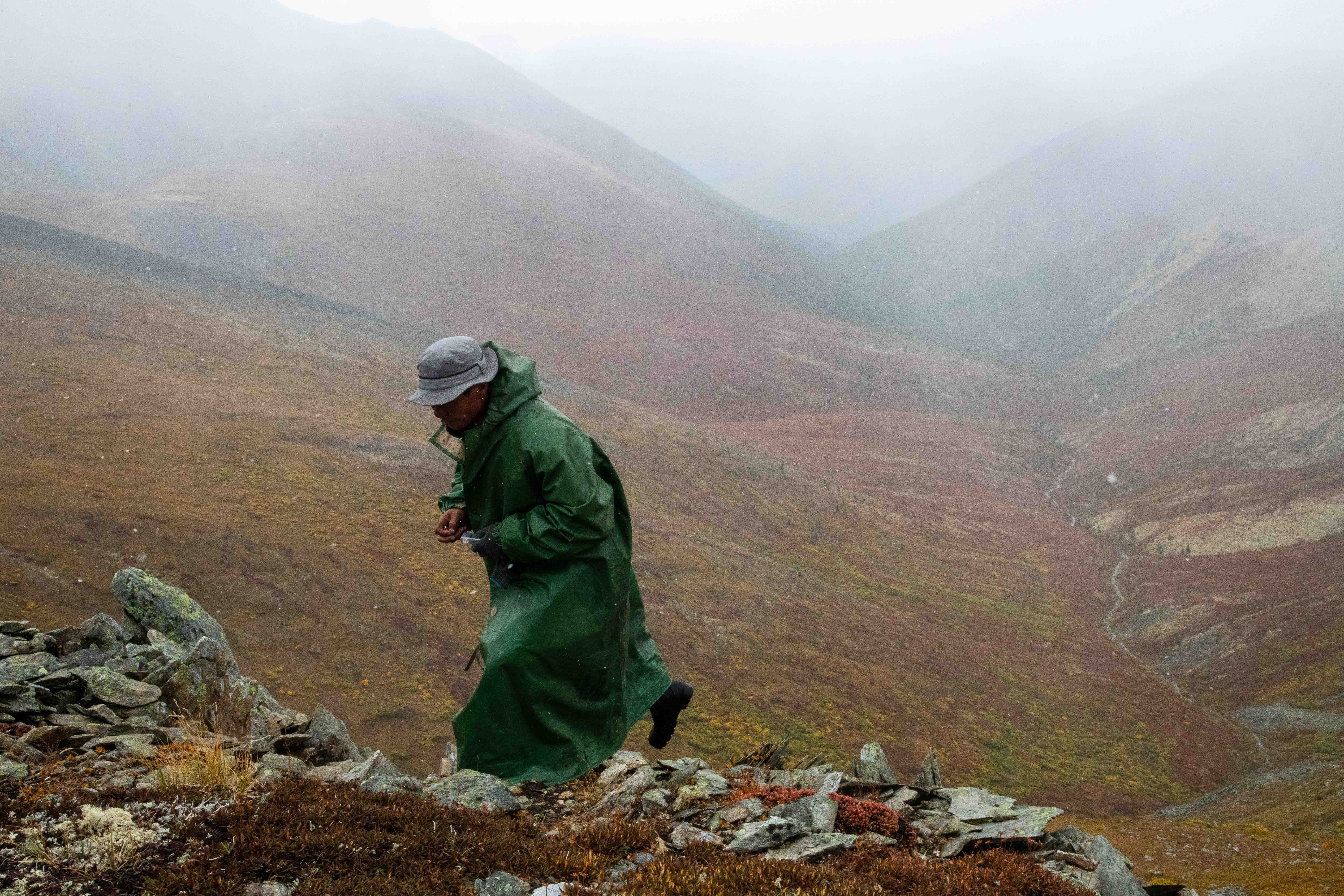
A member of the expedition stops for a smoke break as a light snow falls. Photo: Andrew Califf.
~~
The Dukha and their ancestors have herded in this area for hundreds, if not thousands, of years.
When the Soviet Union annexed the Tuvan People’s Republic in 1944, the border between what was now Russia’s Tuva Republic and Mongolia became militarized and closed to free movement. Reindeer herders in the taiga and Darkhad Depression were cut off from Tuva, their ancestral homeland. The result was a narrow ecological niche for reindeer herding sandwiched between the border with Russia and the Mongolian steppe — home to traditional Mongolian herders who keep sheep, goats, and cattle. This strip of taiga wilderness is the only place in Mongolia where reindeer can feasibly be herded. Over the last half-century, changing climate, politics, and economics, among other factors, forced the Tuvan to assimilate and diversify their herding strategies, ultimately creating a distinct ethnic group in Mongolia, commonly known as the Dukha.
~~
The bones Windle seeks, of course, were once inside living, breathing creatures. In April 2022, Dukha herders gathered 300 reindeer into a small valley to protect them from wolves and other predators. Five days from the nearest town, deep in the mountains and river networks, the wet spring snow was likely deep and dense.
Sometime in the night, some of the reindeer may have wandered up the mountain, their hooves dislodging snow as they searched for a place to graze. Perhaps the animals’ restlessness triggered what came next. Perhaps that had nothing to do with it. Either way, a tsunami of snow roared down on the reindeer, dislodging rocks and boulders and crushing undergrowth and bones alike. The whole herd was in the avalanche runout zone, but luckily, about 200 of the panicked animals must have scrambled up other slopes, fled into the woods, or even extricated themselves unharmed from a tumble in the snow. The remaining 100 were less lucky: The majority were completely buried. The cacophony of fearful bleating, the thunderous rumbling, the concussive destruction — none of it woke the herders who were cowboy camping in the pine forest on the lower slopes of the valley.
In fact, it wasn’t until morning that the herders knew something was wrong. Around first light, they awoke and started kindling a fire for milk tea just like any morning. A group of Dukha men from different families, including Ochir’s brother Yadam Munkh-Ochir, or “Muugi,” set out to prepare the herd to move. In an instant, they learned they lost much of it. It wasn’t until the surviving animals were counted and brands checked that Munkh-Ochir learned he lost half of his portion of the herd.
Puffing on a cigarette in his fashionable combo of an Adidas bucket hat paired with a traditional deel, Munkh-Ochir says, “When we saw it in the morning, there were just legs and antlers sticking out of the snow.”
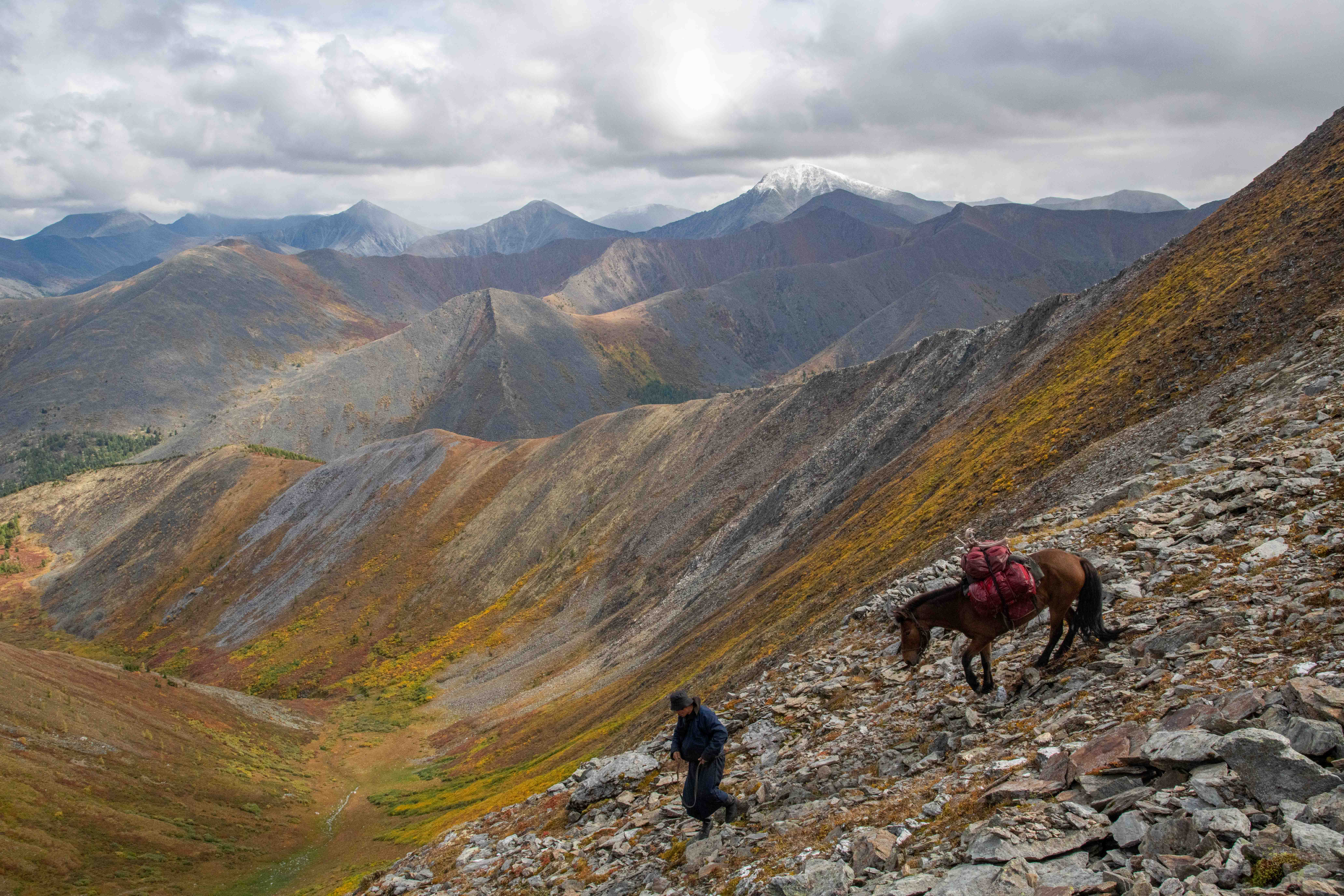
Yadam Munkh-Ochir leads his horse down a steep mountain pass. Photo: Andrew Califf.
~~
The greater loss is not about meat; it’s about milk. But in many ways, it is about tradition. Reindeer are not used for food — they are traditionally kept for milk, and keeping them is an homage to traditional lifeways.
“It’s our old tradition, it’s our way of life, my father, my grandfather, and I continue,” says Ochir. “It is why we keep reindeer even though we have livestock in the steppe.”
Four avalanches in the taiga in the past four years have killed hundreds of reindeer, impacting a way of life the Dukha are struggling to maintain. They have already been forced to assimilate with steppe culture, now also herding goats, sheep, and cows instead of relying on extensive hunting and gathering. When half of a herd is decimated like Munkh-Ochir’s was, it only pushes the Dukha to further rely on a steppe economy. But within this natural disaster and tragic trend Windle sees an opportunity that could benefit archaeological research by deepening the understanding of the historical context of Dukha culture and reindeer herding.
~~
After traveling along an endless river valley, the team rides up a tributary toward the avalanche site. It is the final push, the last day in the saddle for the time being, and things get technical. Disused trails across steep, loose scree are the only way to circumnavigate a waterfall. They are pockmarked with illegal gold mine pits, threatening to swallow horses and riders alike. The team rides up a mountain ridgeline for two hours, and as the gentler taiga mountains drop away, jagged peaks and rock walls rise from the distant horizon.
“I have to remind myself this is really cool what we are doing because it starts to feel normal,” says Windle, laughing. “Then you are on hour six on the back of a horse feeling deluded and crazy, and then you get off the horse and are like, ‘We did it; we didn’t die again today!’”
This strip of taiga wilderness is the only place in Mongolia where reindeer can feasibly be herded.
More than three years after the avalanche, Munkh-Ochir returns with the archaeologists. He points out the slope to the team from the last and highest pass of the grueling five-day ride. The archaeologists have come for the bones of Munkh-Ochir’s herd. It’s unclear whether they will recover them. In tundra and taiga environments, organic material like bones degrades rapidly due to wet and acidic conditions. And given their relatively young age, even if found, these bones aren’t yet archaeologically significant. But with time and effort, they could be.
Windle’s goal is to identify ways to observe the domestication of reindeer in the archaeological record by finding pathological markers on bones that indicate human use of the animals. Setting a baseline for zooarchaeological research is challenging. In 2023, Windle had to wait a year for two skeletons from Ochir’s herd to desiccate. They sat in barrels that Mongolian archaeologist Tumurbaatar “Jerry” Tuvshinjargal kept on his apartment balcony in Ulaanbaatar — to his wife’s chagrin.
With her two skeletons from 2023, Windle identified spinal abnormalities, particularly on the thoracic spine, that coincided with pressure points on Dukha saddles. According to Windle, the abnormalities could be representative of those caused by the saddle and rider. But two animals are not a comprehensive data set, and Windle can’t — and wouldn’t — ask any of the Dukha to kill an entire herd. That is how a tragic avalanche became an opportunity and an expedition plan for 2025. The goal was to see if bone growths on the thoracic vertebrae and long bones were common for riding reindeer.
“With zooarchaeology, we are reconstructing life habits, but mainly labor. This has been a tool for identifying traction for cattle or chariot riding in prehistory,” explains Windle.
Today, Mongolia’s taiga is one of the few remaining places where people still traditionally herd reindeer, and, more uniquely, still ride them. But that behavior might have been much more widespread historically.
Windle and Tumurbaatar even excitedly explained to the team that rock art in the Altai-Gobi actually looks like people riding deer, possibly reindeer. It could have been a depiction of a reindeer caravan exploring farther south. This environment is dynamically different from the taiga, and it is impossible to herd reindeer there today. But if the art is indeed a depiction of a reindeer caravan, its presence that far south could have wide-ranging implications for the promise of Windle and NOMAD’s work. It could show that reindeer played a larger role in human movement across the region much earlier than thought. Or maybe not.
~~
They took their wooden shovels and worked to dig out the visible 30 corpses just to save the meat. After sweating, digging through the slush, they loaded what they could and had a small feast of leg bones back at camp, cooking the meat and marrow over an open fire, because what else could they do? The sheer quantity of meat threatened to spoil. To Munkh-Ochir and his fellow herders, it wasn’t worth digging deeper for the other carcasses. They already had more meat than they could consume before it went bad.
The rest of the bones that Munkh-Ochir and the herders couldn’t recover from the snowy grave now lie submerged in small pools, shattered in rock piles, or clenched by moss in a narrow stream cradled in the valley.
The team surveys a small stream near the avalanche site. Small finds lead to larger ones: skulls and spines from the 100 obliterated carcasses. Windle picks and pries up rocks and stones, uncovering crushed undergrowth and splintered bones.
“The crazy thing is, it isn’t even archaeology!” exclaims Windle.
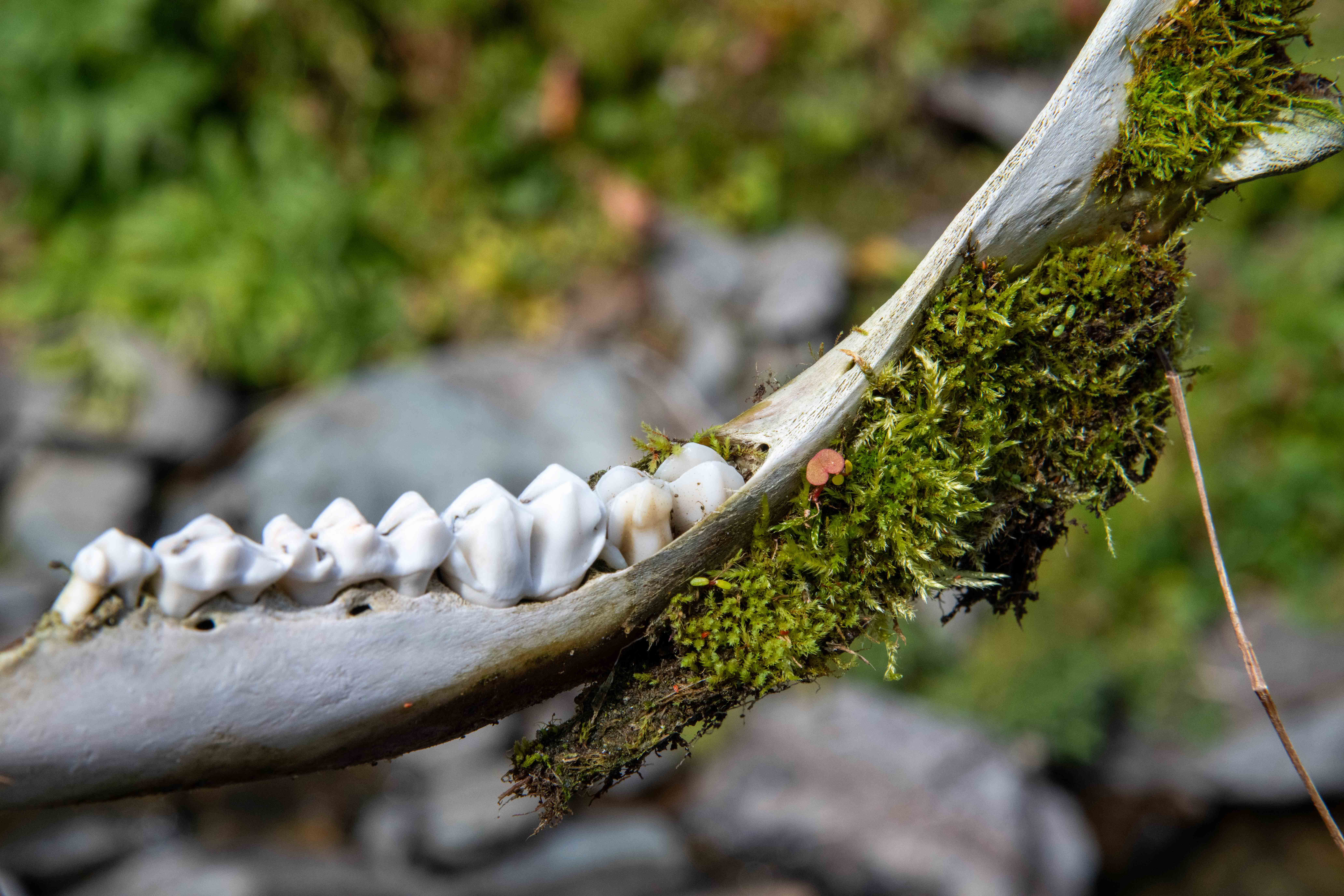
The remains of a reindeer‘s jaw plays host to growths of moss. Hundreds of reindeer in the region have been lost over the last few years to avalanches. Photo: Andrew Califf.
~~
Windle recently earned her Ph.D. and has committed her research career to better understanding the domestication of reindeer. When Ochir told her and NOMAD Science founder Dr. Julia Clark that several avalanches wiped out multiple herds, Windle thought this could be a goldmine of data.
“It’s a huge length to go for something that seems, probably, to a lot of archaeologists, … a very crazy thing to do just for some bones,” says Windle.
Crazy or not, the expedition could be worth it. Learning how people first started using and domesticating animals could completely change our understanding of how cultures throughout history and prehistory used the environment. Yak domestication is theorized to be what facilitated permanent settlement on the Tibetan Plateau, and horse and goat domestication was key to the origin of steppe cultures across Central Asia. These animals have garnered more attention than reindeer by and large due to the limited geographic regions where reindeer thrive and are herded today.
Possible prior evidence of reindeer domestication from Siberia — including the earliest known artifacts: 2,000-year-old items interpreted as headgear — suggests domestication may have already occurred by that time. Windle wants to fill the gap in research and make leaps and bounds in better understanding when and how reindeer were domesticated. She wants to find a key to making future work in the taiga all the more relevant and profound for understanding how the first reindeer herders survived, thrived, and diversified throughout northeast Asia, beyond modern-day taigas and tundras. Whether she’ll be successful remains to be seen.
What is obvious is Windle’s passion for reindeer domestication, which is most notable when with actual reindeer herders. She can be a multidisciplinary nerd when it comes to the anthropology of the reindeer herders. Excitedly, she takes notes on unique practices and explains to the rest of the team the most mundane things about reindeer keeping with an infectious enthusiasm. On one occasion, she regaled us with details of how herders have to shovel reindeer waste regularly because the animals are so meticulous and clean. Windle and her team hope to find reindeer herding camps in the archaeological record by identifying similar patterns of fecal collection in ancient refuse piles.
~~
A life of riding, ranching, and outdoor living in Montana has, in many ways, made NOMAD Science founder Clark a perfect expedition leader for Mongolia. Wilderness EMT training — including helicopter rescue and volunteering for search-and-rescue parties in Montana’s winter storms — helped prepare her for some of the most unexpected scenarios that can arise in backcountry environments. While juggling tons of logistical nightmares or dealing with a wilderness medical emergency, Clark always remains calm, efficient, and purposeful. She sometimes apologizes for getting blunt or short — to everyone’s confusion — because, on the surface, her disposition never wavers.
During a very successful season of survey in 2024 Clark’s bet and hard work paid off. There was, and is, a wealth of archaeological data in the challenging environment. Now, after spending 2025 excavating in the taiga for the first time beyond test pits, the team has identified many stone tools, including arrow points and blades.
“Our first forays into the taiga, you just have to accept that the work goes much, much slower and you have a lot more logistics to work out, so when you look at your results, it seems paltry,” explained Clark. “The amount that you covered and the amount that you did seems so small, and you just have to accept that and lean into the adventure and the novelty and that even these small results mean a lot.”
~~
“It’s our old tradition, it’s our way of life, my father, my grandfather, and I continue.”
A few weeks prior to Windle’s mass grave expedition, Clark, Tumurbaatar, and a small team of rangers completed a far-flung survey circuit to scout for the upcoming archaeological expedition. They were the first archaeologists and researchers to visit the area. This team was the best on horseback, ready to push into completely unknown territory and pristine wilderness. Like Clark, Tumurbaatar also comes from a riding background.
“We aren’t the only team working on horseback in high-elevation areas in this region, but we are amongst the first, and really pushing the boundaries of where we can go,” said Clark. “I think that can really only help archaeology in Mongolia by asking about types of areas we have really never looked at before.”
One goal of the scouting mission was to visit the avalanche site to make sure it would have enough samples for Windle. Their initial report was specific and accurate, down to the bear dung atop nearly buried spines and rib cages. While the preliminary report was useful for Windle’s goals, the team had to pay a hefty price.
It happened with six days left on the trail. Clark and the team had come to a gnarly section of trail: rocks, mud, fallen trees, and low branches. Clark ducked below a branch on the back of her horse, and once they passed it, she found she couldn’t right herself. Her stirrup had caught the end of something large and solid — a 20 to 30 foot fallen log. Her horse spooked, thinking there was something in the bushes. It reared up and thrashed, only shaking the log and the undergrowth more, and Clark used every ounce of strength to keep it from bolting and throwing her into a dense thicket.
Everything happened at once as Clark yanked her foot out of the stirrup and the end of the log snapped, jabbing the horse in its flank and triggering a new fit of bucking.
“I don’t know even now if I went off intentionally to get out of the situation or if he bucked me off,” said Clark, recollecting the chaotic moment. “There was a nice big patch of moss, the kind that is a couple feet deep, and I thought, ‘this will be great,’ it will be like landing in a feather bed.”
It was not entirely like a feather bed. Clark punched through the moss, but a concealed rock cracked a few of her ribs, completely winding her. She first recounted this story while driving off-road. At the time, it still hurt to take deep breaths, and she had to drive slowly to avoid particularly jarring bumps. It was emotionally tumultuous and embarrassing for the experienced rider, but it was also a major loss for the project, preventing her from returning to the avalanche site with the official expedition.
~~
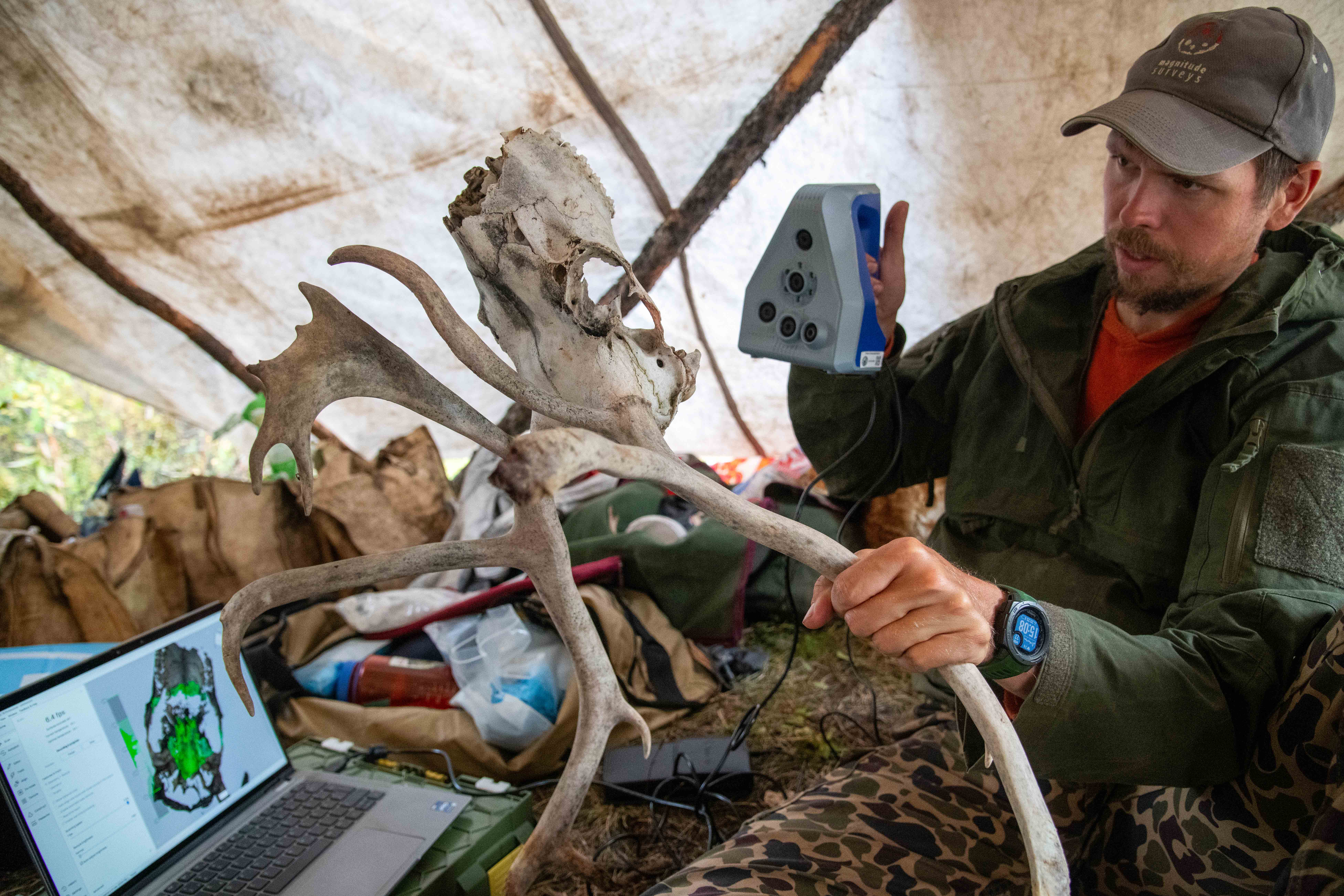
A selection of bones from the avalanche site was collected for further testing. Here, Hans Whitefield scans part of a reindeer skeleton. Photo: Andrew Califf.
After five days of rugged riding without having to open the first aid kit, the team passes the avalanche site and the narrow stream, riding a bit farther to near where the stream widens to set up base camp.
Through drizzling rain and occasional sunshine, everyone toils for the next five days, trying to find and record as many bones as possible. The reindeer remains are labeled by scatter, mapped, photographed, and then hauled back to camp for cleaning and documentation. In total, they excavate more than 20 skeletons and discover more than 500 bones, representing 40 individual reindeer. The team records more than 20 complete skulls and collects about 200 bones for more detailed analysis.
Among the many samples, one vertebra shows pathological markers — significant growths and deformed bone structure. The team collected a wealth of vertebrae samples, but the avalanche site noticeably lacked long bones from the legs, which, along with vertebrae, are the bones most likely to have pathological markers.
Munkh-Ochir knows where they are.
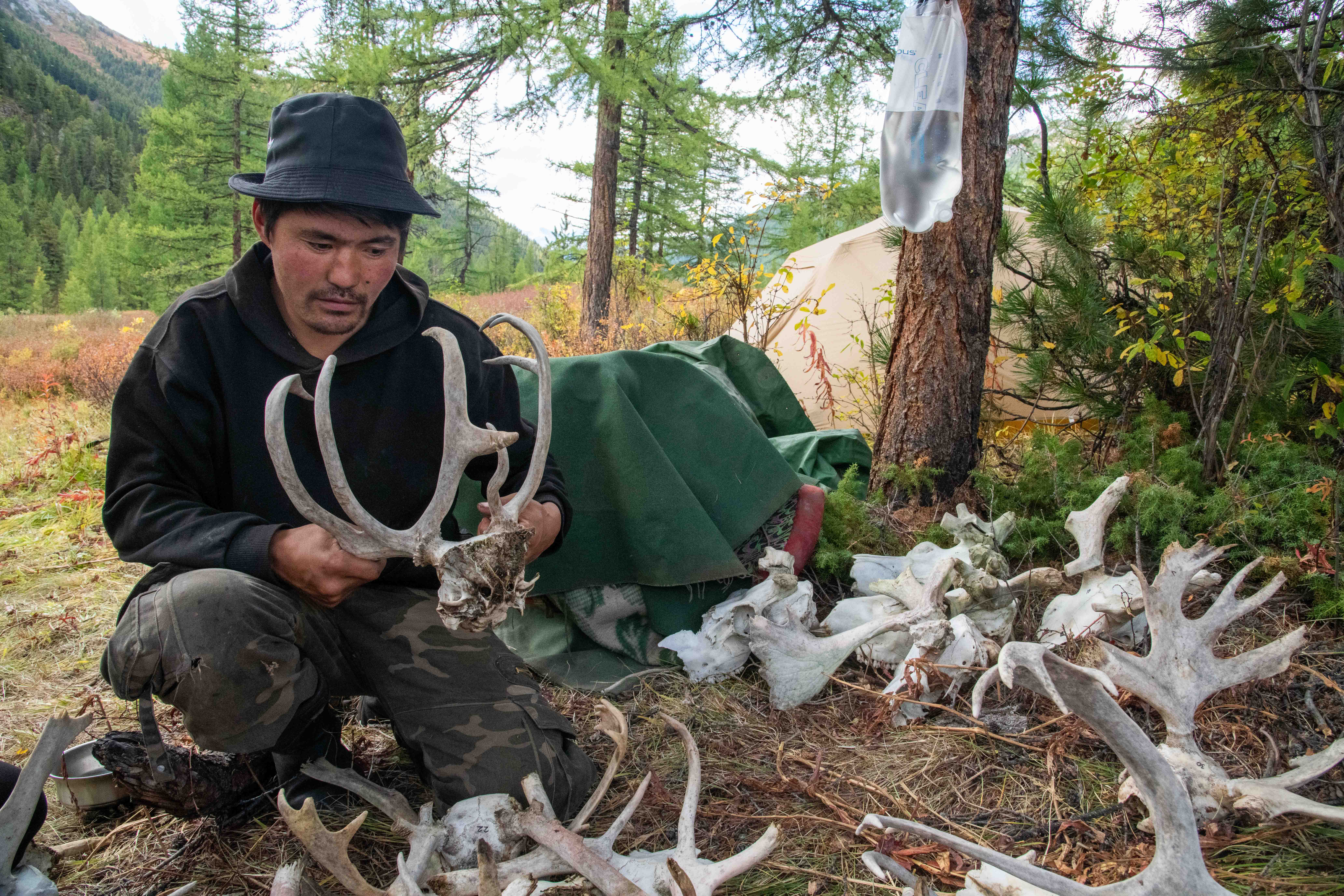
Dukha reindeer herder Munkh-Ochir examines the bones of reindeer killed by an avalanche in 2022. The reindeer lost were part of his herd. Photo: Andrew Califf.
On the second day of the survey, Munkh-Ochir rides out to the avalanche site and leads the team down to the lower slopes. On a very small ledge jutting out from an otherwise forested, rocky, steep, lichen-covered slope is the ghost of a campsite. A clearly defined fire pit is covered in lichen, old ortz poles sag, propped against the surrounding pines, and a neatly organized pyramid of long bones with telltale marks of cracking and cutting to get to the marrow sits off to the side, possibly untouched for three years. The pile is neat but small, and Munkh-Ochir explains many were chucked off the ledge into the stream below, as one would discard a chicken wing.
Even the bones that hadn’t been thrown off the cliff are largely archaeologically useless, as they had been split and cut for marrow, damaging any growths or deformities that might have existed. The team continues to search for better samples, but by the last day of survey work, it feels as if there won’t be any more leg bones to find.
Rain has been persistent throughout the day, and trowling around in the bushes, though yielding more artifacts, soaked every expedition member. With the weather deteriorating and morale dipping, Windle and the rest of the team perseveres to be as thorough as possible.
Just when they are feeling satisfied, loading the last bones into a saddle bag, and excited for some warm milk tea back at camp, Ochir’s dog, Hooter, comes bounding along with a fully articulated, adolescent reindeer leg. It is covered with desiccating flesh, unlike any of the other samples, and absolutely reeks of death, which probably helped the taiga canine find it. The unfortunate part is that no one knows where he found it, so they called it a day nonetheless.

Members of the expedition rest at camp about a day from the avalanche site. Photo: Andrew Califf.
~~
Several days earlier, en route to the avalanche site, the expedition team reached a large Dukha herding camp after a punishing day crossing three mountain passes to reach the forestless plateau in torrential, bone-chilling rain. While soaked jackets and sleeping bags dried the next day by fires wreathed in the aroma of roasting pine nuts, the team visited the nearby Dukha families and got to see the routine of managing a herd.
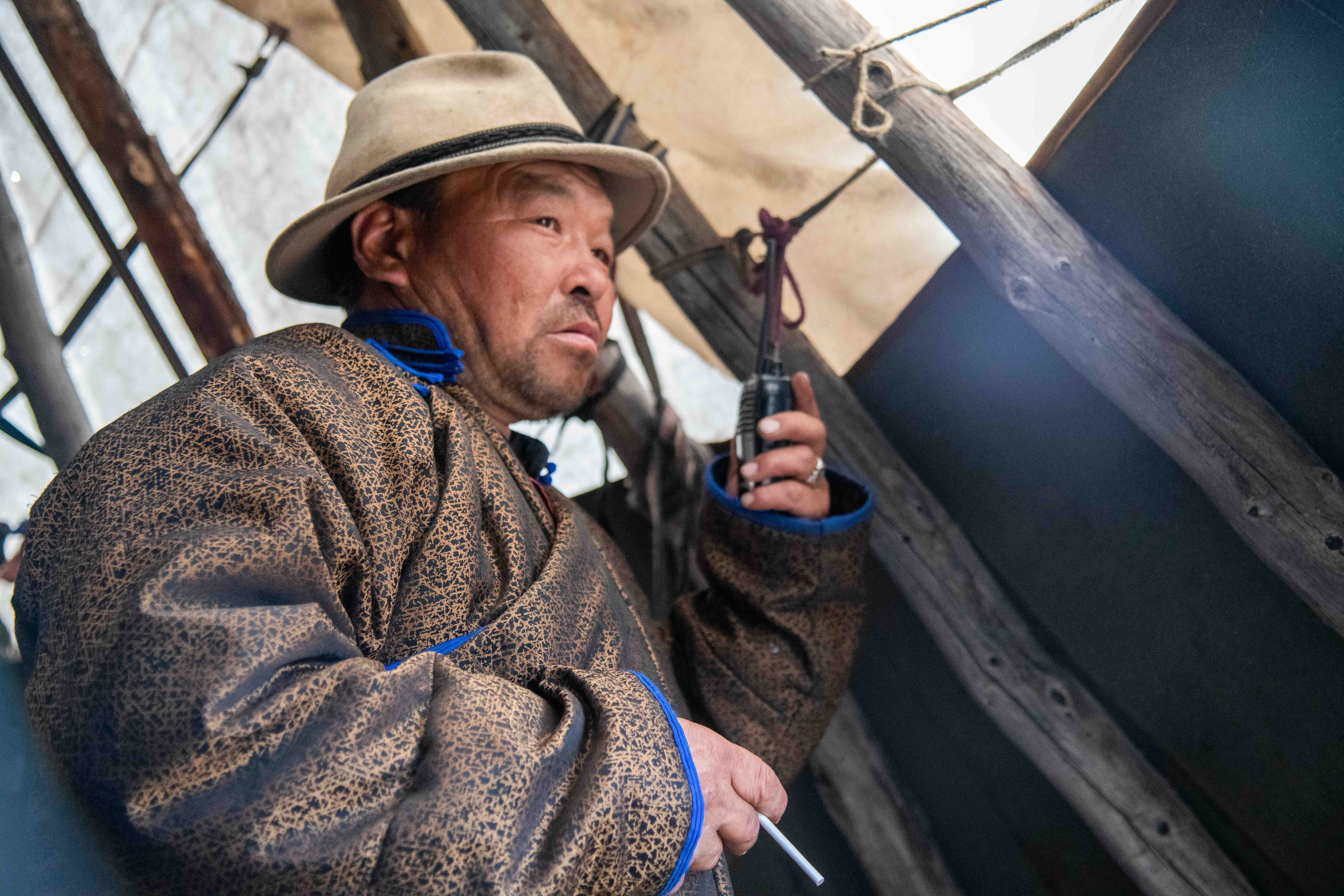
Family patriarch Baayaraa Narankhuu communicates by walkie-talkie with some of the families‘ younger herders. Photo: Andrew Califf.
Every day, the reindeer are taken to pasture. It is a family affair. The young adults herd the reindeer all day, either riding horses or riding the reindeer themselves, and then lead them back to a wide clearing between the five ortzes. All hands chip in, old and young, as the whoops and shouts echo closer to camp. Once all of their reindeer are staked, everyone starts organizing and selectively dispersing their animals to stakes outside the respective owner’s ortzes. The eldest Dukha take their time, but help to the best of their ability. Meanwhile the patriarch, Baayaraa Narankhuu, hauls the two shedding bulls to his ortz, and children fight to drag calves around, encouraging them with ultimately weak physical strikes.
According to Windle, they organize male and female reindeer separately in circles around the calves in the center to both imitate a protective herd huddle for the evening as well as have all the females in one place for milking at 5 a.m. every morning.
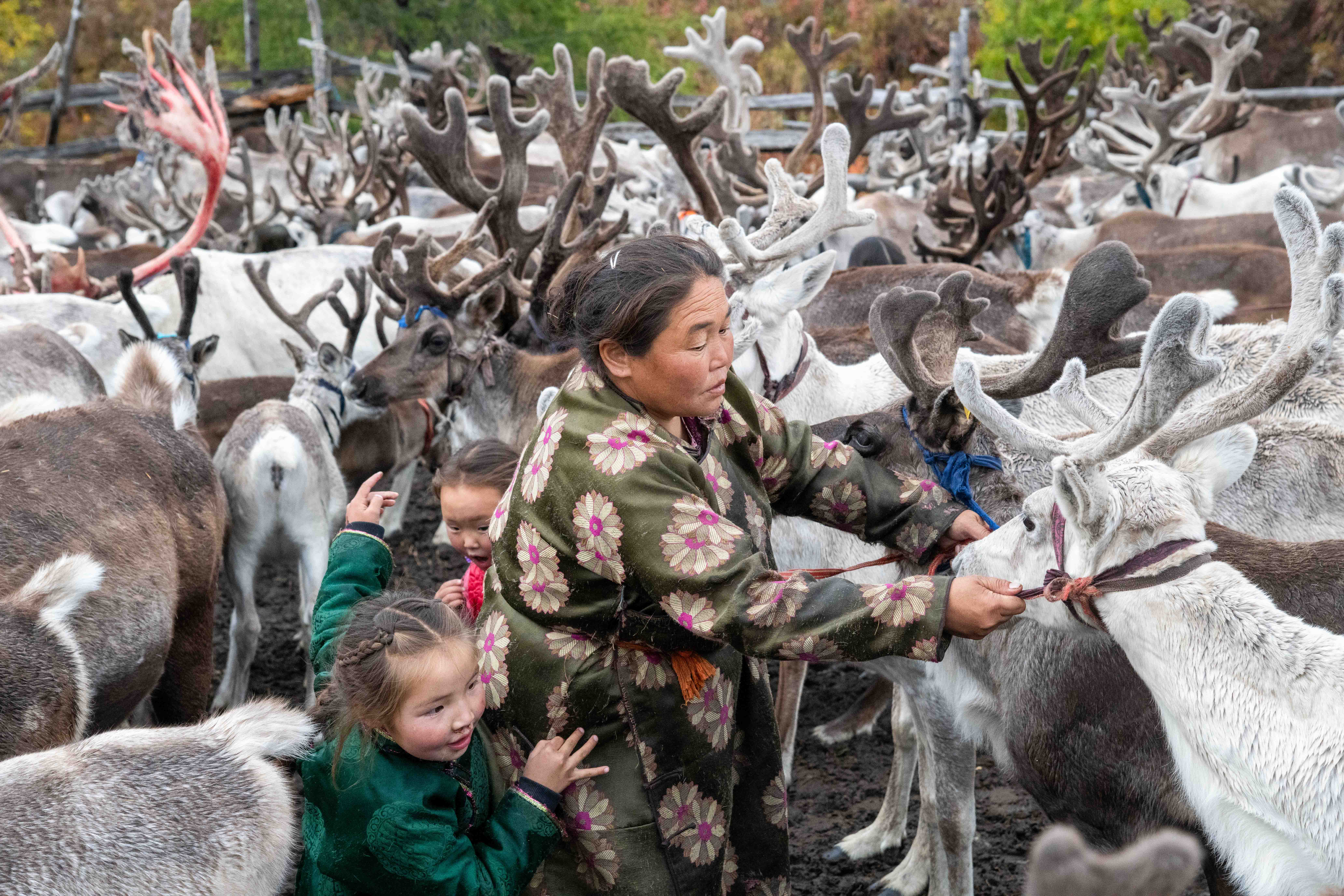
It‘s all hands on deck to manage reindeer, with family members of all ages coming together to graze, stake, and milk the animals. In the background, the natural shedding process of antlers can be seen. Photo: Andrew Califf.
All five families were smaller cogs in a larger familial group. Together, they had lost about 100 reindeer to a different avalanche.
“Yeah, of course it affected us, it was a hardship,” explained Baayaraa Baatar, who lost half of his herd about four years ago. “We lost riding ones and couldn’t eat them, so it’s frustrating, and it is difficult to train new riding reindeer and grow back the herd.”
Mongolia has one of the highest average temperature increases by and large due to its role in supplying charcoal to Russia and China. Studies in Siberia show that permafrost is melting rapidly, releasing methane which, in a domino effect, only further accelerates localized climate change.
Due to border buffer zones, the Dukha are unable to migrate in response to climate changes or even introduce healthier animals into their herds. Ironically, conservation goals further hinder Indigenous use of the landscape.
But it is unclear just how dire the situation is. Approximately 10 to 15 years ago, the number of reindeer in the taiga plummeted below 1,000, but it has dramatically improved, surpassing 2,500 by 2020. Across all four avalanches in the past four years, approximately 300 to 400 animals died. While the loss is a hardship, the Dukha explain they were able to regrow their herd sizes. In the taiga and steppe alike, it is impolite and invasive to ask how many animals a family has — similar to asking someone how much money is in their bank account — and sometimes the reported numbers fluctuate dramatically.
Baatar initially said the family group had 200 reindeer combined, but this led to scoffs when the team spoke with his older brother, who told the NOMAD Science team the number was actually about 400 animals.
“Go ahead, count, does this look like 400?” said Baayaraa Urnna, Narankhuu’s daughter, laughing while letting a whole herd out of a temporary enclosure.
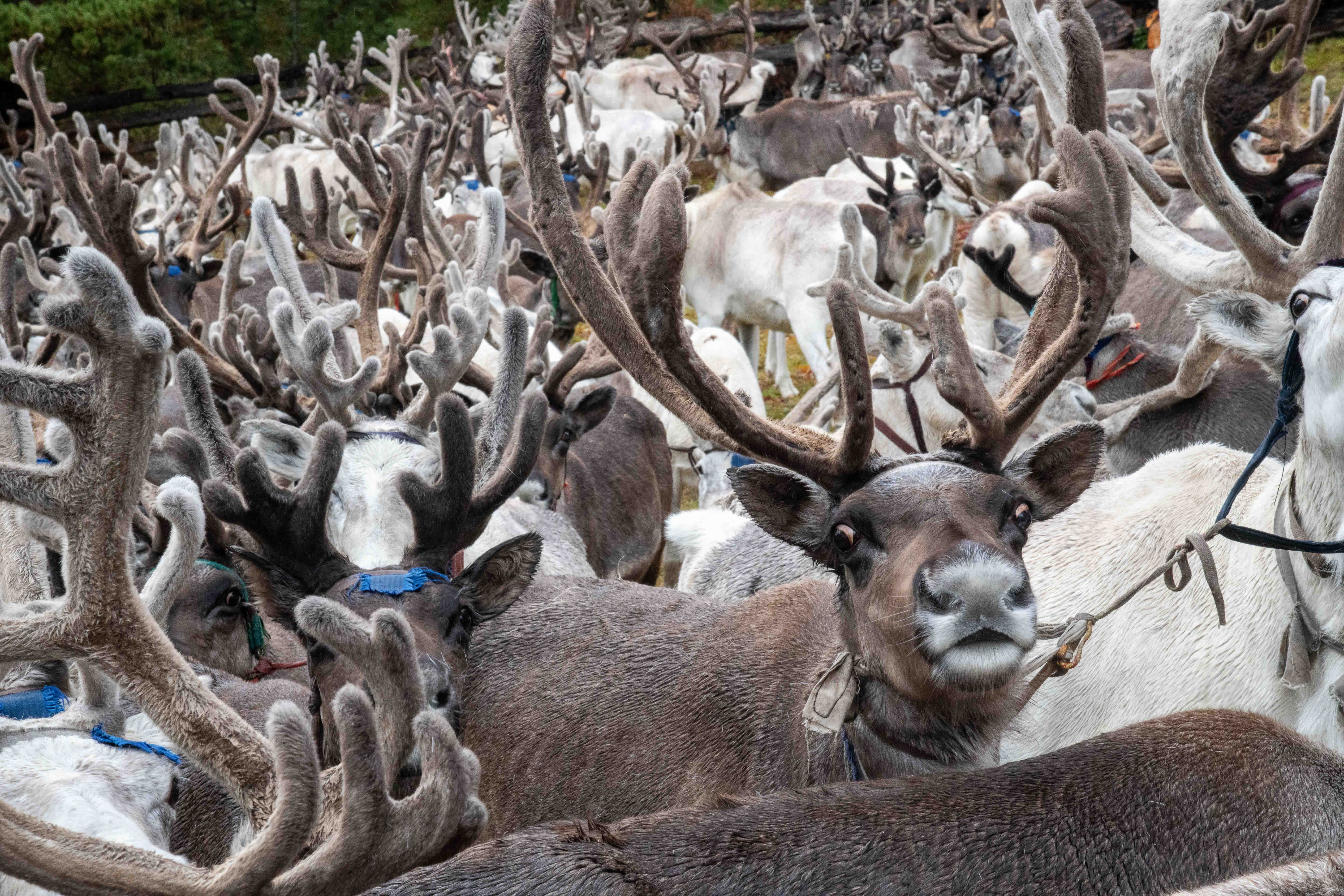
For the Dukha, many of whom have adopted aspects of steppe culture and herd more traditional livestock, reindeer herding is largely about ancestry and culture. Photo: Andrew Califf.
~~
Returning to camp, the archaeology team cleans and processes the finds. Whitefield uses a 3D scanner to make models of the skulls, while the important vertebrae and long bones are collected for lab work. After cleaning, the samples are documented and the vertebrae rearticulated for recording.
It will be months, if not longer, before the team can publish their findings — if they have any. For now, they must pack up camp and set out again on the brutal ride up the high pass in the mist. It is arduous, but the team is now one mountain range closer to home. It will only take four more days of active, rugged “cowboy shit” to bring the bone samples back to the lab. That is where the real work will begin for Windle.
It is a long, tedious project to work in an environment like the taiga, and we don’t know what their discovery is going to be. But the purpose of science is to search for truths big and small. This was just one step in multiple careers’ worth of research, and what Windle finds in the lab may be the key as NOMAD Science keeps pushing farther beyond the jagged peaks — one venture at a time.
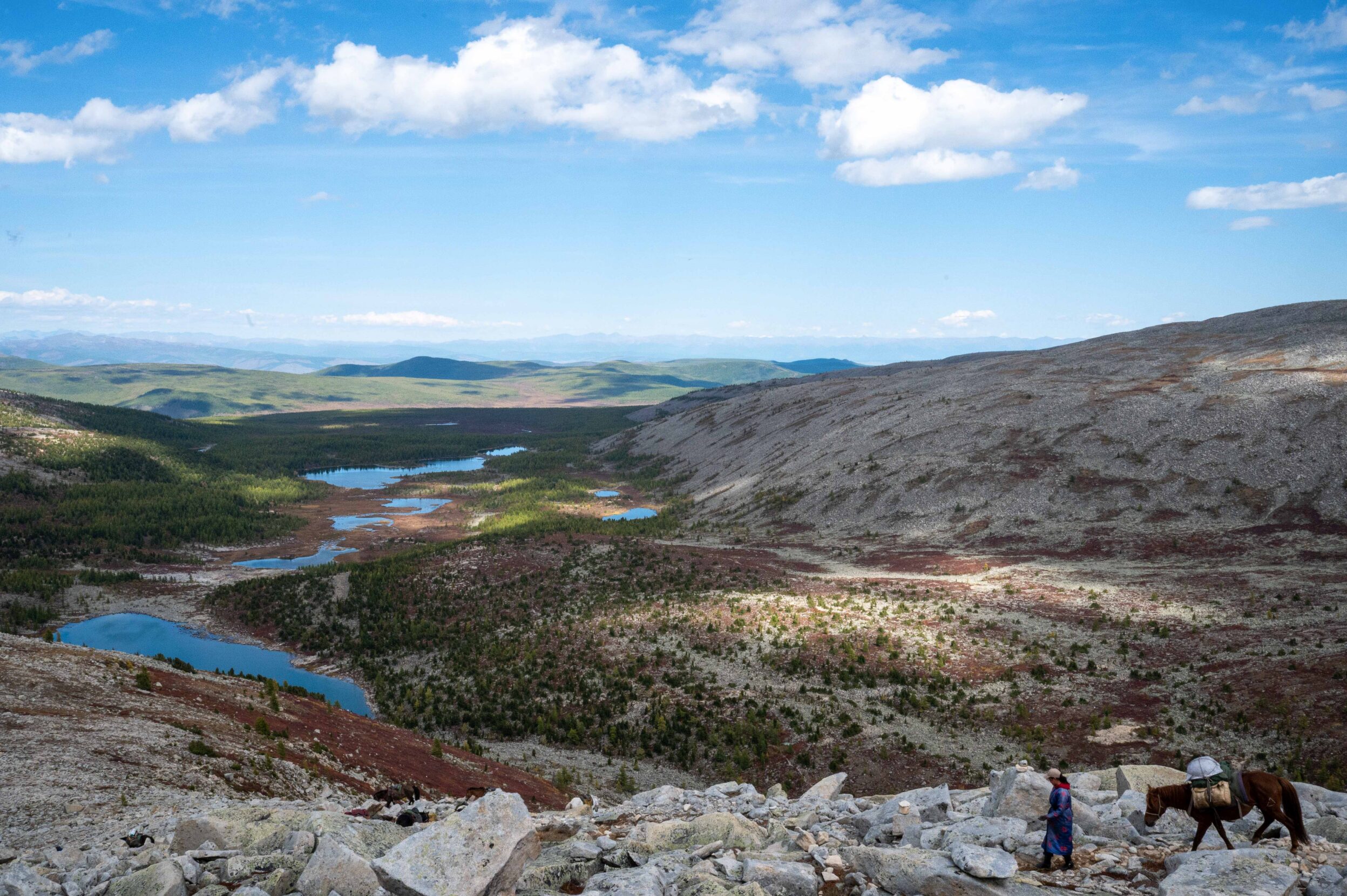
The Dukha and their ancestors have herded reindeer in the Mongolian taiga and Darkhad Depression for hundreds — perhaps thousands — of years. But as they contend with changing culture and climate, what discoveries lie ahead? Photo: Andrew Califf.
Andrew Califf
Andrew Califf is an archaeologist, writer, and photographer aiming to explore and document human-environment interactions within mountainous regions.