

Ad Free. Reader Funded.
Hidden Compass is on Team Human. This article was not written by generative AI. Support the journalist and editors of this piece with a direct contribution!
% of $ Goal
Total number of contributions so far:
0
Total amount raised for journalists
$0
"One thing I really appreciated about working with Hidden Compass is that it's a space where there is time for nuance and complexity. By donating, that's what you're supporting. You're able to help us as writers, but also as an outlet, continue to tell these kinds of stories."
- Anna Polonyi, Hidden Compass Journalist
"The reason why I contributed was because the article that I read really resonated with what I was feeling. I felt like the author was in my head... It just moved me and I felt like I needed to do something."
- Hidden Compass Reader
The Hudson begins in the heavens, from which it falls, gathering in a pond called Lake Tear of the Clouds and trickling slowly, as it has for millennia. From its headwaters in the Adirondacks, it travels southward, joined by smaller rivers like capillaries to a vein. It winds through the Highlands of upstate New York, the roots of ancient mountains. A billion years ago, they were as tall as Everest; eroded now by time.
As the bedrock weakened, the Hudson crashed through and carved what is now known as the Hudson Valley. Because a river, most of all, is opportunistic — by definition creating division at every turn.
Two men, laughing together as only childhood friends do, hike a mountain trail and look below. Together, they take in the view. There is the open sky where hawks and eagles soar through myriad shades of blue. There are the pine trees and chestnut oaks that stand tall and touch eternity. The rabbits and bucks that leap through bushes; the caterpillars, ants, and trillions of microorganisms that dance in the dirt; the flora, fauna, and crisp mountain air that imbue the hills with resonance — brilliant, vast, like something close to God.
Most of all, the men gaze down over the fjord that connects it all. For now, they stand on the same side of this schism.
~~
Richard Shea, slim with black hair and greying stubble, fastened the buttons into the slits of his baby blue dress shirt. He wasn’t nervous, of course not. He’d learned to take it on the chin: People aren’t themselves at these open fora, he tells himself; they seldom mean what they say. His track record rested reassuringly in the back of his head. For decades, he’d served Cold Spring, a small village of almost 2,000 people adjacent to the Hudson.
It was early evening when Richard left his home near the water, where black-and-white photographs of the Shea family hold court on the mantel. For five generations, the Sheas had been cornerstones of Cold Spring, ever since they emigrated from Ireland, a lineage of county judges and many town supervisors.
He glanced at the green Rivian in the driveway. Haldane High — the school his grandfather built, the one that Richard and then his own kids attended — was too close to warrant a drive. He walked.
For 11 years, he was town supervisor. And he was good. Really good. His tenure became the stuff of legend after his zoning war with the late Cold Springer — and Fox News magnate — Roger Ailes. The tension crescendoed one night in his old high school gym. Ailes marched into the town meeting with a lawyer, a scowl, and fire in his belly. He wanted to expand, to build, build, build — the Ailes ethic dictated that “God made trees so you can build houses and have baseball bats.”
Naturally, he wasn’t partial to Richard’s green zoning inclinations.
And Ailes let Richard know it, ranting and raving and ranting some more about his understanding of liberty and how Richard was not just unworthy of office, but resolutely un-American. The magnate threatened him. Richard had to tell his kids why their dad’s face was plastered on signs near their school and why his tires had been slashed. He had to kneel to meet them in the eye and find words when they asked, “Daddy, why do they hate you so much?”
It was all right, he assured them, because people ought to stand for something no matter how much they’re loathed.
Against Ailes, Richard held firm. Cold Spring stayed green thanks to his resolve.
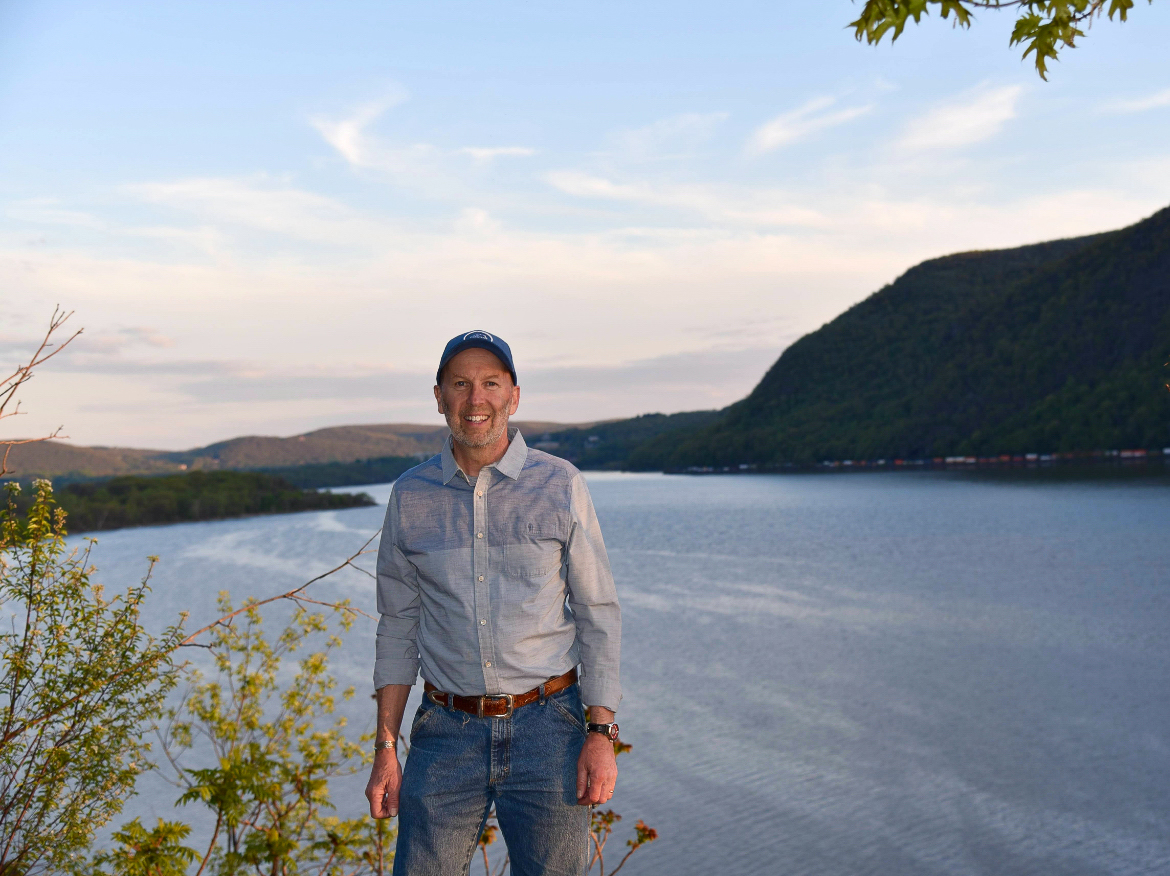
Former town supervisor Richard Shea hasn’t shied away from controversy in the name of protecting and advancing his hometown. Photo: Courtesy of Richard Shea.
~~
Now, 14 years later, in 2023, Richard again made his way to the front of Haldane’s gym. He looked into the audience and recognized many from his time as their representative, as their neighbor, as their classmate.
Scanning the room, he met the gaze of an old friend — bushy-bearded, his greying hair speckled with streaks of black and white.
The emcee tapped the microphone and began to speak, begging for a respectful audience.
Richard moved the mic from across the table.
“Hi, I’m Richard Shea, a lifelong resident of Cold Spring, former town supervisor, former town board member, former caretaker at Little Stony Point. I have over 30 years of community service in this community. So, I’m glad to see everybody out. It’s gonna be a great discussion.”
Applause.
A fellow panelist, the woman to Richard’s right, gestured toward him and whispered. Richard leaned forward into the mic once more:
“And currently a board member of Hudson Highlands Fjord Trail — the newest member,” he said, chuckling dryly.
Nothing.
Richard spent the evening stumping for the Fjord Trail, a controversial project that was slowly tearing Cold Spring apart, splitting the village into impassioned factions. He answered biting questions, responded to snide and sarcasm. He wasn’t always calm. He often paused for jeers.
People ought to stand for something no matter how much they’re loathed.
One man, though, surprised everyone with his silence. Behind the bristles of his beard, Dave Merandy managed to keep his mouth shut. Often rowdy, he didn’t trust himself to speak — not about the trail — in such a public setting. Not with what was brewing inside him.
When the panel ended many raucous hours later, Dave stepped out of the gym and inhaled dusk’s cool mountain air.
~~
A year later, the Metro-North rolls to a halt at Cold Spring Station. Through its western windows, I see the peaks of mountains foregrounded by the Hudson.
I exit the train and walk a few steps east of the station to enter Cold Spring. As a reporter, I’ve come from Manhattan to understand the conflict tearing apart this quaint town that has, for years, been my favorite place to hike.
Signs pepper the yards near the station, stakes pummeled into grassy lawns, fastened tight:
“Fjord Trail is Our Pjark!”
“Fjord Forward! A park for all of us”
I walk down Main Street. A lone bookshop is open amidst restaurant after restaurant, store after store, of locked doors where star-spangled flags flap and half-roundels drape from windows. Facades, bright yellow and salmon pink, mark the commerce that turned Cold Spring’s rifle store into a latte lounge and inspired the hardware store to sell pottery, the kind weekenders like to take back home.
Seven antique stores remain, selling everything from JFK pins to baseball cards — relics of the American Century. Behind counters, old men and women stand like fixtures while dogs lounge on varnished floors.
Main Street is sleepy on spring weekdays like this one, when city dwellers like me wax restless in our apartments and cubicles, wandering through visions of the country. We see miles of state park land, greening and gorgeous, where branches shake and flutter from the touch of nesting robins. We picture a path on a distant mountain, Breakneck Ridge, considered one of the most popular day hikes in America. We hear the Hudson gush and north country winds blow softly.
What few locals I saw — strangers — smiled at me, nodded, as I passed by pink and purple flowers on the pristine sidewalk.
Eighty-nine years before the founding of the Union, Dutch traders started a trading post on land inhabited by the Wappinger tribe. In 1730, Cold Spring was founded on that land.
Cold Spring Pier juts from the foot of Main Street, a half-circle with a gazebo in its center. Near the water, benches face the United States Military Academy at West Point, its gray stone bell tower looming above the distant trees. A decorative cannon also faces the water — “The Parrott Gun,” reads the plaque. The machine was built in a nearby foundry and shipped to, among other places, Virginia, where it shot Confederates dead at the Battle of Bull Run.
In the 1920s, crosses burned on the mountains. Fed by gusts of highland wind, flames flickered through the night. One summer evening in 1927, a thousand white robes marched like phantoms, cheered on by thousands more, to nearby Peekskill. Fireworks exploded in the sky.
Like all villages, nations, and people, Cold Spring is rooted in contradictions — contradictions that can’t be reconciled but beg to be accepted.
Soon, I would see just how deep the division goes.
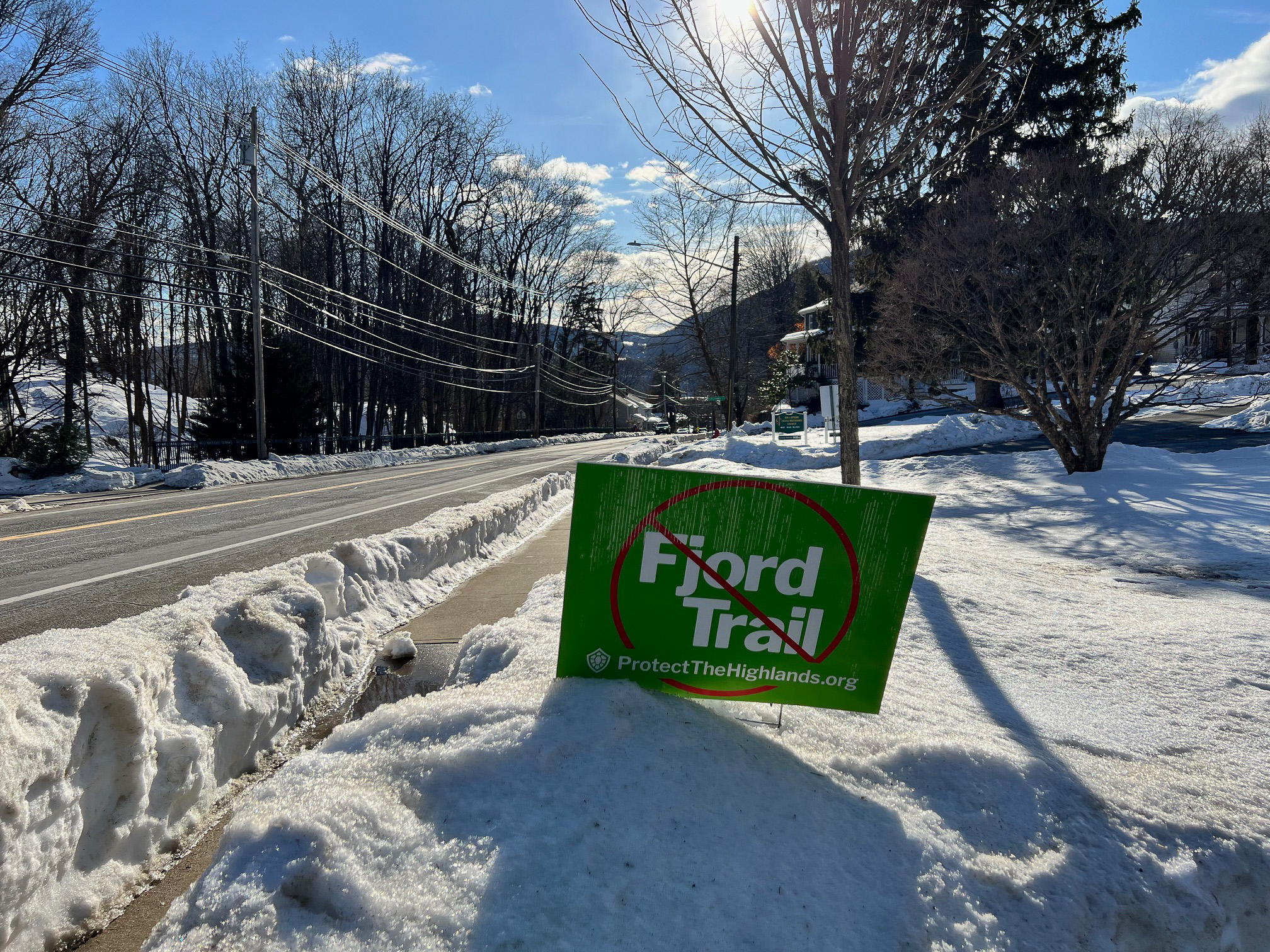
A yard sign opposing the Fjord Trail development stands out in the snow. The trail project has divided communities and friends as the region grapples with benefits and costs of development. Photo: Courtesy of Dave Merandy.
~~
Wind howls on the Hudson as it rushes past Dockside Park by the foot of Main Street. I stand on the shore.
It’s here that Fjord Trail, a 7.5-mile development up the river, is to start. When the project was first conceived in the early 2000s by Richard Shea and a couple of other village officials, it was touted as a 1.6-mile-long safety measure, a solution to the lack of sidewalks between Cold Spring and Breakneck. It would cost about $3 million, and nearly every Cold Springer was on board. It began to grow in scope incrementally, which raised a few eyebrows, but only a few and little else.
Then the project sputtered. Funding dried up.
In 2017, Christopher Davis picked up the phone. A resident of nearby Garrison, he offered to help pay for the trail. As a mutual fund manager and billionaire board member of Coca-Cola and Berkshire Hathaway, he could afford it. And it wasn’t the first time he’d financed green projects in Cold Spring. But the trail’s initial design, he felt, was “a little bit soulless.”
Then, seemingly out of nowhere, came a 2020 announcement. The trail would be redesigned from the ground up. It would include parking spaces, a visitor center, restrooms, and a shuttle service; it also featured a swimming area, a play area, and hammock-like contraptions called forest nets.
The initial trail from two decades ago — that stretch between Cold Spring and Breakneck — is now the first quadrant of the development; that section alone will cost nearly $100 million. New York State pledged $20 million to the project, with an additional $14 million in public funding. The fruit of the joint effort would draw nearly 270,000 new visits per year, a more than 50% increase in the region’s foot traffic.
Over the past few years, the group leading the initiative has made some changes to the plan in the wake of community outrage, nixed the much-maligned forest nets, and removed the proposed swimming and play areas from the design. They also added Richard, a local hero, to their board.
~~
A woman and a man trot on the patchy brown grass that lines the shore. Dave Merandy wears a dark fedora with a feather tucked into its twill band. He’s a fourth-generation Cold Springer and a former three-term mayor of the town, serving as recently as 2021. He was known to be rowdy, and he still is — ever-eager to call a spade a spade.
Nearly 70 years old, Dave has protected his village for most of his life, drawing from the same pool of pride and grit he used to craft his forest home, where deer graze behind the kitchen.
He was class president at Haldane and then left the village one day, hopped into an Econoline Ford, and drove to Washington, where he marched on the capital as napalm rained on Saigon. He’s a retired general contractor, and during his time as mayor, he was seen on hands and knees placing bricks on Main Street. Dave is Dave — that’s what folks kept telling me, as if tautology could explain a man, but Dave Merandy is Dave Merandy, and so it does.
Dave is the president of Protect the Highlands, a nonprofit founded in 2023 to fight the expanded Fjord Trail due to concerns about over-tourism and environmental detriment. Grace Kennedy is a fellow board member.
Grace walks with him up the river. She’s in bright yellow shades and a bright yellow windbreaker, and she’s grinning big and wide. A garden designer, she’s a Manhattan expat who lives in the neighboring town of Garrison.
“The one ad campaign that drove them crazy was when we said ‘Don’t Be Fjooled,’” says Grace, chuckling, after introducing herself.
“That was definitely our best,” says Dave, smiling softly, deep-set eyes flickering.
“Oh my God, they just couldn’t stand it!”
Last winter, New York State released a preliminary environmental impact statement on the trail. Dave and Grace frequently reference its findings: The Fjord Trail would affect the habitat of nine rare or endangered species, like the Atlantic sturgeon and the bald eagle [editor’s note — in January 2026, the final report was published]. For the trail’s construction to be permitted, developers must make every effort to mitigate that harm. The government does, however, essentially accept that some collateral damage is unavoidable.
And it doesn’t take much issue with the most controversial segment of the trail — that mile-long stretch set to be propped up by pilings not on the shoreline, but in the river itself.
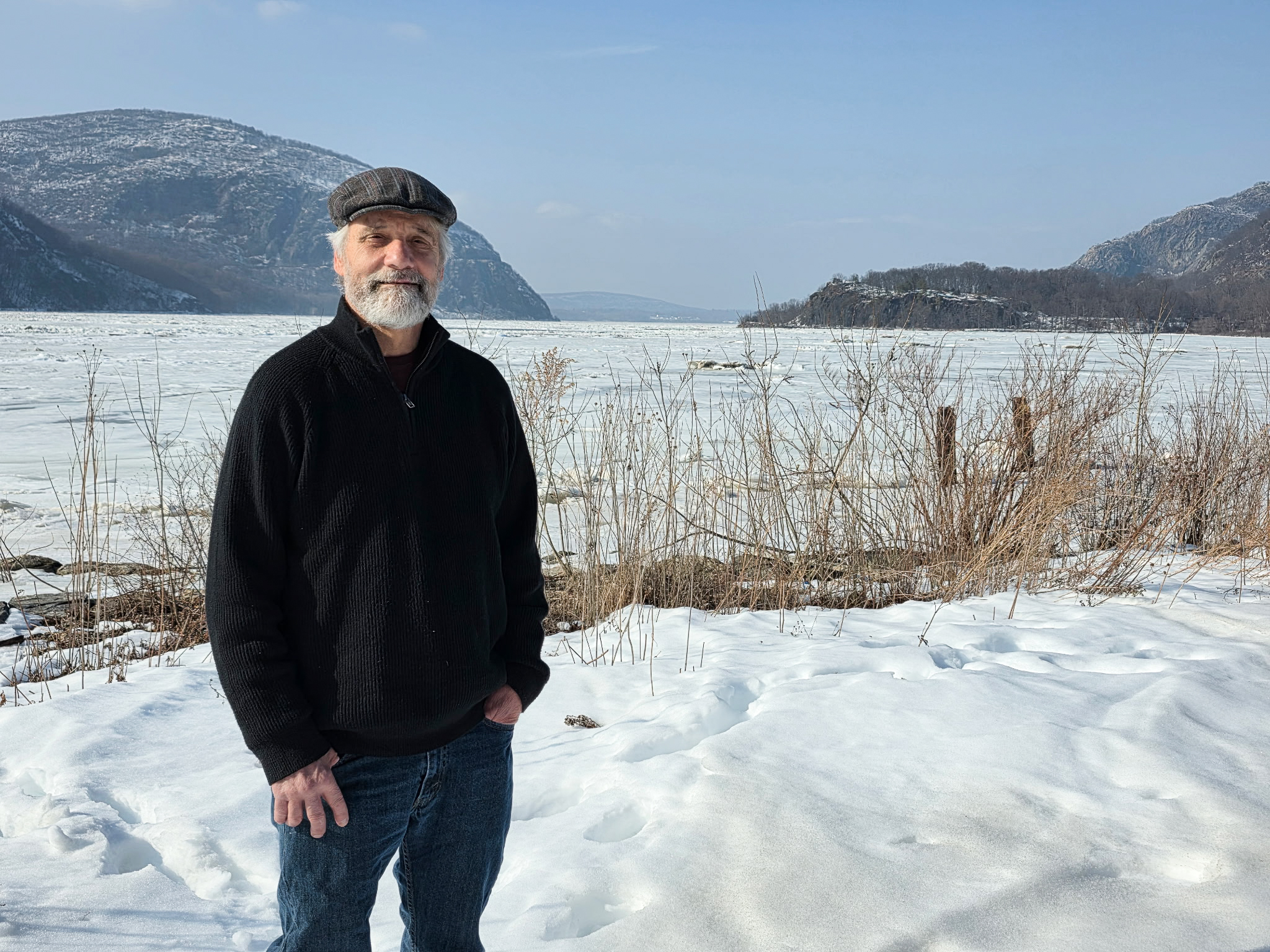
As president of Protect the Highlands, former Cold Spring mayor Dave Merandy wants to protect his hometown and the surrounding forests and mountains of the Hudson Highlands from the proposed Hudson Highlands Fjord Trail. He and others believe the project will cause unacceptable environmental degradation and overtourism. Photo: Courtesy of Dave Merandy.
~~
A local environmental group, Riverkeeper, urged trail developers to avoid construction in the river for a number of ecological reasons, most of which are self-evident. It implored the project to assess the attraction’s greenhouse gas emissions, a feature absent from the initial report. The developers are in talks with the group, though they’re under no obligation to listen.
Woods will be destroyed for the trail’s construction, though most of the trees along the route are either dying or invasive; the shoreline’s ecology was muddled and warped by centuries of pollution. Degradation was hastened by the railroad tracks that run along the river. Native sassafras and red oaks gave way to the Rosa multiflora, which took root in the soil.
Grace recalls a conversation she had a few months prior: “One of the park’s people said, ‘Well, some of them are going to be dead in 50 years anyway.’ Yeah, so are you, but I’m not free to kill you now either!”
The matter raises the age-old questions of environmental ethics: What belongs? What’s natural? And does any of that matter when judging something’s fate — what lives and what dies, even if it’s already dying?
I don’t have the answers. Nobody does, not really.
~~
The Hudson begins in the heavens, from which it falls, gathering in a pond called Lake Tear of the Clouds and trickling slowly, as it has for millennia.
As Dave drives us down a highway near the shore, he points at a patch of stumps north of Dockside.
“They just cut down these,” Dave says. “That’s for parking,” he says, adding sarcastically: “and that’s for the Hilton,” gliding his index finger rightwards.
“And the Best Buy goes over there,” adds Grace.
“Yeah, and maybe they can make it like Dubai and build jetties all the way up the river,” says Dave.
If there were actually plans to build jetties up the river, Grace and Dave feel they wouldn’t have a say. Important parts of the trail’s planning — its expansion into an attraction — happened behind closed doors. That’s because, for all its public funding, the Fjord Trail relies heavily on private donors, on Christopher Davis’s billions.
“I think he’s done great things, but that doesn’t mean everything that he’s going to come up with is going to be good,” Dave says. “And I don’t think he should be dictating the future of my community. Who the fuck gives him the right to do that exactly?”
For all their concerns about the project, Dave and Grace are surprised by the moderate support the trail receives from locals, who see it as a step forward for Cold Spring.
“It feels kind of criminal to sell out your town,” says Grace.
“I just – I just don’t understand it,” says Dave. “You were raised here.”
~~
“When did certain individuals become gatekeepers for who can enjoy the Highlands?” Richard asks me during a video call the next day, a Fjord Trail cap on his head.
“They feel like they’re in this tiny little thing here — this fucking snow globe — that nobody can come into,” he says. “You don’t have a right to block people from coming here. No one gave you that right. No one bestowed to you ownership of this area.”
“The only way you’re going to save the world — the environment — is if people see it and think there’s something there that is worth preserving: ‘I love this, and I don’t want you to harm it,’” he continues. “And the more people who love it, the better it’s going to be.”
~~
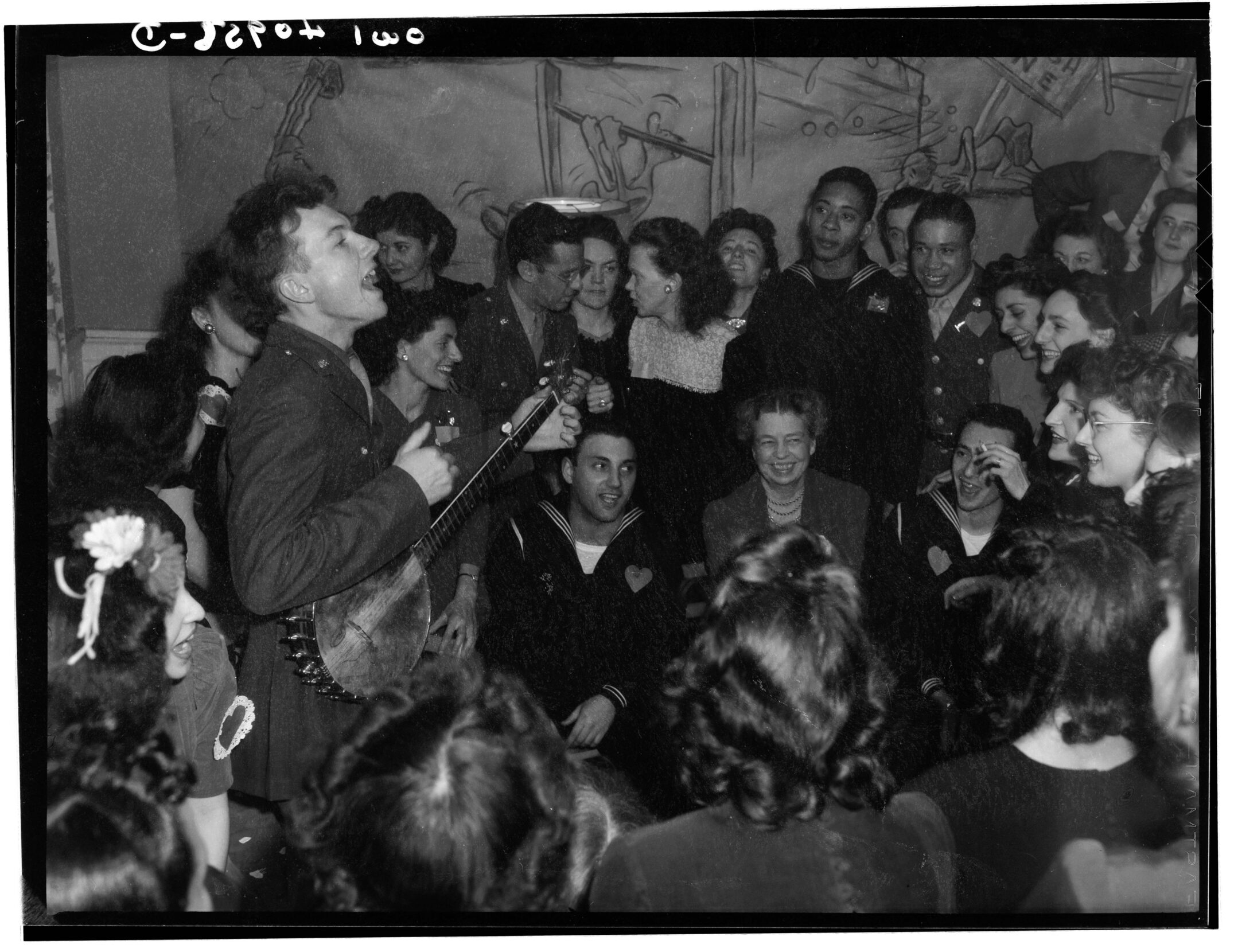
A young Pete Seeger performs in Washington, D.C., in 1944. In subsequent years, he would become an ardent environmental activist and a notable resident of Cold Spring. Photo: Joseph A. Horne / Library of Congress.
When Richard was a boy, he met Pete Seeger in the Highlands. They got to talking, Seeger with his wisdom and Richard with the wide eyes of a 14-year-old in awe. Richard mentioned he’d just gotten a banjo. Seeger responded, why don’t you bring it?
Richard ran up the street and across town, disappearing into his home. He emerged from the front door in no time at all, holding his banjo with a thumping heart. He ran back to Seeger, who was where he’d left him, just waiting. And it was there, at that spot overlooking the river, that Richard learned to play the banjo. Pete Seeger taught him his very first song, the words and the notes, and they sang it in unison, harmonizing Guthrie’s great ballad: “This Land is Your Land.” Together, the boy and the man sang of a vision for America, one of sharing and plenty.
Richard’s eyes still twinkle when he thinks back to that moment — he’s a kid again and his lips form the biggest grin.
They became friends, Seeger and Richard, and later, colleagues, serving together on a local civic board.
“Pete said it was all about inclusivity, all about getting people to the river and getting a more diverse crowd here,” Richard tells me. “He felt this keenly.”
~~
“How could Pete Seeger be for it?” Dave once asked me about the Fjord Trail, going on to cite a common misunderstanding about the musician. “I mean, he was against electrical fucking instruments. Fuck — this isn’t an acoustic project.”
Dave’s version of Seeger differs from Richard’s. Dave’s is a man, a minimalist, who lived a solitary life at the top of a mountain overlooking the river that he loved. He wouldn’t have wanted that disrupted by pilings or tourists.
Dave wrote me after one of our talks:
“Probably 20 or so years ago I was going out with this incredibly beautiful woman…who I was madly in love with. It was a very ethereal time. One day while walking from her small apartment … I told her I loved her. Her response was, ‘You don’t know what love is.’…The funny thing was and pretty much still is, is that I’m not sure I can define love. You asking me about my experience with nature is much like her saying I didn’t know what love is. I don’t think I can adequately define either…
“Nature, [like love], is beautiful and unpredictable. Both open the door to fantastic experiences and both can subtly or dramatically turn on you. It’s a great dance well worth the risk.”
Like his version of Seeger, Dave’s nature is intimate. Ineffable.
It is love.
~~
Seeger came to the Valley in the 1940s and never left it, not even in death. He fell in love with the mountains and the river. But things were different then, in that pre-nascent stage of the environmental movement. Sewage oozed into the Hudson. The water was murky, contaminated by hazardous waste from factories, stained by the color of the dyes in use.
So Seeger got a boat, and plucked his banjo as he told America of the vessel. He called the sloop Clearwater, and serenaded it with a song of the same name.
I was sitting on my front porch as I watched the river rot
Thinking about the sturgeon that are gone but not forgot
And the buffalo an restless underneath the prairie sod
And the smoke stacked up to heaven so’s it hid the face of God
It was the late 1960s. He set sail from Maine with a group of activists, wind whisking through his face while the sloop was cradled down the coast by the Atlantic’s cyan waves.
The ship cut through the sewage lying on the river’s face
And the sloop docked in the garbage that was all around the place
And the crew struck up a hornpipe and the boots rang on the wood
And the sound fell on the river and the river found it good.
He wound up in Washington and, with Don McLean by his side, pleaded with Congress on the first Earth Day to consider conservation. Two years later, amidst mounting public pressure spurned by Seeger’s efforts, a bill passed that would go on to become the Clean Water Act of 1972.
The mountains rang as children laughed and women raised a song
The bison thundered down the plains a hundred thousand strong
The Ghost Dance tent was raised again and the Lion wandered free
And the rivers ran like silver from the mountains to the sea.
~~
In 1978, a group of young men — Marines — marched to Cold Spring’s dock and cut the Clearwater loose in the middle of the night. One clenched an American flag in his fist. Seeger was a Marxist, blacklisted and resented by many locals for the longest time.
Decades prior, he had opened for Paul Robeson at a show in nearby Peekskill. It was one of the first times Seeger sang “If I Had a Hammer.” People in the crowd hurled stones and racial slurs. A riot ensued that ravaged Peekskill. By the time the violence quelled, 140 people had sustained injuries, and the local chapter of the Ku Klux Klan had received an increase in new applications.
As we lunch on Main Street, Richard tells me his mom was at that show. She feared for her life. His face turns solemn and sickly.
“There’s pictures of Klan funerals here,” he says. “Did you see them?”
I had.
In stark black and white, Klan members kneel on the grass, their hoods pointing to the sunny sky. The white cloth of their robes bleed into each other and bleed into the stripes of the flag and bleed into the petals of the roses they place on Cold Spring’s soil. Men and women in dark suits and dresses stand above the mass of white, heads down in grief for the person in the ground.
“You just look at that and say, ‘That cannot be real. I know that spot. I’ve stood there.’ I mean, that ground is poisoned — you can’t get rid of that. You have to acknowledge that. You have to heal that wound.”
“If you’re not actively trying to break free of that,” he adds, “then you’re aiding it, and I refuse to be complicit.”
The population of Cold Spring is almost entirely white. “A gallon of milk” is how Richard describes it. “I’m a white guy. I grew up here. I am embarrassed by this at times. It is uncomfortable, and it should be.”
Since they came to America centuries ago, the Sheas, with their bright blue Irish eyes, have called Cold Spring home. It’s Richard’s home. And, through his own composed exterior, his community’s anger does affect him. It hurts, though it takes him some time to admit it.
“It’s heartbreaking to me, that aspect,” he told me once. “It weighs on my mind a lot. That’s why I’m really introspective about my motivations, about whether I believe in [the Fjord Trail].”
His father is buried in the same cemetery as the Klansman. His body lies right by Haldane High, where Richard met his wife in ninth grade homeroom; decades later, their son was the lead in the school’s production of “Our Town.”
Ghosts linger. Past and present bleed together. Opening access to Cold Spring, Richard feels, could set it free.
~~
Two men, laughing together as only childhood friends do, hike a mountain trail.
Recently, Dave came across a letter he received many years ago. It was long and heartfelt, and it brought him great comfort during his divorce. “Whatever you need, I’m here for you,” it read; somewhere in the note, Richard had referred to him as brother.
Dave still thinks about that every now and then.
Dave and Richard first crossed paths in the fourth grade. As the years passed, they would hike together the forests of Cold Spring, the mountains, and the riverside. They became close — very close — like family, like brothers. Through the decades, they grew up; they grew old together in Cold Spring.
Dave remembers a fiery conversation they had, how it happened in his home before the Trail forum at Haldane High. They spoke about the project and Richard’s decision to join the board. It didn’t go well; Dave wasn’t listening. He couldn’t — he hardly knew the man before him.
“How did this get to here?” Dave asks himself aloud as we sit in his living room. “Maybe we can — I don’t think we disagreed on much. Maybe we did. Maybe where we’re at in life changes.”
Richard remembers the letter too, scrawling it from the Spanish Peaks of Montana, where the forest service had him stationed, having heard the news of Dave’s divorce.
“The fact that friends no longer speak to me causes me great pain along with even greater confusion … Both Dave and I … were there for each other when we found ourselves in need,” he wrote to me once.
The men no longer speak to each other.
~~
On Earth Day, I buy the first ticket to Cold Spring. The battle over the Fjord Trail continues, and it’ll likely go to the courts where it could drag on for years.
I enter the train, take my seat, and give my ticket to the mustached conductor as he marches through the cars. I wait and wait as the train shoots down the track and the skyscrapers give way to stillness.
As rain sprinkles on Main Street, I step out of the Metro-North once more.
I walk down the street and see the same signs as I had months before, and I feel the hurt, the love, and the American kind of melancholy that lingers in a fading town or a street in transition. I go uphill by a residential path and, when the sidewalk turns to grass, I march by the side of the road, which slowly slopes, as the rain begins to pour.
I reach a clearing where cars are parked and families gather. Beneath a tent, a man plays “Oh! Susanna” on an acoustic guitar, an upbeat cover of a mournful song. Stalls have been erected. Clusters of dahlias and the reddest bell peppers are displayed for sale. I see organic dog food and sustainable beef hot dogs. Award-winning goat cheese wrapped in plastic. There is champagne tea made of crushed grapes from Long Island and sustainably canned mushrooms. A little girl in rain boots hops into a puddle.
Hudson Highlands Fjord Trail has a stall near the entrance of the market, though there is no sign of Richard at the moment. At the very back of the market, Dave and Grace man the Protect the Highlands stall.
I stop to say hello and walk farther back, back behind the big yellow house at the foot of the path at the end of the market.
Taking a seat on a damp wooden bench, I inhale the scent of wet soil and take it all in. From above, the rolling mountains sink into the valley, settle in the water, and emerge as the grass and the trees and the mist and the rain.
There, between the abiding mountains and the hilltop market’s busy stalls, runs a schism — a schism we named the Hudson Valley many years ago.
The river rushes through it, unrelenting. It finds respite only in the ocean.
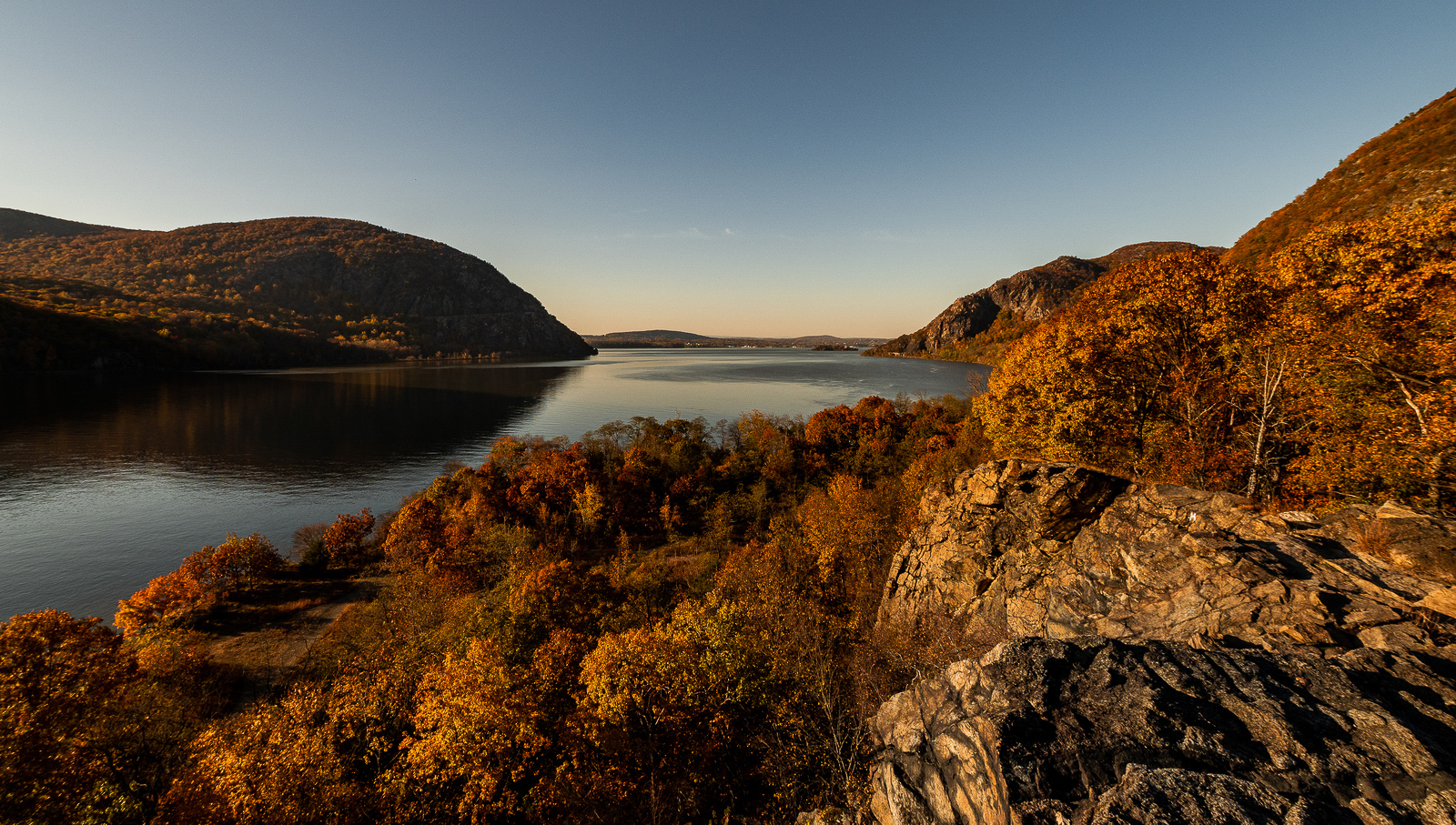
The Hudson Highlands stand on the precipice of development and conservation. Photo: Pierce Johnston.
Omar Drissi
Omar Drissi is a senior at NYU, where he studies philosophy and journalism. He resides in an apartment the size of a sardine can but, luckily, his bedroom window overlooks a brick wall.