


Support Hidden Compass
Our articles are crafted by humans (not generative AI). Support Team Human with a contribution!
*Some of the names in this story have been changed to protect the identities of the individuals.
The sky is vast and heavy on this warm afternoon in a meadow up near Banihal, the gateway tunnel of Kashmir, bordered by the mighty Pir Panjal Range. In the middle of the grass is a colorful tent, made from patches of red, blue, and green cloth that gently flutter in the wind. Ropes tie down the shelter, and a few heavy stones keep it steady.
Inside, a group of women sits in a loose circle on old woven rugs. Their hands busily twist wool into bracelets, their voices rising and falling in soft cadences like the rolling hills outside. The air smells fresh, wet grass mixed with the faint smoke from a fire somewhere nearby.
One girl, maybe 16 years old, holds her bracelet tight, her fingers shaking just a little. She has dark eyes that keep flicking to the open flap of the tent, where the meadow stretches out to a river that sparkles in the sun.
An older woman sits near the corner, humming a slow tune, something that sounds older than words. Her silver bangles make a faint jingle as she rocks gently.
The sound fills the space. Others listen in silence. For a moment, the air stills and lightens, as if the women have stepped into a memory, one that always has been — and always will be — core to their existence.
~~
There’s another memory, one quite different in tone, that returns to me often. Cries of anguish, loud and raw, resound through the forest. It is May 24, 2021, and I have come to South Kashmir’s agrarian Shopian district to report on an eviction drive set to be carried out here by the forest department.
The Gujjars, a pastoralist community, and Bakarwals, a nomadic subgroup, have lived for centuries in these verdant valleys and mountains, moving with their herds of sheep, goats, cows, and buffaloes from one season to another. Together, they constitute the third-largest ethnic group in the region, making up 10 to 20 percent of the population of Jammu and Kashmir.
Every spring, they travel hundreds of miles from the plains of Jammu to the high meadows of Kashmir. When winter nears, they head back before snow blocks the passes, keeping alive one of the oldest mountain traditions in the Himalayas.
Up there, the sky felt huge, like it could hold everything.
On this day, though, police and guards patrol menacingly as bulldozers and excavators barrel through, razing huts and houses in the name of protecting forestland, with seemingly no regard for the nomadic people who call this land home.
Along this trail of destruction, a heart-wrenching scene of devastation unfolds — women crying out, children panicking about the force being used, elders looking on in shock. The wailing is relentless.
For a decade, I’ve been reporting on the changing rhythms of nomadic life in Kashmir. But this day leaves me shaken, rendered helpless in the face of such pain.
I keep returning to something a researcher named Sameera told me once about these people: “They’re the invisible backbone of our food systems and forests. Yet when they lose a home or a forest patch, nobody listens. That silence becomes internalized.”
Though I can’t stop a bulldozer, I can show up and listen.
~~

Illustration: Radha Ramachandran.
“We used to sing right here on this trail,” Shabo, a Bakarwal woman, tells me, her voice almost lost in the wind. She walks a narrow dirt trail high up in the Pir Panjal. Her goats scamper ahead as if they’re playing a game.
Singing has always been a big part of life for her people, their songs acting as maps across vast terrain, as stories that pass down history, as prayers for safe passage. Women would chant them while calling the animals back, or teaching children the names of every river and peak they crossed.
“My mother used to sing about lovers meeting under those big deodar trees,” Shabo says, stopping for a second to wipe the sweat off her forehead with the back of her hand. “I can’t even recall the words now.”
Shabo’s in her early 40s, but she moves slowly. Her back is a little bent from all the years of carrying loads of animal feed, firewood, cooking supplies, and other gear required for a life on the move. She wears a shawl with faded embroidery in saffron and indigo, and it keeps slipping off her shoulders as she shifts the heavy sack balanced there.
Her 10-year-old son, Javed, tags along behind, swinging a kettle of tea from his hand. His little sneakers are muddy from the path.
Around them, the pine trees loom tall. Their needles make a soft whispering sound in the breeze. But Shabo’s not looking up. Her eyes are glued to the ground, as if she’s hunting for something she dropped long ago.
Her husband passed away two winters ago. They got caught in an early snowstorm without proper shelter, and he didn’t make it. Ever since, Shabo says she talks to him in her dreams, then wakes up sweaty and alone, her heart pounding.
In their language, Gojri, there are no clinical words for this kind of pain. People simply say things like “gussa aata hai” (“I get angry”), or “dil dukhta hai” (“my heart hurts”).
Sometimes they don’t say anything at all.
Singing used to help with that ache, Shabo explains. It was a way to let out the pain and to connect with others on the trail. But these days, the paths are increasingly silent, and so is she.
“It’s not just about the music,” she adds, looking over at Javed, who has started humming a little tune to himself. “It’s about who we are, you know? Without it, something feels missing.”
That evening, we sit by a small fire. The flames crackle and send sparks up into the darkening sky. Shabo pokes at the embers with a stick, her face lit up in the glow. She tells me more about how singing was woven into every part of their lives — births, weddings, the long migrations of a nomadic lifestyle.
“A good song,” she says, “could make the heaviest load feel lighter.”
~~
As we move along this old trail, the valley below looks different from what Shabo’s elders remember. The wide green pastures that once stretched for miles are now broken by new highways. Black asphalt cuts across the land like a scar in the sun. Electric utility poles rise in rows, their wires humming above the fields. Villages stand where there was once open space, and the rumble of trucks and machines roars incessantly.
Change has many faces here. Summers are hotter and drier, leaving little grass for the herds. Winters come at odd times — sometimes too early, sometimes too late — which forces pastoralists to either leave high pastures before animals have sufficiently grazed, or increase their risk of becoming trapped by sudden storms.
“They got caught in an early snowstorm without proper shelter, and he didn’t make it.”
And then there are the new laws, namely India’s landmark Forest Rights Act. Extended to Jammu and Kashmir after 2019, the law was meant to protect forest dwellers by securing their grazing and housing rights. In practice, many nomads say it has made life more complicated. Traditional grazing routes now fall into conservation zones, and forest officials often ask them to move or impose fines. Some of their shelters are considered encroachments into protected forestland, and obtaining official permission to use them can take months.
The new rules block old routes that families like Shabo’s have used for a thousand years. At the same time, new roads, towns, and settlements are sprouting on the edges of wild areas, cutting across their traditional paths with almost no oversight. Nomads are now squeezed between strict rules on one side and unchecked development on the other.
~~
Mubeena lives in a simple shelter, pieced together from tarp and tin, on the outskirts of a busy highway town. She’s a 28-year-old Bakarwal mother, with a round face and eyes that look tired. Her dopatta is pulled tight over her dark braided hair, and she stands outside with her toddler hanging onto her leg, staring at those electric utility poles that line the road like creepy skeletons.
“The forest was so quiet,” she says softly. I have to lean in to hear her over the constant honk of trucks and cars rushing by. “Up there, the sky felt huge, like it could hold everything.”
Her family had to leave their old forest camp about three years ago. The pastures were drying up, and the new rules made it impossible to stay.
Now, her husband drives a tractor for work, and Mubeena stays home with the children in this noisy, crowded place that feels nothing like home.
When she talks about the hills, her voice gets a little brighter, but then it fades. “I miss how the sky looked just before sunset,” she says, “all pink and gold. Now, it’s just poles and wires and this endless racket. I can’t even sleep right.”
The panic started during thunderstorms — a common trigger for Gujjar and Bakarwal women now living in makeshift shelters after losing their forest homes, each storm a reminder of the uncertainty and loss they face.
Her chest tightens, her breath shortens, and once she even fainted. A local doctor gave her some sleeping pills, but they don’t touch the deeper fear. She has nightmares of landslides burying her old camp, and wakes up terrified of losing more.
“I miss the rhythm of it all,” Mubeena tells me, rocking her child gently. “The fire popping, the goats calling out, the wind in the trees. Here, everything’s just loud and fast. It screams at you.”
The wailing is relentless.
In the forest, their days followed the sun, the seasons changing slowly and naturally. In town, it’s all clocks, concrete, and chaos.
One afternoon, we sit inside her shelter, the thin walls shaking from a passing truck. Mubeena brews tea on a small stove, her hands steady but her eyes distant. “Sometimes I just sit and listen for the silence,” she says. “But it never comes.”
~~
Over in Rajouri, a mobile clinic is parked on a dusty patch of ground. It’s just an old van, really, with shelves inside crammed full of bandages, bottles of medicine, and a little folding table. Shafiq Ahmad is the community health worker running it. He’s in his 50s, wearing a simple kurta that’s seen better days, with glasses that keep sliding down his nose. His beard has gray streaks, and his hands are calm as he listens to a woman talk about her endless nights without sleep.
“They don’t always open up right away,” Shafiq tells me later, looking out the van’s window at the hills in the distance. “But when they do, it’s like a floodgate opens.”
A benchmark 2015 report from aid group Médecins Sans Frontières, with support from Srinagar’s mental health institute and the University of Kashmir, found that 45% of adults in Kashmir reported symptoms of depression, anxiety, or post-traumatic stress disorder. More recent research has focused on the worsening mental distress among nomadic people who have been displaced, and the disproportionate impact on women, especially.
Most of these folks are Muslim, and their daily prayers and customs provide comfort and a shared sense of stability, their faith an anchor that helps them persevere. But sometimes religion can also complicate their willingness to seek help.
Shafiq sees it every day: older folks who think their pain is some kind of test from God, young ones who feel totally out of place.
His clinic, backed by a local group, brings basic help to these far-off spots. Western approaches — pills and labels — don’t always fit, though. “They don’t want drugs,” Shafiq says, shaking his head. “They want someone to really listen.”
I watch him work one day, sitting with a man who has lost his grazing land. The man speaks slowly, his words heavy, and Shafiq just nods, letting him go on.
“It’s grieving,” Shafiq explains later. “Not for a person, but for a whole life that’s gone.”
~~
I walk through a construction zone, the air thick with dust. A group of children plays near a half-built road, laughing, but their parents watch with worried eyes. I can feel the tension in the air.
The Gujjars and Bakarwals know change well. Back in 1947, when India and Pakistan split, the new borders ran right through their migration paths. Families were divided, and grazing spots were cut off. And the Kashmir turmoil ever since brings checkpoints, curbs, and a constant undercurrent of worry.
~~
*Irfan is 15, tall and skinny for his age, leaning against the window in his government hostel in the historic urban center of Anantnag. His hair’s a mess, and his school uniform hangs loose on him. Through the glass, the hills climb up, covered in pines he used to run through in his nomadic youth, chasing after his father’s sheep.
“Back there, time didn’t matter,” he says. “It was just the trees, the wind, and the animals.”
These days, his life is all about school bells and book stacks. The hostel is meant to give children from tribal families a shot at education, but to Irfan, it feels like a chain pulling him away from where he belongs.
He wants to be a vet someday, to help animals like the ones he grew up with. But he misses the forest so much it hurts.
“I feel like I’m in two places at once,” he admits, pulling out his phone to show me pictures of his old camp: tents, fires, and smiling faces. “Part of me is stuck here with the books, and part is still out there.”
Bakarwal children, such as Irfan, are growing up in a difficult middle ground. Their parents’ nomadic ways are fading fast, but the new world with its schools and towns doesn’t feel quite right either. It’s tough, carrying that split inside you.
~~
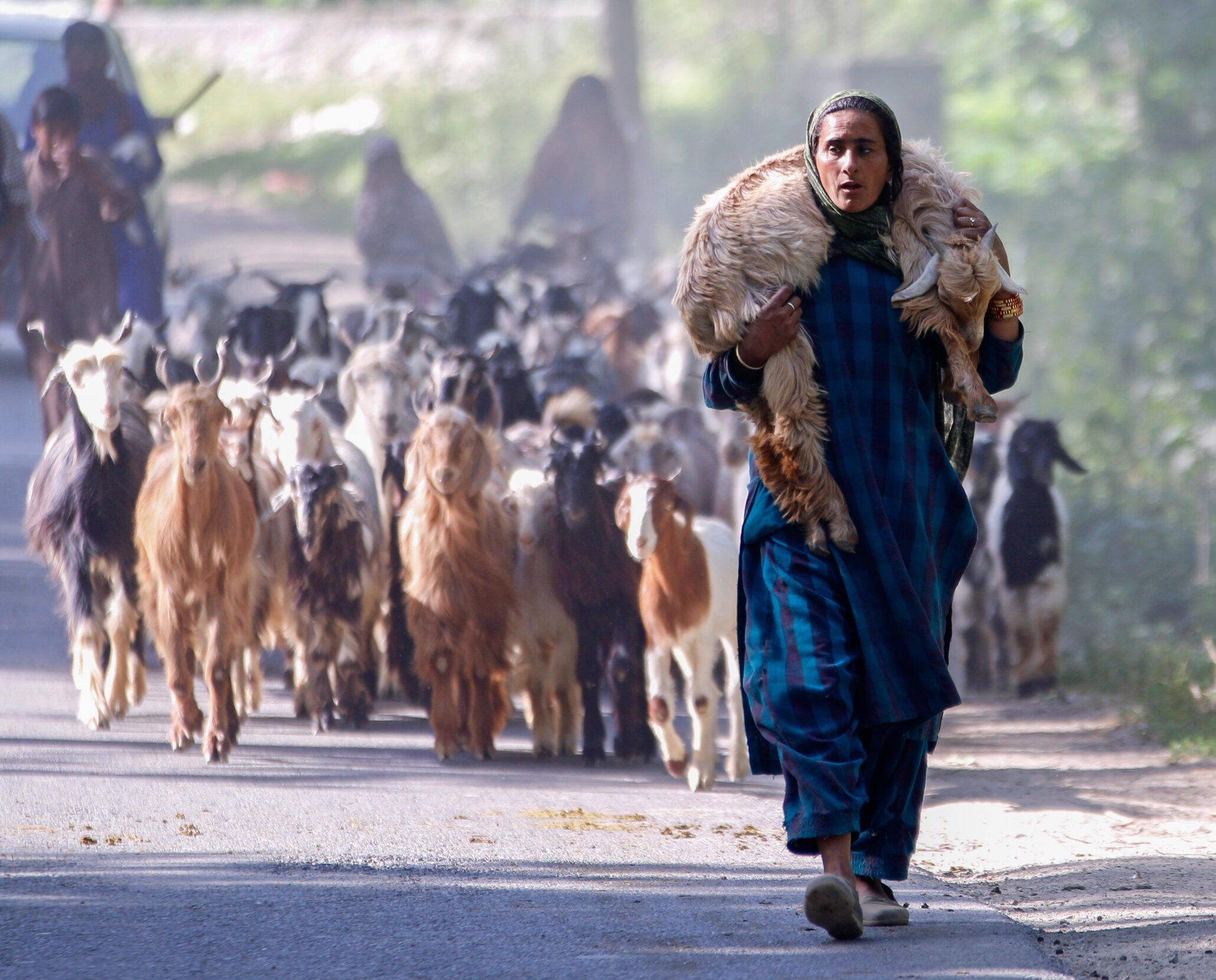
A Bakarwal woman leads her herd along the migration route from Jammu to Srinagar, following the six-month seasonal journey her community has made for generations. Photo: Kamran Yousuf.
Up in the border town of Uri, in a plain community hall with wooden floors and open windows, Dr. Naila Rasheed leads a session. She’s 40, with a determined look. Her hijab frames her face as she sits on the floor with her notebook. The room is full of women, some fidgeting, others silent. Rasheed asks them to close their eyes and think about the last place they felt truly safe.
One woman speaks up, with a shaky voice: “A meadow, with the goats eating grass, the air cool on my skin.” Another talks about a tent, the warmth from a fire inside. Rasheed nods, then explains later, “For them, safety isn’t walls or locks. It’s the flow of life connected to the land and people.”
Rasheed is a psychologist from Srinagar focused on the adverse mental effects of displacing people, especially in tribal groups.
Her work is pushing for big changes, like using the old ways, including stories told around fires, music, herbs, and rituals that go back centuries. “We can’t just place clinics without ongoing support,” she tells me over tea after the session is over. “Healing has to come from inside the community, valuing what they already know.”
I think of what Shafiq told me about mobile clinics like his: Money is tight, and when winter hits with all that snow, whole areas get cut off.
Despite the challenges, there’s a noticeable shift happening now. Rasheed tells me that she and fellow health care providers are securing funding and support to address mental health in the region, trying novel programs and outreach for those affected by displacement. At the same time, researchers are commissioning studies to better understand the living conditions, health challenges, and social struggles of Gujjar and Bakarwal communities. Rights activists are also raising their voices publicly, especially after forest evictions like the one I witnessed forced many families out of their traditional homes, highlighting the urgent need for policy attention and support.
We walk outside, the hall behind us, and Rasheed points to the mountains. “Resilience is there,” she says. “But we have to support it, not just watch from far away.”
I think about the language that typically appears in anthropological and migration studies on displacement, peppered with academic terms like ambiguous loss and cultural bereavement. The more time I spend with health care workers and researchers, and in community with these people, the more another term surfaces — almost as if the erosion of identity is itself a syndrome. A rootlessness syndrome.
~~
Singing has always been a big part of life for her people, their songs acting as maps across vast terrain, as stories that pass down history, as prayers for safe passage.
Out near Shopian, a few young Bakarwal men gather around a phone, their heads close together under the shade of some trees. The one in charge, Asif, is 20, with a scar on his cheek from falling as a child. His eyes are quick, darting over the screen.
“See this path?” he says, pointing to a thin line on the map. “My grandfather walked it every season. But it’s not on any official maps anymore.”
Asif and his friends are using apps to trace old, forgotten trails and add them to open-source maps anyone can use. We hike a short way together, phones out, marking spots. It’s simple, but you can see the hope in their eyes, as if they’re reinstating more than just lines on a screen.
For them, mapping is like putting pieces back together. “If we can find the old ways again,” Asif says, grinning a bit, “maybe we won’t feel so lost inside.”
It’s one way of fighting back, of holding onto what’s being lost. Because the real loss isn’t just the paths, it’s a deeper connection to where you come from and your sense of self. Reclaiming those roots, or even forming new ties to old traditions, just might lead to a way forward.
~~
In Baramulla, known historically as the western gateway to the Kashmir Valley, a Gujjar elder named *Meharban sits under the wide branches of a chinar tree, a small recorder in hand. They’re 70, their turban neat and white, their hands rough from a lifetime of work. The tree’s leaves are turning red, falling around them like confetti as they talk into the device. They tell stories of valiant migrations, happy marriages, and winters so cold the rivers turned to ice.
“Memory is like medicine,” they say, with a steady and warm voice. “When things get hard, those old happy times bring comfort and patience.”
I sit with them for an hour, the recorder whirring softly. They laugh at one story, about a tricky river crossing. They’re recording these oral histories for their grandchildren and anyone who’ll listen, a way to give voice to the past as everything shifts — documenting what has been, and listening to what is next.
~~
For a moment, the air stills and lightens, as if the women have stepped into a memory.
Back in the tent on the meadow near Banihal, evening has started to fall. Gujjar and Bakarwal women have come from all over, some walking for hours just to be here and fill the tent. Lanterns flicker inside, softening the edges of those long afternoon shadows.
The weekly gathering began with a health worker who learned about women’s groups in the city and thought, “Why not here?”
When the old woman’s voice rises in song, it isn’t long before others join in, their rich voices filling the tent with a collective beat. My eyes drift to the girl so tightly clutching her bracelet and notice that her shoulders have relaxed ever so slightly.
Eventually, songs fade into stories. Women talk about a lost forest, a home taken away, a life rhythm broken.
The young girl, Zara, finally opens up, with that bracelet still in her hand. Her cousin drowned in a river accident two summers ago, taken by a sudden flood. This was her first time talking about the tragedy. “I see the water every night in my dreams,” she says, tears starting. “It haunts me, won’t let go.”
An older woman reaches over and takes her hand.
The women keep weaving those bracelets, fingers moving steadily, and voices lifting again and again in song. This healing tent is a new gathering pulled from old traditions, like the all-night singing at weddings and the ballads sung during migrations, in a place where pain gets spoken, heard, and shared.
Outside, the river courses on, but inside this tent, it’s warm and connected — with the women’s melodies holding past, present, and future together in a moment as boundless as the sky.
Mir Seeneen
Mir Seeneen is a South-Asia based journalist whose work bridges the deeply local and the profoundly global. She has been published in publications such as The Guardian, Wired, Al Jazeera, The Diplomat Magazine, TRT World, and others.