



READER SELECTION
This Intrepid Interlude was hand-picked by the badass members of The Alliance.
Want to vote on upcoming pitches?
This is the final installment in our four-part “Intrepid Interlude” series by Hidden Compass’s 2025 storyteller in residence, Tulsi Rauniyar. Earlier this year, Hidden Compass Allies voted to assign a story series on human-tiger conflict in Nepal. In the first three installments, Tulsi explored the conflict from the viewpoint of the locals, the park rangers, and the land. Now, Tulsi widens the scope of the narrative one last time.
For 47 days, the capture team searched for the tiger that killed Padmakala Thapa.
Camera traps caught her shadow. Bait was placed — buffalo calves, deer carcasses — but she seemed to know where it would be before it was laid, to read the forest for signs of human interference. Once, they cleared thickets with excavators, trying to force her into the open. She slipped away as if the forest itself closed behind her. Her stealth was extraordinary, even for a tiger.
Eventually, one of her almost-grown cubs was found and relocated to another part of the Bardia–Banke complex. But the mother herself was never captured. She had been seen before in nearby grasslands, but after that, she vanished into a part of the forest where she could not be found. Then, they called off the search.
One ranger put it plainly: “She knew we were looking, and she knew how to stay hidden.”

The stealth of a tiger is notorious. Sometimes, the closest one gets is a pugmark like this one. Photo: Tulsi Rauniyar.
~~
The search for this single tigress raises a question that echoes through the villages skirting Bardia National Park — a question that has captivated me throughout this four-part series: How many tigers are too many?
In the villages, locals say there are already too many. In the field offices and research stations, the numbers tell another story.
A century ago, some 100,000 tigers roamed Asia. In Nepal, the tiger is woven into the nation’s spiritual fabric, appearing in temples as a divine being. In Buddhist Thangka paintings, tigers are one of the four dignities guarding the four directions (along with a dragon, garuda, and snow leopard), with tigers representing confidence. Across the Kathmandu Valley and the Terai, shrines feature tiger statues, marking the creature as a protector. Among the Tharu people, who are Indigenous to these forests, the tiger holds a place in cosmology and folklore as a forest guardian with spiritual power. The Tharu worship forest deities associated with tigers, and in rituals and festivals, tiger imagery represents courage and strength. A brave person might be called “bagh jasto,” like a tiger. Some elders tell stories of tigers as “forest kings.”
But almost two decades ago, deforestation and rampant poaching whittled the global population down to fewer than 3,200 wild tigers scattered across 13 countries. Locals felt the forest was quieter. Fewer tiger signs, fewer roars at night, less need for constant vigilance. Rangers thought extinction was imminent. People wondered if the next generation would know the animal only as a relic behind bars.

For many years, extinction of the Bengal tiger seemed inevitable. Photo: Tulsi Rauniyar.
The alarming decline prompted a global conservation effort. In 2010, at a tiger summit in St. Petersburg, Russia, Nepal joined 12 other tiger range countries in committing to double their populations by 2022, launching Project TX2. The Government of Nepal embraced the efforts, and the country became the first to surpass the doubling target. By 2022, 355 tigers lived in Nepal’s protected areas, nearly tripling from 121 a decade earlier. Tiger tracks and scat became common again. Prey populations recovered. Anecdotes emerged of spotting tigers near villages, highways, even on the edges of cultivated fields.
Bardia National Park now boasts some of the best odds of a tiger sighting, a distinction that has made it one of the premier landscapes for tracking the great cats in Nepal.
But the rising death toll — over five years, tigers in Bardia district claimed at least 36 lives, and locals said some deaths likely went uncounted — suggests Nepal’s conservation model, once held up as a global success, is beginning to fracture under its own achievements.
~~
A recent study of the Bardia–Banke Complex calculated what conservation scientists call ecological carrying capacity — the upper limit of how many tigers the land can sustain based on prey and habitat. Normally, a male Bengal tiger claims 40 to 60 square kilometers. A female holds 20 to 30. But in the high-density zones of Bardia today, where prey concentrates, home ranges have compressed dramatically to just 7 to 8 square kilometres per tiger.
This compression might suggest the habitat is at capacity, that there’s no room left. Yet conservationists interpret it differently: They point to the fact that tigers are adapting, compressing their territories because prey is abundant enough to support them in smaller areas. The total protected landscape, they argue, could theoretically hold more tigers if prey populations continue to recover and if tigers continue to adapt their spacing patterns. It’s not that individual tigers need less space, it’s that they’re tolerating closer proximity to one another because resources allow it. The ecosystem, by this measure, has not yet reached its theoretical limit.
Yet even with this potential for more tigers, conflicts arise. “When territories overlap, older, weaker tigers that can no longer defend their range are forced to move,” says Thumbahangphe. “The only direction left for them is toward easy prey at the forest’s edges, livestock around human settlements. The majority of tigers we have seen causing conflict are impaired, weaker individuals.”
Dr. Hem Sagar Baral, a veteran conservation biologist, says droughts further compound the problem by drying up water sources and reducing palatable fodder inside the park. This forces tigers to venture beyond core zones into buffer areas, farmland, and nearby settlements in search of food and water. The behavior intensifies in El Niño years when rainfall is delayed or insufficient.
People wondered if the next generation would know the animal only as a relic behind bars.
Speaking to locals and conservationists, it seems that from the tiger’s perspective, recovery remains incomplete. A truly recovered population would have sufficient habitat not just for survival but for natural behaviors — dispersal corridors for young tigers seeking new territories, buffer zones where they can hunt without encountering humans, and water sources that don’t all dry up in drought years. It would mean prey populations stable enough that fewer tigers are forced to choose between starvation and livestock. It would mean space not just to exist but to thrive without constant compression and conflict.
The question of “how many tigers are too many” assumes there’s a perfect number, a point at which tigers are abundant enough to be considered recovered, but not so numerous they threaten human lives and livelihoods. But perhaps that’s the wrong question entirely.
~~
I’ve spoken with a dozen families whose lives have been torn apart by human–wildlife conflict — families like Padmakala’s, whom I wrote about in Parts One and Two, and Manmohan’s, whom I wrote about in Part Three. Still, I returned to the forest longing to see a tiger in the wild, where it naturally belongs.
Beneath that longing ran an undercurrent of unease and vigilance. I recalled Manmohan’s mother’s words: “The animals are just trying to live in a world that keeps shrinking around them. We all are.”
~~

Naturalist Ram Thapa surveys the forest. Photo: Tulsi Rauniyar.
“The iris of the tiger’s eye is deep golden,” Ram Thapa said, his hands steady on the jeep’s steering wheel.
I gripped the metal frame of the vehicle, hot as a furnace under the midday sun. In the tiger’s eyes, we are intrusions. They must see us as strange creatures, loud and clumsy, moving without pattern or logic.
The morning sun hung in the tall trees as if caught there, its glare filtering through the canopy in golden shafts. Damp earth and grass mingled with the metallic tang of sweat and jeep oil, thick in the air.
Ram, a forty-something naturalist, had been guiding visitors through Bardia National Park for almost two decades.
“A tiger is shy; don’t be nervous.” Ram pointed to faint claw marks on a tree, some scat nearby. “It leaves traces. We follow the traces, and the tiger decides if it will reveal itself.”
Every now and then, we passed jeeps full of tourists in camouflage, their cameras and binoculars at the ready. We passed solitary women trudging through the water near the shoreline. In their flowing saris, mostly shades of red, yellow, and green, they cut picturesque silhouettes against the landscape, masking the peril of their work as they grazed livestock along the park’s fringes, sometimes in defiance of the law.
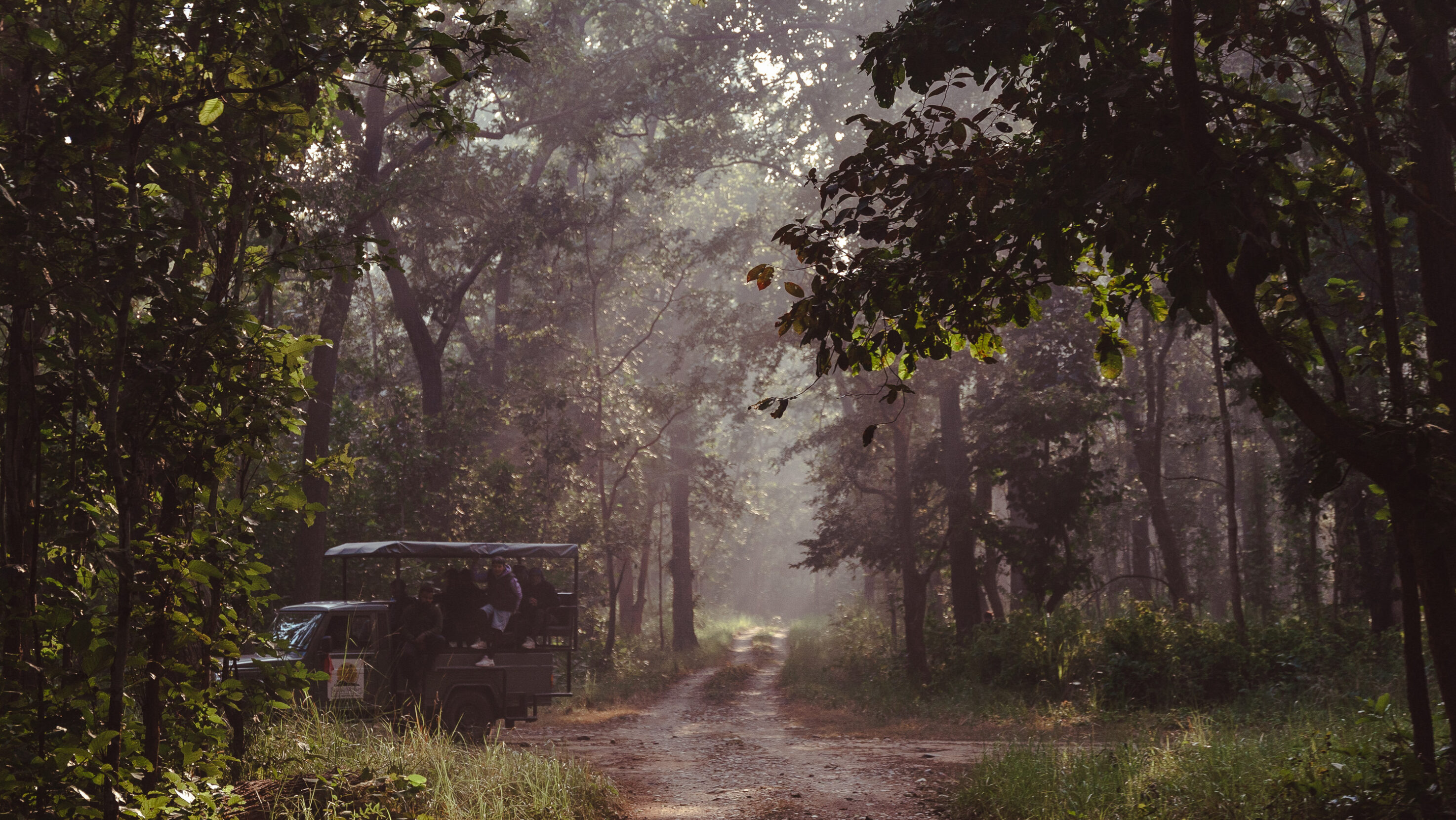
Bardia National Park’s elusive Bengal tigers bring thousands of visitors to the protected area each year in search of a sighting. Photo: Tulsi Rauniyar.
Ram continued, describing the animal with the passion of someone who knew it intimately. Its muscles coiling beneath striped fur, paws pressing into soft earth, claws retracting and extending, leaving traces we struggle to interpret. It can swim for miles, kill an animal many times its size, and drag a carcass through the forest with brutal strength. Every sound we make — the snap of twigs, the puff of our breaths — is heard by a tiger nearby. And yet, for all that power, it is not reckless. It waits, it measures, and then it decides.
Like most naturalist guides I met in the region, Ram was clearly fond of the wildcat. He had seen tigers up close hundreds of times, he said proudly. “The size is what first takes you. The head alone looks as if it belonged to some prehistoric creature, heavy with muscle, jaws lined with fangs. And those stripes aren’t just fur. Even if shaved bald, the markings would remain etched into its skin.”
Few animals are granted the distinction of being charismatic, and the tiger is one of them. “Objects of dark fascination,” author John Vaillant once wrote, or, as Ram put it, “something to look up to,” “majestic and powerful.”
Tigers are not only striking to look at, but they are also remarkably efficient predators. I heard countless accounts of their exceptional stealth and their strategic, almost chess-like stalking of prey. Every account I gathered from someone who had seen an attack or lived through one included some version of the sentence: One second it wasn’t there, and the next it was.
~~
After more than five hours in the forest, Ram’s patience was wearing thin. He was determined to show me a tiger. He spoke of a creek where tigers often came to cool off in the heat, at the intersection of two channels. We spotted a small boat moored along one of the banks. Fresh pugmarks, only minutes old, circled the boat, tracing a path from bank to bank.
This was a hotspot for tiger sightings. Ram once saw a tiger take a nap just 15 feet away from a man sleeping on a boat. It was a scene he had seen many times. He had also heard of mahouts being attacked and killed here.
… Nepal’s conservation model, once held up as a global success, is beginning to fracture under its own achievements.
“I don’t know what goes on inside a tiger’s head,” he said.
I thought about that long after we left the forest. For all our research and camera traps, we still know so little about how a tiger thinks or what it means to share space with something we can neither predict nor control. Nepal’s conservation success is often told in numbers: tigers doubled, forests revived. But on the ground, those numbers blur. What they can’t capture are the lives — human and animal — entwined within those statistics.
The real question, then, is not how many tigers are too many. The real question is: In a changed landscape, what does actual coexistence look like? And is what we have now even close?
~~
We drove for hours that day, Ram and I, through sal forests and along riverbeds, past grazing buffalo and women collecting firewood. We saw pugmarks pressed into the mud near a waterhole. Ram stopped the jeep, crouched beside them, and traced their edges with his finger. Fresh, he told me. Made this morning.
But still we saw no tiger.
Later, near a thicket of tall grass, Ram caught a scent on the wind. He inhaled deeply, then nodded.
“Tiger,” he said. “Strong smell. Very close.”
I strained to catch it, and there it was: heavy, musky, pungent. Somewhere in that grass, unseen, a tiger was watching. Or sleeping. Or simply existing in a space we could not enter.
The jeep wheels crunched over riverbed stones. Sunlight dripped on the leaves above. Birds called from the canopy. In that suspended moment, I felt the pulse of the forest — Ram scanning for signs and scents, patient and deliberate, while others, walking these same paths, moved quickly, wary of what might be hidden in the grass. Some sought the tiger, some tried to avoid it altogether.
Life here is a careful negotiation between curiosity and caution. Tigers still kill livestock. People still die. The conflict has not vanished, and it may never. But maybe coexistence isn’t the absence of struggle; it’s the choice to keep trying, to live with what frightens us, to adapt rather than erase. It asks for awareness, respect, and recognition. Awareness that sends women to the forest in groups now, carrying sticks and calling out to warn what they cannot see. Respect for the tiger’s power and its right to exist. Recognition of what Manmohan’s mother already knows, what Ram showed me in those pugmarks, what everyone living on this edge understands: The land has changed. There is less of it for everyone, and both humans and tigers are learning, however uneasily, to share what remains. And maybe that’s the point. Coexistence isn’t something to be achieved but constantly renegotiated, fraught and imperfect between species that must survive on the same shrinking ground.
Perhaps, this is what coexistence looks like.
As the jeep eased to a stop at the end of our ride, I turned to Ram. “Do you think I’ll ever see a tiger?” I asked.
He chuckled. “One thing I’ve learned,” he said, “is that you don’t choose when to see a tiger. The right tiger chooses you.”

A divine being, a forest guardian, a forest king. Photo: Courtesy of Tulsi Rauniyar.
Tulsi Rauniyar
Tulsi Rauniyar is the 2025 Hidden Compass Storyteller in Residence and a 2026 Pathfinder Prize finalist.